Map of Netherlands showing where the Damman arms are recorded
The Damman arms were recorded in Netherlands, c. 1815.
Arms such as these were typically recorded in Friesland.
Friesland was low, wet country on the northern coast of the Netherlands, farmed by families who had held the same land for centuries. Free landholders were unusually common there, and a free landholder could carry arms.
This is where the arms were entered in the register. Families often moved to other parts of the country, so the same name can turn up in more than one region.
Region
Friesland
First recorded
1815
Granting Authority for the Damman Arms
Hoge Raad van Adel
Photograph made by me · CC BY-SA 3.0
The body that granted and recorded arms in Netherlands in this period.
William I of the Netherlands
Sovereign of the period
William I of the Netherlands
1815–1840
Reigning in Netherlands when the Damman arms are first recorded.
How Arms Worked in Netherlands
In the Netherlands, coats of arms were often used by noble families and those who held specific public offices. These arms were passed down through the generations to legitimate descendants. Younger branches of a family usually kept the original design without needing to add special marks. This system ensured that the family identity remained clear and consistent over many years.
Granting authority
The Hoge Raad van Adel is the official body that regulates and manages noble titles and coats of arms in the Netherlands.
How they got arms
Families typically obtained their coats of arms through official royal grants or by proving their long-standing historical use of the symbols.
Where arms were recorded
Coats of arms are officially recorded in the registers held by the Hoge Raad van Adel, which began its work in 1814.
The family's standing
Recorded among the armigerous families of Netherlands.
Origin & History of the Damman Family in Netherlands
The family name Damman has deep roots in the northern regions of the Netherlands, particularly within the province of Friesland. The name is classified as a topographic surname, which means it was originally used to describe a person who lived near a specific landmark. In this case, the name likely refers to someone who resided near a dam or a dike, structures that were essential for managing the water levels in the low-lying Dutch landscape. By the early 19th century, records confirm that members of the Damman family were established residents of Friesland. During this period, the family lived through a time of significant transition as the Netherlands moved from French occupation toward the formation of a unified kingdom. Because these early ancestors lived in a region defined by its constant struggle against the sea, the name served as a practical way to identify families based on the geography of their homesteads.
Coat of Arms & Family Crest Details
Symbols on this shield
fessThe military belt, and readiness to serve
mulletThe third son, and a divine quality from above
Colours
Gold (Or)Means: Generosity
Red (Gules)Means: Military strength
Historical info
Source
J. B. Rietstap, Armorial Général, Gouda: G. B. van Goor Zonen, 1884–87
Blazon (the actual original written record)
“D'or à la fasce vivrée de gu., ch. de deux molettes du champ.”
FlandreFlandre, c. 1663
Digital archive packCoat of arms PNG, gold border print PDF, vector SVG and the certificate of authenticity. Sent to your email in minutes.
Map of France showing where the Damman arms are recorded
The Damman arms were recorded in Flandre, c. 1663.
Flandre grew rich on cloth, and its towns were among the busiest in Europe. Merchant families bought land with their profits and took arms to go with it, so trade put as many names in the registers here as land did.
This is where the arms were entered in the register. Families often moved to other parts of the country, so the same name can turn up in more than one region.
The body that granted and recorded arms in France in this period.
Louis XIV of France
Sovereign of the period
Louis XIV of France
1643–1715
Reigning in Netherlands when the Damman arms are first recorded.
How Arms Worked in France
In France, a coat of arms was a mark of honor that passed down through the male line to all legitimate descendants. Families often used the same shield without changes to show their shared heritage. If a branch wanted to stand out, they could add a small mark to their shield to show their specific place in the family tree.
Granting authority
The Juge d'armes de France acted as the official authority that regulated and verified coats of arms across the country.
How they got arms
Families typically inherited their arms from ancestors, though they could also receive them through royal grants or by proving their noble status.
Where arms were recorded
Coats of arms were officially recorded in the Armorial Général de France, which began its main collection in the year 1696.
The family's standing
Recorded among the armigerous families of Flandre.
Origin & History of the Damman Family in France
The history of the Damman family is deeply rooted in the historical region of Flanders, which straddled the border between modern-day France and Belgium. By the year 1663, records confirm that members of this family were well-established in this area, living through a period of significant political transition as the French monarchy expanded its influence over the Flemish territories. The name itself is thought to be topographic in origin, likely derived from the Middle Dutch word "dam," referring to someone who lived near a dike or a dam. This suggests that the early Damman ancestors were likely hardworking people who managed the complex water systems essential for farming and survival in the low-lying coastal plains of the region. As the French crown solidified its control over these lands during the seventeenth century, families like the Dammans became part of a unique cultural blend, balancing their traditional Flemish heritage with the administrative and social changes brought by the French state.
Coat of Arms & Family Crest Details
Symbols on this shield
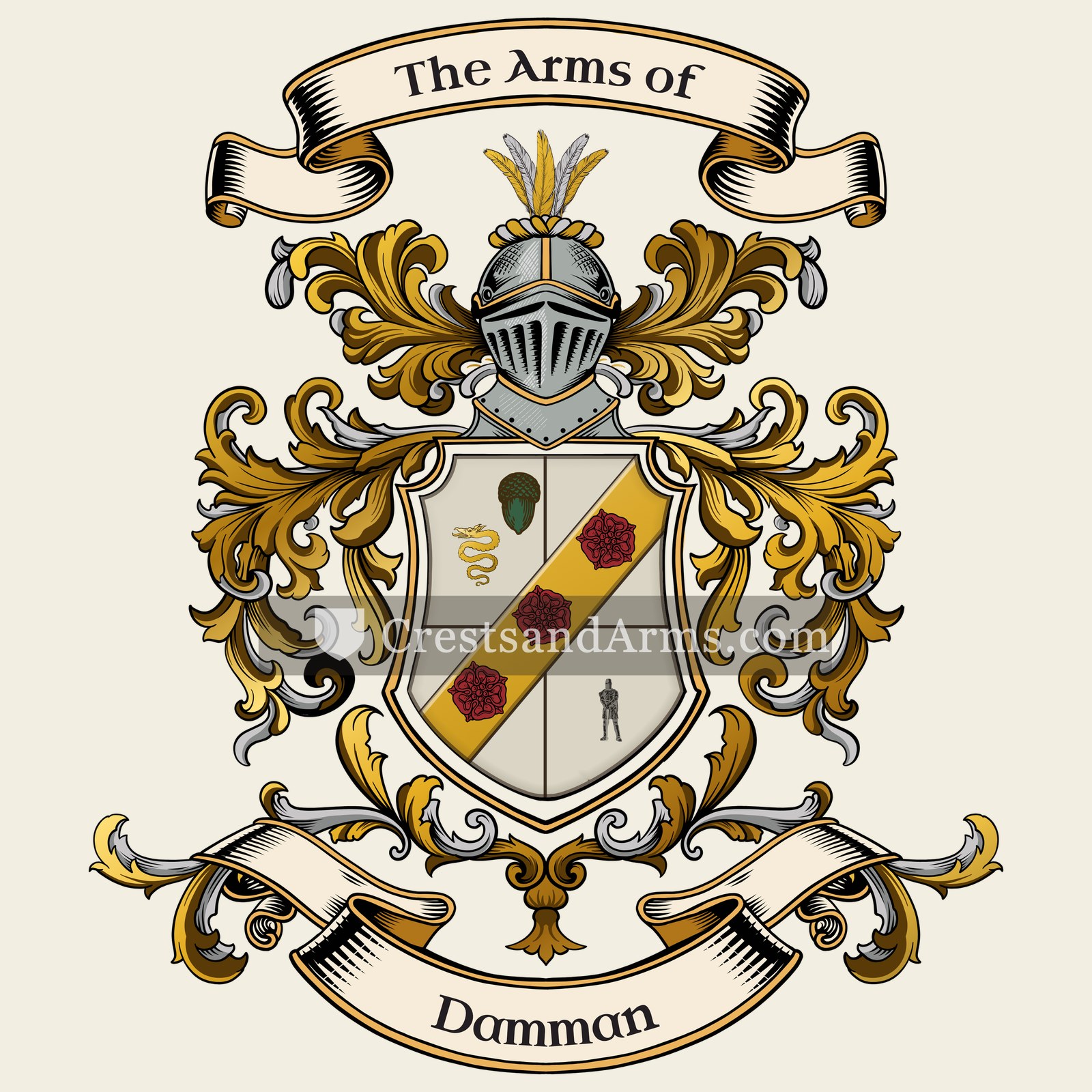
bendDefence, and the scarf of a commander
oakGreat age, strength and steadfastness
serpentWisdom, healing and prudence
roseThe seventh son, and beauty with grace
knightChivalry and service in arms
Colours
Silver (Argent)Means: Peace and sincerity
Gold (Or)Means: Generosity
Red (Gules)Means: Military strength
Black (Sable)Means: Constancy
Historical info
Source
J. B. Rietstap, Armorial Général, Gouda: G. B. van Goor Zonen, 1884–87
Blazon (the actual original written record)
“Ec.: au 1 d'arg. à une branche de chêne de sin., en barre; au 2 d'azur à une couleuvre ondoyante en pal d'or, cour. du même; au 3 de gu. à la bande d'or, ch. de trois roses du champ; au 4 coupé d'or sur sa., l'or ch. d'un homme iss., mouv. du coupé, hab. de sa., coiffé d'un bonnet du même, tenant de sa main dextre une épée et en sa sen. un bouclier. Deux cq. cour. C.: 1° la branche de chêne, en pal, entre un vol du 3 (sur l'aile dextre la bande est transformée en barre); l. d'or et de gu; 2° la couleuvre, entre deux prob. d'azur; l. d'or et d'azur.”
GermanySchwarzbourg, c. 1836
Digital archive packCoat of arms PNG, gold border print PDF, vector SVG and the certificate of authenticity. Sent to your email in minutes.
Map of Germany showing where the Damman arms are recorded
The Damman arms were recorded in Schwarzbourg, c. 1836.
This is where the arms were entered in the register. Families often moved to other parts of the country, so the same name can turn up in more than one region.
The body that granted and recorded arms in Germany in this period.
Frederick William III of Prussia
Sovereign of the period
Frederick William III of Prussia
1797–1840
Reigning in Netherlands when the Damman arms are first recorded.
How Arms Worked in Germany
Prussian heraldry was strictly tied to social rank and noble status rather than being a free choice for every citizen. These symbols were treated as permanent family property that moved through the generations to all legitimate heirs. If a family branch wanted to change their design to stand out, they had to apply for official permission to alter their specific version of the shield.
Granting authority
The Prussian Heroldsamt acted as the central state office that managed and strictly controlled all noble titles and coats of arms.
How they got arms
Families usually obtained their arms through formal royal grants or by proving their long-standing noble status to the state authorities.
Where arms were recorded
All official coats of arms were kept in the rolls of the Prussian Heroldsamt, which functioned from 1706 until 1918.
The family's standing
Recorded among the armigerous families of Germany.
Origin & History of the Damman Family in Germany
The family name Damman likely originated as a topographic surname, identifying people who lived near a dam, a dike, or a body of water. In the German language, the suffix "mann" often denoted a person associated with a specific place or occupation, suggesting that the earliest ancestors were individuals who maintained or lived alongside water management structures. By the early 19th century, the family had established a documented presence in the region of Schwarzburg. This area, located in the Thuringian Forest, was characterized by its mountainous terrain and deep river valleys, which would have made the skills of water management and land maintenance essential for local survival. The presence of the Damman family in this region by 1836 reflects a history rooted in the practical labor of rural German life, where families were often defined by their direct relationship to the landscape and the natural resources they managed.
Damman Meaning & Related Branches
Root word
dam
a barrier or embankment built to hold back water
This name
Dammana topographic name for someone who lived near a dam or dike
also spelled
Daman
Related arms
Damanvariant spelling
van Dammenvariant spelling
Bambergrecorded with Damman, same area
Briesenrecorded with Damman, same area
Documented Sources
J. B. Rietstap, Armorial Général, Gouda: G. B. van Goor Zonen, 1884–87
AlleFriezen, Burgerlijke Stand (Civil Registration) Friesland, 1811–1950
Tresoar, Frysk Histoarysk en Letterkundich Sintrum, Bevolkingsregisters (Population Registers)
Meertens, P.J., De betekenis van de Nederlandse familienamen, 1950
Van der Schaar, J., Woordenboek van voornamen, 1964
Digital archive packCoat of arms PNG, gold border print PDF, vector SVG and the certificate of authenticity. Sent to your email in minutes.


 fireZeal and purification
 fireZeal and purification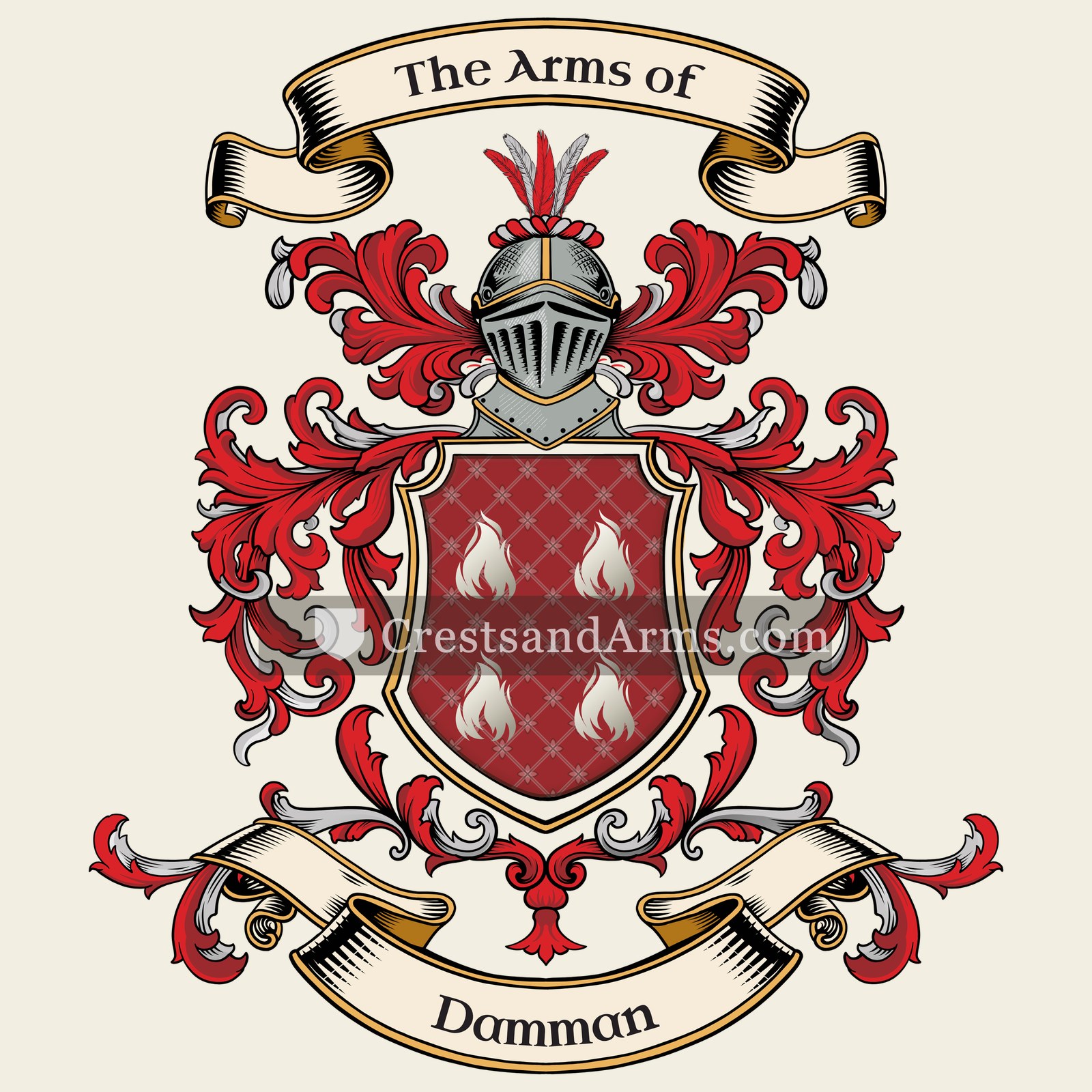


 fessThe military belt, and readiness to serve
 mulletThe third son, and a divine quality from above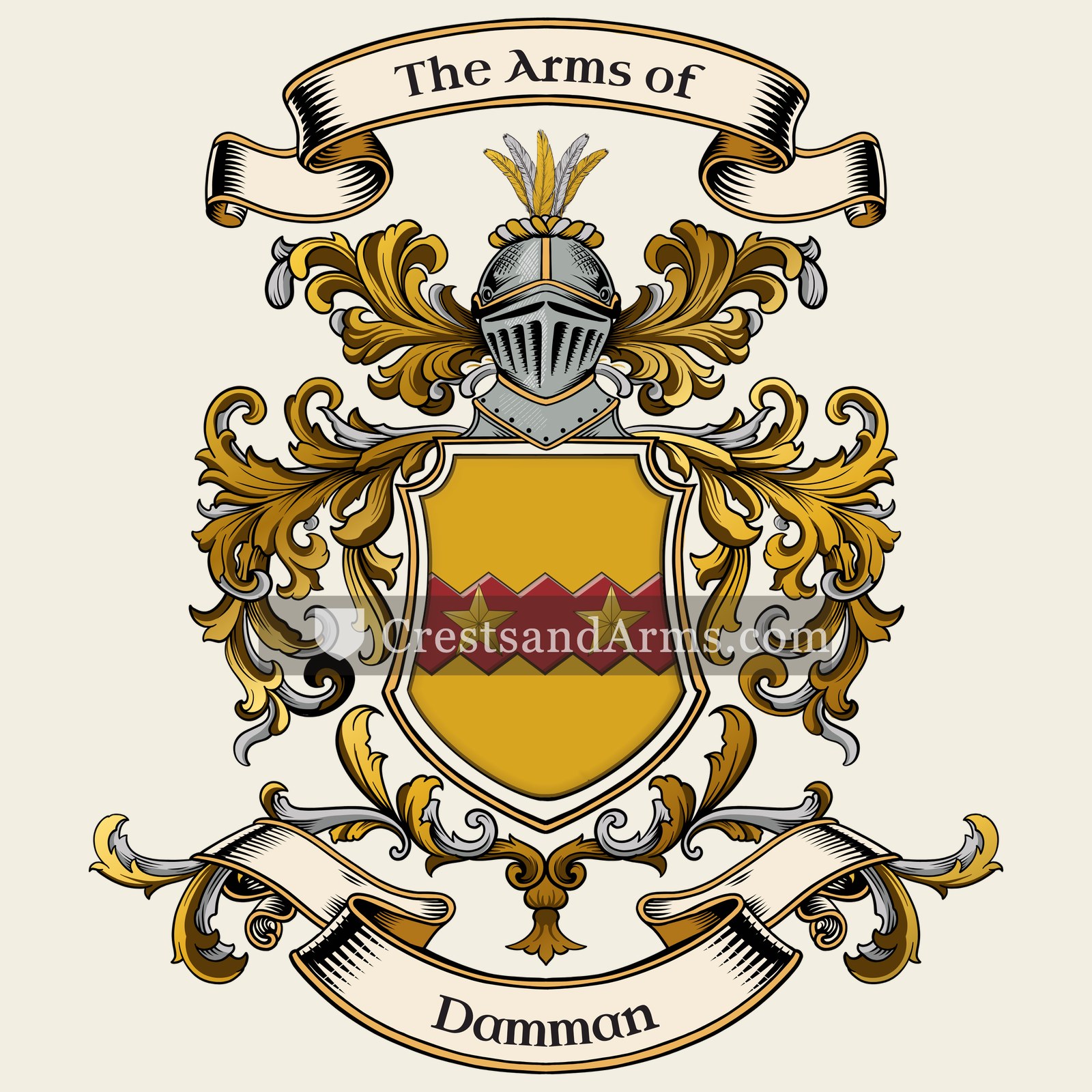


 bendDefence, and the scarf of a commander
 oakGreat age, strength and steadfastness
 serpentWisdom, healing and prudence
 roseThe seventh son, and beauty with grace
 knightChivalry and service in arms