Map of France showing where the Damond arms are recorded
The Damond arms were recorded in Ile-de-France, c. 1663.
Ile-de-France is the country around Paris, and proximity to the court mattered. Families who served the crown were rewarded with land near it, and land near the capital carried arms almost as a matter of course.
This is where the arms were entered in the register. Families often moved to other parts of the country, so the same name can turn up in more than one region.
The body that granted and recorded arms in France in this period.
Louis XIV of France
Sovereign of the period
Louis XIV of France
1643–1715
Reigning in France when the Damond arms are first recorded.
How Arms Worked in France
In France, a coat of arms was a mark of honor that passed down through the male line to all legitimate descendants. Families often used the same shield without changes to show their shared heritage. If a branch wanted to stand out, they could add a small mark to their shield to show their specific place in the family tree.
Granting authority
The Juge d'armes de France acted as the official authority that regulated and verified coats of arms across the country.
How they got arms
Families typically inherited their arms from ancestors, though they could also receive them through royal grants or by proving their noble status.
Where arms were recorded
Coats of arms were officially recorded in the Armorial Général de France, which began its main collection in the year 1696.
The family's standing
Recorded among the armigerous families of Ile-de-France.
Origin & History of the Damond Family in France
The family name Damond traces its roots to the historical landscape of northern France, where it emerged as a distinct identifier during the seventeenth century. By 1663, records confirm that members of the family were firmly established within the Île-de-France region, which served as the political and cultural heart of the French kingdom. During this era, families in the region often lived in close-knit rural communities or growing urban centers surrounding Paris, where they participated in the agricultural and trade cycles that defined the local economy. The name itself likely evolved from regional dialects or descriptive terms common to the area, reflecting the linguistic shifts occurring in the French language at the time. As these early ancestors navigated the social structures of the Ancien Régime, they contributed to the steady development of the Parisian basin, leaving a footprint that persisted through generations of French history.
Meaning of the Damond family crest colors & symbols
Symbols on this shield
chevronProtection, and faithful service completed
mountThe ground held, and steadfastness upon it
starThe celestial goddess, and nobility
Colours
Blue (Azure)Means: Loyalty and truth
Silver (Argent)Means: Peace and sincerity
Green (Vert)Means: Hope
Gold (Or)Means: Generosity
Historical info
Source
J. B. Rietstap, Armorial Général, Gouda: G. B. van Goor Zonen, 1884–87
Blazon (the actual original written record)
“D'azur au chev. d'arg., acc. en chef de deux étoiles (5) d'or et en p. d'un tertre du même.”
Switzerlandc. 1745
Digital archive packCoat of arms PNG, gold border print PDF, vector SVG and the certificate of authenticity. Sent to your email in minutes.
Map of Switzerland showing where the Damond arms are recorded
The Damond arms were recorded in Switzerland, c. 1745.
Arms such as these were typically recorded in Bern.
Bern was the largest of the Swiss cantons and ran itself, with its own council and its own courts. Its governing families held office for generations, and office of that kind carried a shield with it.
This is where the arms were entered in the register. Families often moved to other parts of the country, so the same name can turn up in more than one region.
The body that granted and recorded arms in Switzerland in this period.
How Arms Worked in Switzerland
In Switzerland, coats of arms were not restricted to the nobility and were often adopted by common citizens and families. These symbols were passed down through generations to show family identity. When branches of a family grew, they often changed small details of the design to distinguish their own line from the original group.
Granting authority
Cantonal and civic authorities managed the use of coats of arms within their specific regions and local jurisdictions.
How they got arms
Families typically assumed their own coats of arms based on local custom rather than receiving them from a central monarch.
Where arms were recorded
Arms were recorded in various cantonal and civic registers starting from the fourteenth century throughout the Swiss region.
The family's standing
Recorded among the armigerous families of Switzerland.
Origin & History of the Damond Family in Switzerland
The history of the Damond family in Switzerland is deeply rooted in the cultural landscape of the Bern region during the mid-eighteenth century. By 1745, records confirm that members of the family were established residents, participating in the social and economic life of the city. During this era, Bern was a powerful center of trade and politics, and families like the Damonds often integrated into the local community through skilled labor or agricultural management. The name itself likely evolved from older regional dialects, reflecting the linguistic blend of French and German influences common in the Swiss cantons. As the family settled into their lives in Bern, they contributed to the steady growth of the city’s population and helped shape the local identity that defined the region before the major political shifts of the nineteenth century.
Damond Meaning & Related Branches
Root word
Adamas
A Greek term meaning unconquerable or invincible.
This name
DamondA French variant of the name Damon, signifying one who is untamable or constant.
also spelled
Damont
Related arms
Damontvariant spelling
Documented Sources
J. B. Rietstap, Armorial Général, Gouda: G. B. van Goor Zonen, 1884–87
Archives nationales de France, Minutier central des notaires de Paris
Foisil, Madeleine, Le Sire de Gouberville: un gentilhomme normand au XVIe siècle, 1981
Goubert, Pierre, L'Ancien Régime: La société, 1969
Digital archive packCoat of arms PNG, gold border print PDF, vector SVG and the certificate of authenticity. Sent to your email in minutes.


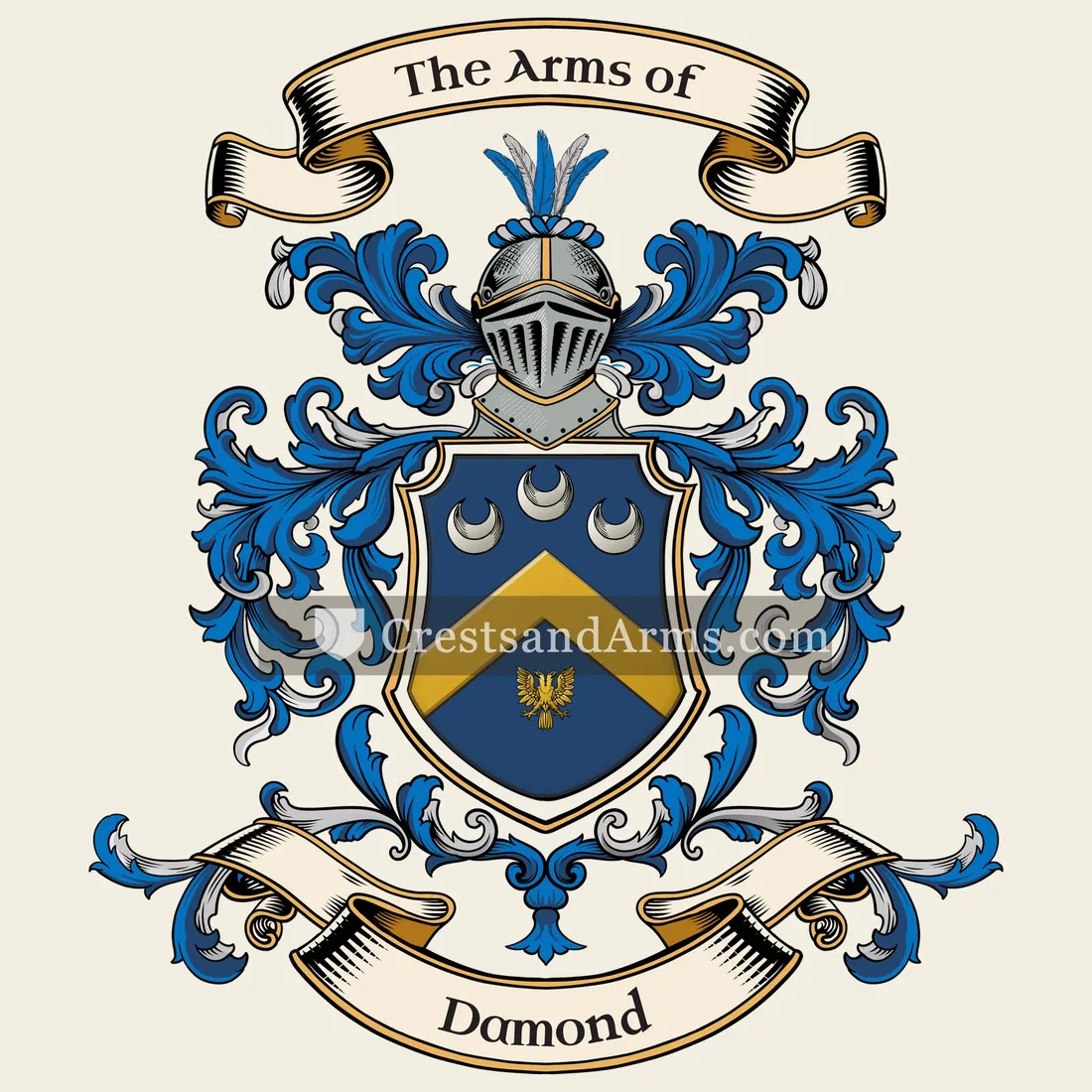
 chevronProtection, and faithful service completed
 crescentHonour by the sovereign, and the second son
 eagleNobility, strength and a keen mind
 chevronProtection, and faithful service completed
 crescentHonour by the sovereign, and the second son
 eagleNobility, strength and a keen mind


 mountThe ground held, and steadfastness upon it
 starThe celestial goddess, and nobility