Map of Germany showing where the Danberg arms are recorded
The Danberg arms were recorded in Mecklenburg, c. 1765.
Mecklenburg was farming country in the north of Germany, held by a small number of families who kept their estates for generations. Owning land was what entitled a family to arms, so a great many Mecklenburg names ended up in the registers.
This is where the arms were entered in the register. Families often moved to other parts of the country, so the same name can turn up in more than one region.
The body that granted and recorded arms in Germany in this period.
Francis I, Holy Roman Emperor
Sovereign of the period
Francis I, Holy Roman Emperor
1745–1765
Reigning in Germany when the Danberg arms are first recorded.
How Arms Worked in Germany
In the Holy Roman Empire, coats of arms were often granted to individuals by the Emperor or his representatives. These arms were then passed down through the generations to all legitimate descendants of the original holder. Younger branches of a family usually kept the same shield design without needing to change it, as the arms belonged to the entire lineage.
Granting authority
The Holy Roman Emperor held the sole power to grant new coats of arms throughout his vast imperial territories.
How they got arms
Families typically obtained their coats of arms through a formal imperial grant or by proving their noble status to the authorities.
Where arms were recorded
These grants were officially recorded in the Imperial Chancery registers, which began keeping formal records of such honors during the Middle Ages.
The family's standing
Recorded among the armigerous families of Mecklenburg.
Origin & History of the Danberg Family in Germany
The surname Danberg originates from the German region of Mecklenburg, where records confirm the family was established by at least 1765. The name is likely topographic in nature, meaning it was derived from the physical landscape where the family lived. In the German language, the prefix "Dan" often relates to a valley or a low-lying area, while "berg" translates to a hill or mountain. This suggests that the earliest ancestors were likely farmers or laborers who settled near a prominent hill overlooking a valley. During the eighteenth century, life in Mecklenburg was defined by the manorial system, where families were often tied to the land they worked for local nobility. As the family grew, they became part of the rural social fabric of Northern Germany, eventually moving from small agricultural villages into the developing towns of the region as the economy shifted toward trade and craftsmanship.
Danberg Meaning & Related Branches
Root word
Dann and Berg
A judge or forest clearing combined with a mountain or hill.
This name
DanbergA topographic surname referring to someone living near a mountain or hill associated with a judge.
also spelled
Daneberg
Documented Sources
J. B. Rietstap, Armorial Général, Gouda: G. B. van Goor Zonen, 1884–87
Landeshauptarchiv Schwerin, Kirchenbücher der Evangelisch-Lutherischen Landeskirche Mecklenburgs (Church records of Mecklenburg)
Lübker, Detlef, Lexikon der schleswig-holstein-lauenburgischen und eutinischen Schriftsteller von 1796 bis 1828, 1829


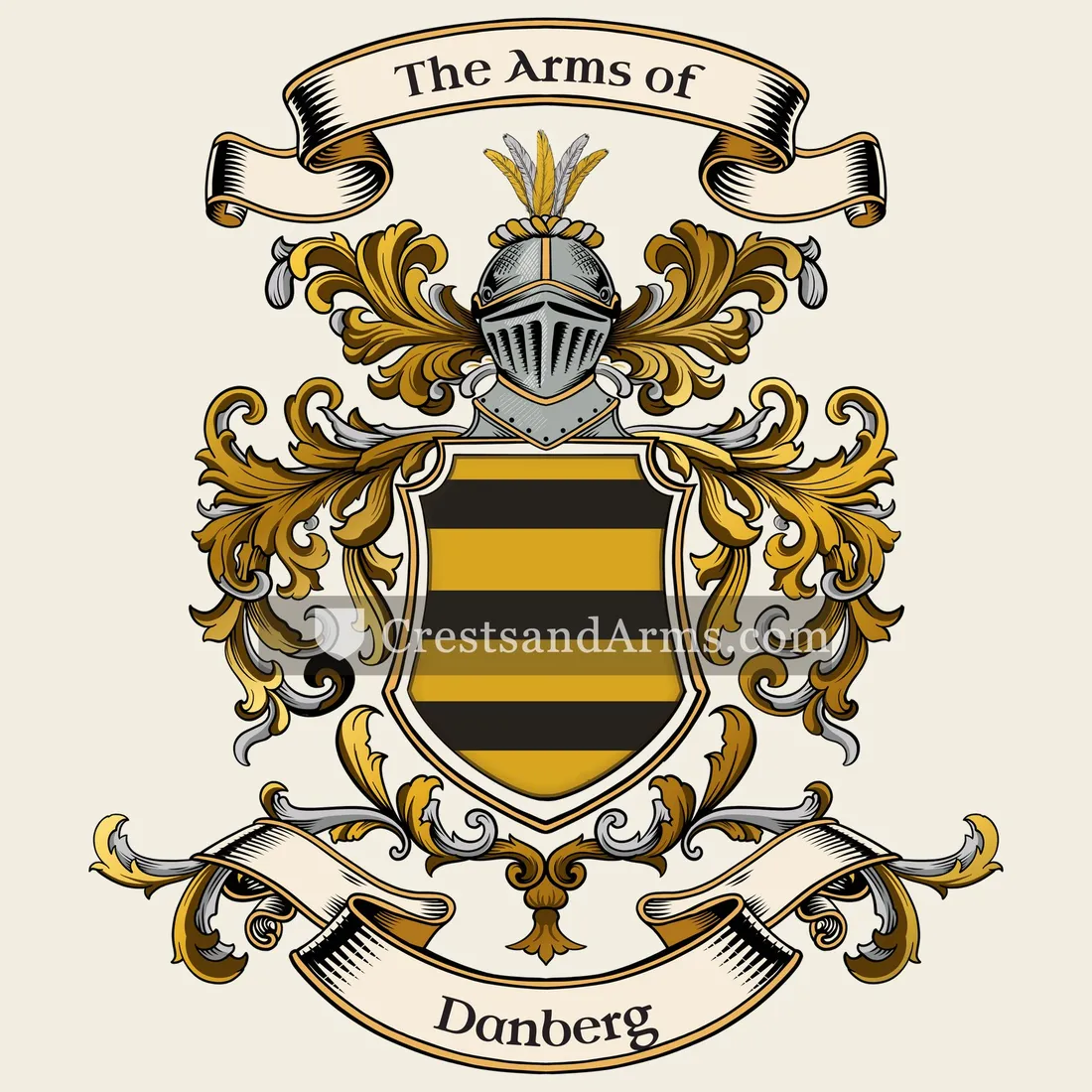
 fessThe military belt, and readiness to serve
 chequyConstancy, and the counting-board
 fessThe military belt, and readiness to serve
 chequyConstancy, and the counting-board