Map of England showing where the D'Angle arms are recorded
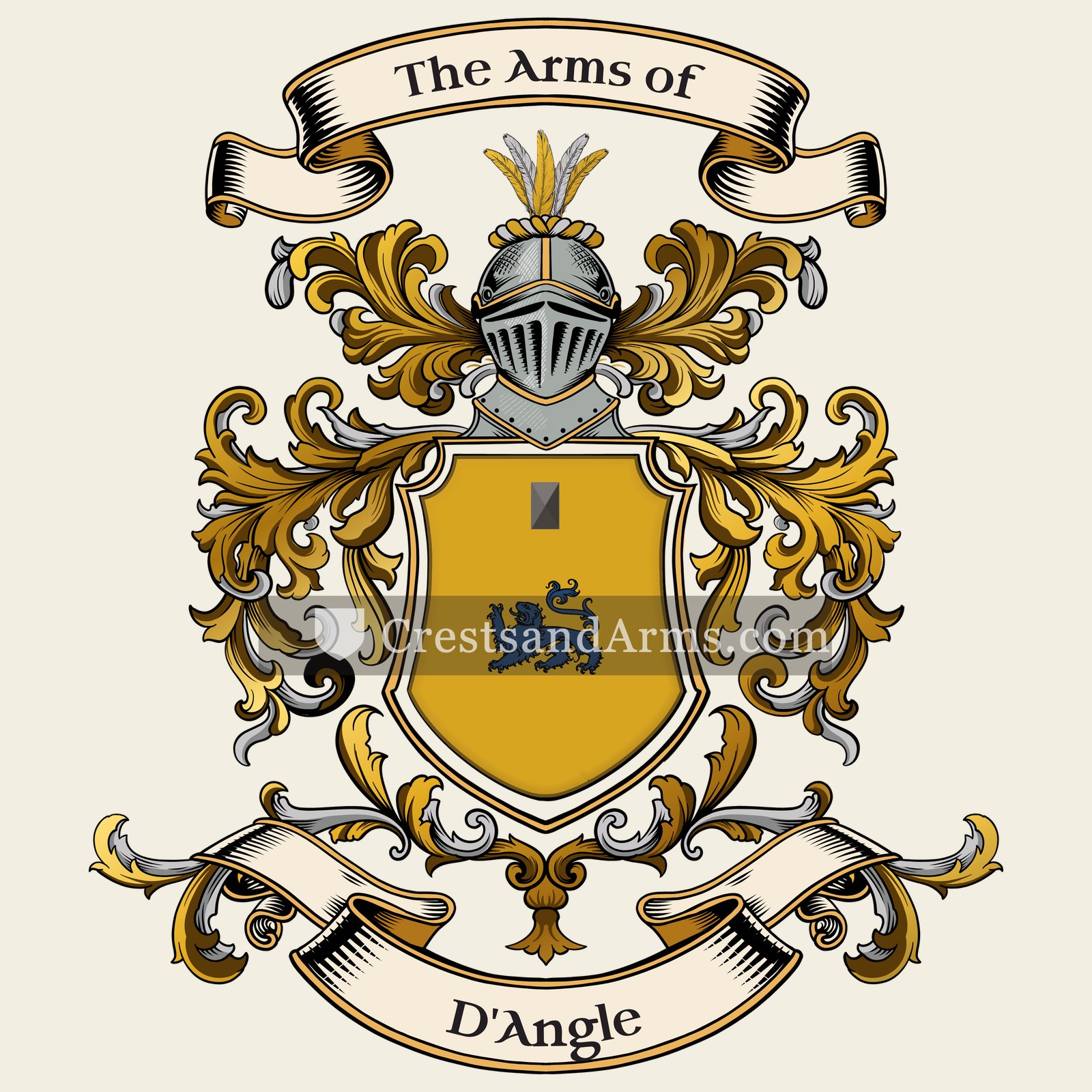
The D'Angle arms were recorded in Poitou, c. 1363.
Poitou was western French farming country, divided among a large number of small landed families. Its gentry were numerous and modest, and even a small estate was enough to justify a shield.
This is where the arms were entered in the register. Families often moved to other parts of the country, so the same name can turn up in more than one region.
The body that granted and recorded arms in England in this period.
Edward III of England
Sovereign of the period
Edward III of England
1327–1377
Reigning in England when the D'Angle arms are first recorded.
How Arms Worked in England
English heraldry allowed arms to be shared by all legitimate descendants of the original owner. These symbols were treated as personal property that moved through the generations to all children. While the eldest son kept the original design, other family members could use the same shield without needing to change it or register their own unique versions.
Granting authority
The College of Arms in London has regulated the use of coats of arms throughout England and Wales since 1484.
How they got arms
Families typically obtained their coats of arms through a formal grant from the Crown or by proving their ancient right to them.
Where arms were recorded
All official coats of arms are recorded in the registers kept at the College of Arms, which date back to the fifteenth century.
The family's standing
Recorded among the armigerous families of Poitou.
Origin & History of the D'Angle Family in England
The family name D'Angle traces its roots to the historical province of Poitou in western France. By the year 1363, members of this family were already established as influential figures within the region. The name is linked to the village of Angle-sur-l'Anglin, which sits along the banks of the Anglin River. During the fourteenth century, the family rose to prominence through their service to the French crown and their involvement in the complex politics of the Hundred Years' War. They were recognized as members of the local nobility who managed significant estates and held positions of authority in the Poitou area. Their early history reflects the typical path of medieval landowning families who gained status by maintaining strong ties to both their ancestral lands and the royal court.
D'Angle Meaning & Related Branches
Root word
Angulus
Latin term meaning a corner, angle, or nook.
This name
D'AngleRefers to a person who originated from a specific corner or angled piece of land.
also spelled
Dangell
Dangill
Dangel
Documented Sources
Sir Bernard Burke, The General Armory of England, Scotland, Ireland and Wales, London: Harrison & Sons, 1884
Lehugeur, Paul. Histoire de Philippe le Long, roi de France (1316-1322). 1897
Valois, Noël. L'administration royale dans les pays d'états. 1887
Archives nationales, Trésor des chartes
Archives départementales de la Vienne, Série E (Familles et seigneuries)
Digital archive packCoat of arms PNG, gold border print PDF, vector SVG and the certificate of authenticity. Sent to your email in minutes.


 lionCourage, strength and royalty
 billetThe sealed letter, and a message delivered
 lionCourage, strength and royalty
 billetThe sealed letter, and a message delivered