Map of England showing where the Dangles arms are recorded
The Dangles arms were recorded in Poitou, c. 1363.
Poitou was western French farming country, divided among a large number of small landed families. Its gentry were numerous and modest, and even a small estate was enough to justify a shield.
This is where the arms were entered in the register. Families often moved to other parts of the country, so the same name can turn up in more than one region.
The body that granted and recorded arms in England in this period.
Edward III of England
Sovereign of the period
Edward III of England
1327–1377
Reigning in England when the Dangles arms are first recorded.
How Arms Worked in England
English heraldry allowed arms to be shared by all legitimate descendants of the original owner. These symbols were treated as personal property that moved through the generations to all children. While the eldest son kept the original design, other family members could use the same shield without needing to change it or register their own unique versions.
Granting authority
The College of Arms in London has regulated the use of coats of arms throughout England and Wales since 1484.
How they got arms
Families typically obtained their coats of arms through a formal grant from the Crown or by proving their ancient right to them.
Where arms were recorded
All official coats of arms are recorded in the registers kept at the College of Arms, which date back to the fifteenth century.
The family's standing
Recorded among the armigerous families of Poitou.
Origin & History of the Dangles Family in England
The family name Dangles traces its roots to the historic province of Poitou in western France. Records confirm that members of the family were established in this region by 1363. During this period, Poitou was a landscape shaped by the Hundred Years' War, which forced many local families to navigate complex political loyalties between the French and English crowns. The name likely developed as a topographic descriptor, referring to individuals who lived near specific geographic features or land boundaries within the rural districts of the province. As the family grew, they became integrated into the local social structure of Poitou, often appearing in regional tax rolls and land deeds that documented the transfer of agricultural property. By remaining in this central French territory for generations, the Dangles family helped define the local identity of the region during the transition from the medieval era to the early Renaissance.
Dangles Meaning & Related Branches
Root word
dangler
An occupational term for a maker of pendants or decorative hanging items.
This name
DanglesA topographic or occupational surname referring to someone who lived near or crafted hanging ornaments.
also spelled
Dangell
Dangill
Dangel
Documented Sources
Sir Bernard Burke, The General Armory of England, Scotland, Ireland and Wales, London: Harrison & Sons, 1884
Archives départementales de la Vienne, Fonds de l'abbaye de Saint-Cyprien de Poitiers, 1363
Beauchet-Filleau, Henri, Dictionnaire historique et généalogique des familles du Poitou, 1891
Rédet, Louis, Dictionnaire topographique du département de la Vienne, 1881
Digital archive packCoat of arms PNG, gold border print PDF, vector SVG and the certificate of authenticity. Sent to your email in minutes.


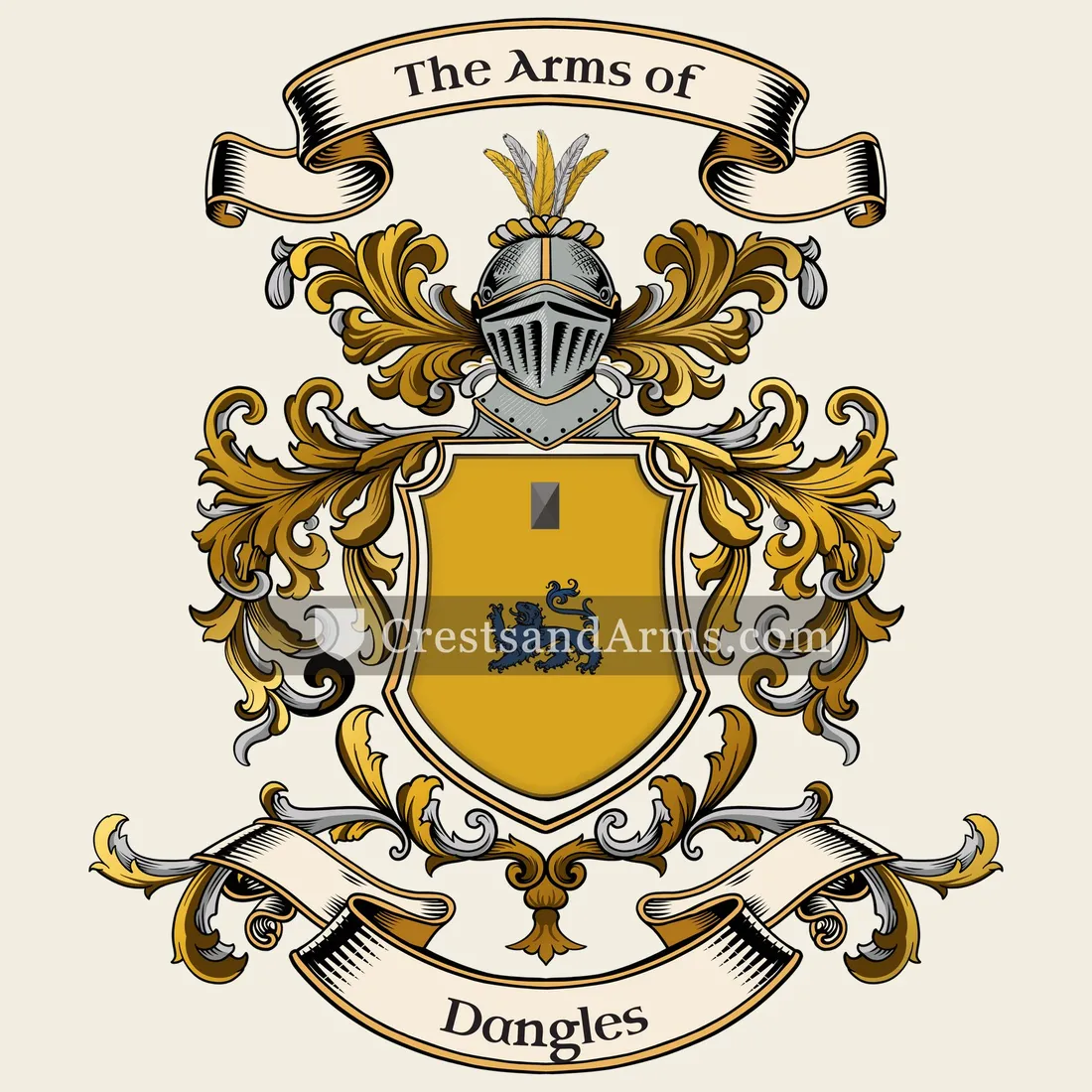
 lionCourage, strength and royalty
 billetThe sealed letter, and a message delivered
 lionCourage, strength and royalty
 billetThe sealed letter, and a message delivered