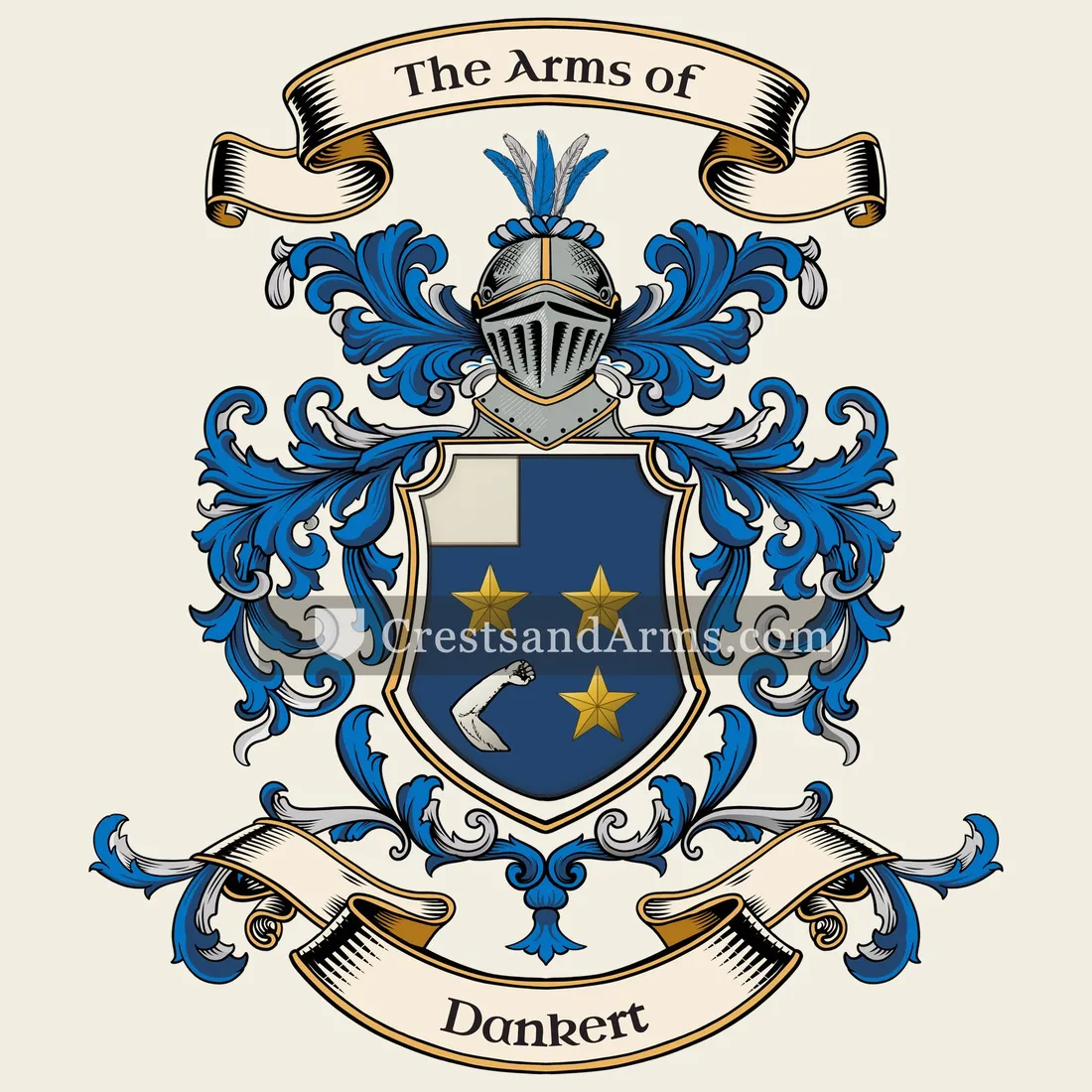
A record of documented arms, meaning and origin, researched for the Dankert family of Netherlands.
Reg. 7261 · Dutch, D–F
Meaning of the Dankert family crest colors & symbols
Symbols on this shield
cantonA mark of honour granted by the sovereign
armA person of action, industrious and laborious
mulletThe third son, and a divine quality from above
Colours
Blue (Azure)Means: Loyalty and truth
Silver (Argent)Means: Peace and sincerity
Gold (Or)Means: Generosity
Historical info
Source
J. B. Rietstap, Armorial Général, Gouda: G. B. van Goor Zonen, 1884–87
Blazon (the actual original written record)
“D'azur à un bras paré, mouv. d'une nuée au canton sen. du chef, la main tenant un bâton en bande au-dessus d'une tour en p., le tout d'arg., acc. de trois étoiles d'or en chef, 2 et 1.”
NetherlandsAmsterdam, c. 1815
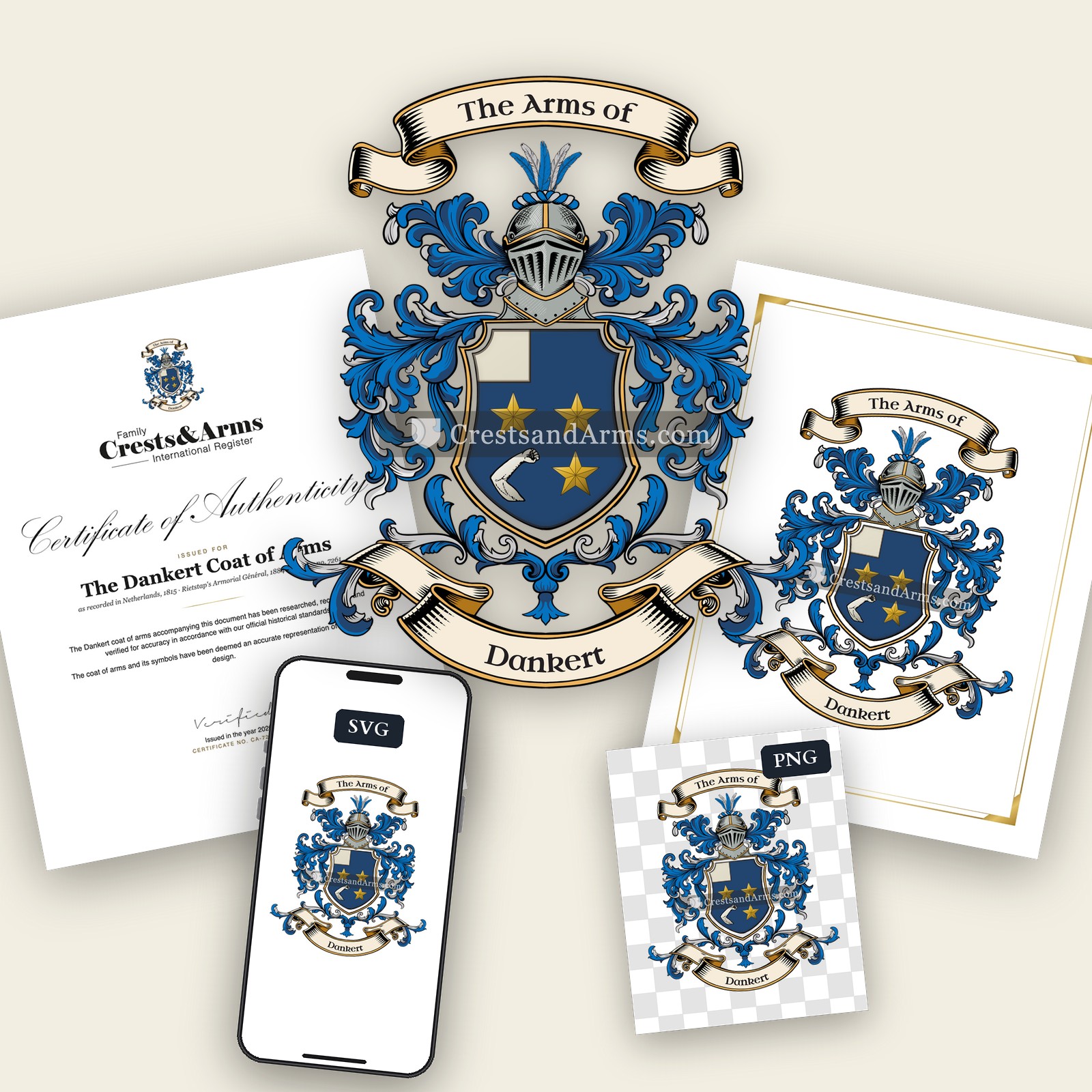
Digital archive packCoat of arms PNG, gold border print PDF, vector SVG and the certificate of authenticity. Sent to your email in minutes.
Map of Netherlands showing where the Dankert arms are recorded
The Dankert arms were recorded in Amsterdam, c. 1815.
This is where the arms were entered in the register. Families often moved to other parts of the country, so the same name can turn up in more than one region.
Region
Amsterdam
Town
Amsterdam
First recorded
1815
Granting Authority for the Dankert Arms
Hoge Raad van Adel
Photograph made by me · CC BY-SA 3.0
The body that granted and recorded arms in Netherlands in this period.
William I of the Netherlands
Sovereign of the period
William I of the Netherlands
1815–1840
Reigning in Netherlands when the Dankert arms are first recorded.
How Arms Worked in Netherlands
In the Netherlands, coats of arms were often used by noble families and those who held specific public offices. These arms were passed down through the generations to legitimate descendants. Younger branches of a family usually kept the original design without needing to add special marks. This system ensured that the family identity remained clear and consistent over many years.
Granting authority
The Hoge Raad van Adel is the official body that regulates and manages noble titles and coats of arms in the Netherlands.
How they got arms
Families typically obtained their coats of arms through official royal grants or by proving their long-standing historical use of the symbols.
Where arms were recorded
Coats of arms are officially recorded in the registers held by the Hoge Raad van Adel, which began its work in 1814.
The family's standing
Recorded among the armigerous families of Netherlands.
Origin & History of the Dankert Family in Netherlands
The surname Dankert is rooted in the Germanic linguistic tradition, evolving from the ancient given name Dankwart, which combines the elements for "thought" and "guardian." By the time the family was firmly established in Amsterdam in 1815, the name had transitioned from a personal identifier into a stable hereditary surname. During the early nineteenth century, Amsterdam served as a bustling center for trade and industry following the end of the Napoleonic era. Families like the Dankerts were often part of the urban middle class, contributing to the city's economic recovery as it transitioned into a modern capital. The name reflects a long history of migration across Northern Europe, where it moved from its Germanic origins into the Dutch-speaking regions, eventually becoming a permanent fixture in the records of the Netherlands.
Dankert Meaning & Related Branches
Root word
Dancard
A Germanic compound meaning bold or brave in thought or counsel.
This name
DankertA patronymic surname derived from the personal name Dancard, signifying a bold advisor.
also spelled
Dankerts
Documented Sources
J. B. Rietstap, Armorial Général, Gouda: G. B. van Goor Zonen, 1884–87
Beider, Alexander, A Dictionary of German Surnames, 2011
Nederlands Instituut voor Genealogie, Dankert Family Records, 1815
Stadsarchief Amsterdam, Bevolkingsregister van Amsterdam, 1815
Digital archive packCoat of arms PNG, gold border print PDF, vector SVG and the certificate of authenticity. Sent to your email in minutes.


 cantonA mark of honour granted by the sovereign
 armA person of action, industrious and laborious
 mulletThe third son, and a divine quality from above
 cantonA mark of honour granted by the sovereign
 armA person of action, industrious and laborious
 mulletThe third son, and a divine quality from above