Map of Italy showing where the Danzy arms are recorded
The Danzy arms were recorded in Bologne, c. 1775.
This is where the arms were entered in the register. Families often moved to other parts of the country, so the same name can turn up in more than one region.
The body that granted and recorded arms in Italy in this period.
Alvise Giovanni Mocenigo
Sovereign of the period
Alvise Giovanni Mocenigo
1763–1778
Reigning in Italy when the Danzy arms are first recorded.
How Arms Worked in Italy
In the Italian states, coats of arms were often used by noble families to show their status and history. These symbols were passed down through the generations to all legitimate male descendants. Younger branches of a family usually kept the original design but sometimes added small changes to distinguish their specific line from the main branch.
Granting authority
Various local rulers and city governments controlled the use of coats of arms across the different Italian states.
How they got arms
Families often assumed their own arms or received them as official grants from local lords, popes, or city councils.
Where arms were recorded
Arms were recorded in local city archives or private family books rather than in one single national register.
The family's standing
Recorded among the armigerous families of Italy.
Origin & History of the Danzy Family in Italy
The name Danzy is deeply rooted in the historical landscape of Northern France, with documented evidence placing the family in the city of Boulogne-sur-Mer as early as 1775. During this period, Boulogne served as a bustling maritime hub and a vital center for trade across the English Channel. Families living in this region were often connected to the complex social and economic shifts of the eighteenth century, ranging from merchant activities to the administrative life of the port. The presence of the Danzy name in local parish and civil records suggests that early family members were integrated into the urban fabric of this coastal community. As the region navigated the turbulent years leading up to the French Revolution, the Danzy family likely experienced the transition from the traditions of the Ancien Régime to the new social structures of the modern era. Their history reflects the resilience of families who maintained a steady presence in a strategic European gateway during a time of significant national transformation.
Danzy Meaning & Related Branches
Root word
Dante
Derived from the Latin word durans meaning enduring or lasting.
This name
DanzyAn Italian locative or patronymic surname likely indicating a descendant of someone named Dante.
also spelled
Danzy
Documented Sources
J. B. Rietstap, Armorial Général, Gouda: G. B. van Goor Zonen, 1884–87
Archives départementales du Pas-de-Calais, Registres paroissiaux et d'état civil de Boulogne-sur-Mer, 1775
Lartigue, Jean-Claude, Dictionnaire des familles du Boulonnais, 1998
Digital archive packCoat of arms PNG, gold border print PDF, vector SVG and the certificate of authenticity. Sent to your email in minutes.


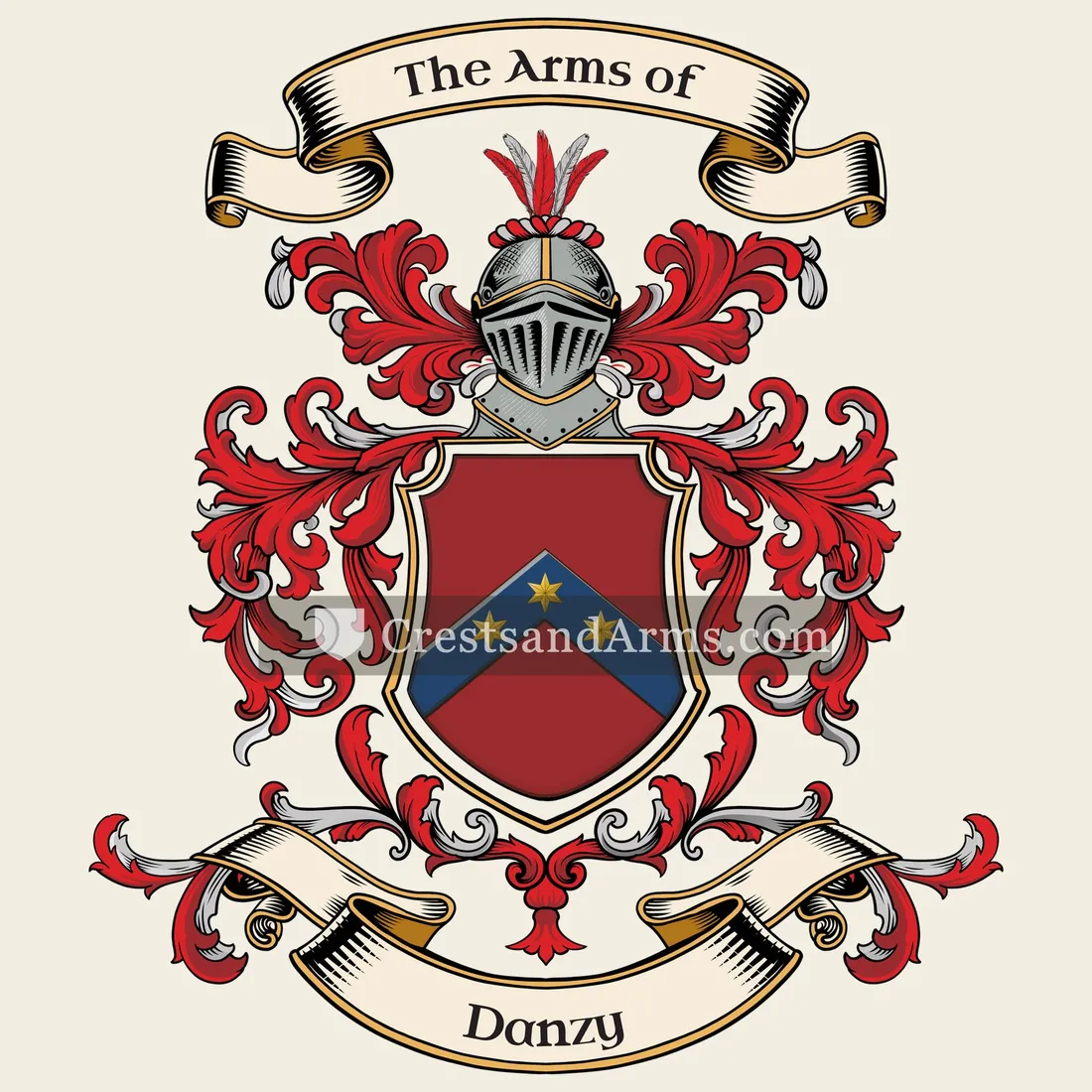
 chevronProtection, and faithful service completed
 starThe celestial goddess, and nobility
 chevronProtection, and faithful service completed
 starThe celestial goddess, and nobility