Map of France showing where the Darcy arms are recorded
The Darcy arms were recorded in Berry, c. 1663.
Berry was central French farming country, quiet and long-settled. Its estates were modest and stayed in the same hands for centuries, and steady landholding of that kind is exactly what puts a name into the heraldic records.
This is where the arms were entered in the register. Families often moved to other parts of the country, so the same name can turn up in more than one region.
The body that granted and recorded arms in France in this period.
Louis XIV of France
Sovereign of the period
Louis XIV of France
1643–1715
Reigning in France when the Darcy arms are first recorded.
How Arms Worked in France
In France, a coat of arms was a mark of honor that passed down through the male line to all legitimate descendants. Families often used the same shield without changes to show their shared heritage. If a branch wanted to stand out, they could add a small mark to their shield to show their specific place in the family tree.
Granting authority
The Juge d'armes de France acted as the official authority that regulated and verified coats of arms across the country.
How they got arms
Families typically inherited their arms from ancestors, though they could also receive them through royal grants or by proving their noble status.
Where arms were recorded
Coats of arms were officially recorded in the Armorial Général de France, which began its main collection in the year 1696.
The family's standing
Recorded among the armigerous families of Berry.
Origin & History of the Darcy Family in France
The history of the Darcy name in France is deeply connected to the central region of Berry. By the year 1663, records confirm that members of the family were well established in this area. During the seventeenth century, Berry was a place where families often held roles in local administration or land management. The Darcy family likely lived in this rural landscape as part of the provincial gentry. They navigated the social changes of the French monarchy while maintaining their presence in the heart of the country. Their life in Berry reflects the broader experience of families who built stable, long-term roots in the French provinces during the reign of Louis XIV.
Coat of Arms & Family Crest Details
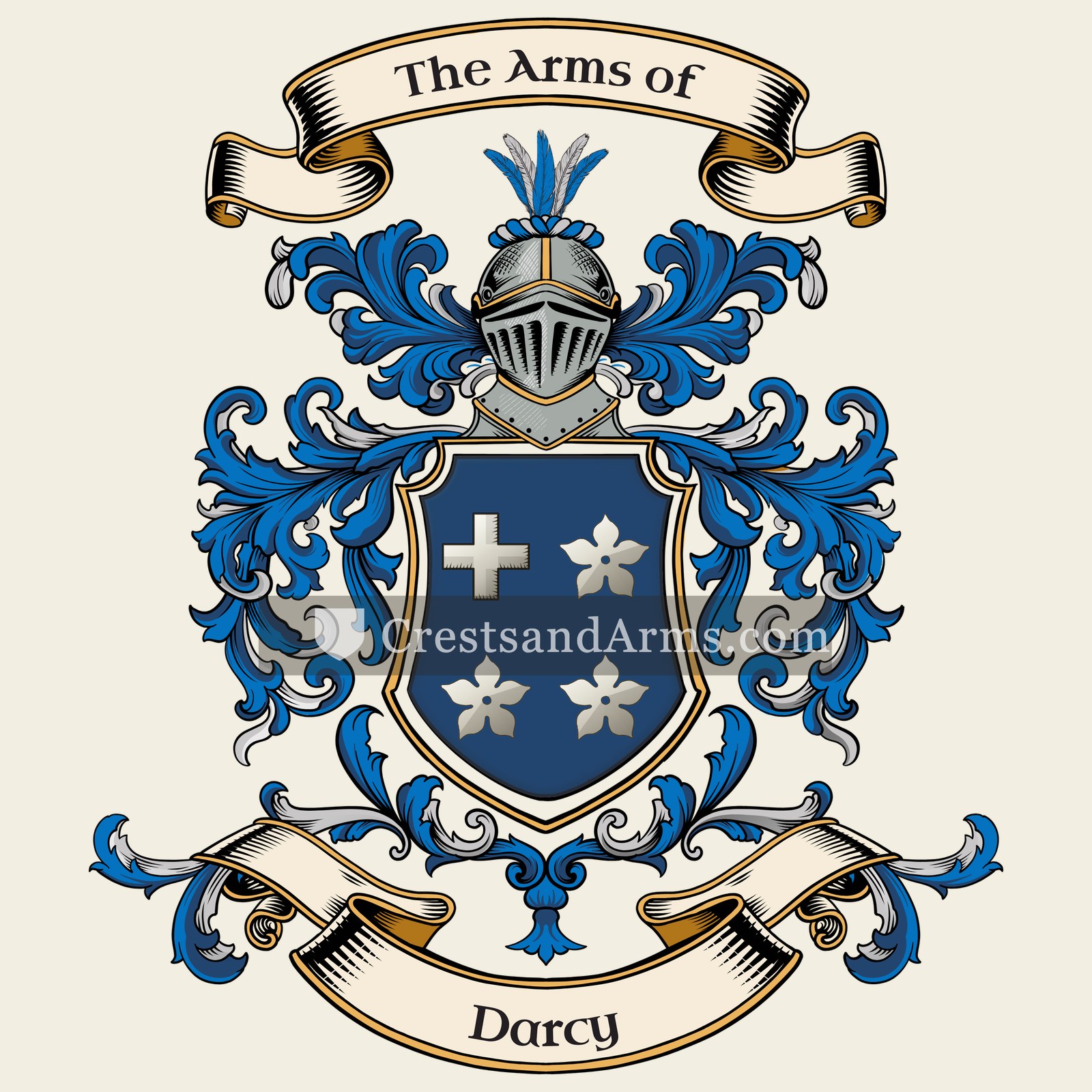
Symbols on this shield
cross symbolChristian faith and service
cinquefoilHope and joy
Colours
Blue (Azure)Means: Loyalty and truth
Silver (Argent)Means: Peace and sincerity
Historical info
Source
Sir Bernard Burke, The General Armory of England, Scotland, Ireland and Wales, London: Harrison & Sons, 1884
Blazon (the actual original written record)
“Az. semée of cross crosslets and three cinquefoils ar”
Englandc. 1418
Digital archive packCoat of arms PNG, gold border print PDF, vector SVG and the certificate of authenticity. Sent to your email in minutes.
Map of England showing where the Darcy arms are recorded
The Darcy arms were recorded in England, c. 1418.
Arms such as these were typically recorded in York.
Yorkshire is the largest of the English counties, and it held more gentry families than any other. Land there was split among a great many households rather than a few, so a great many of them carried arms.
This is where the arms were entered in the register. Families often moved to other parts of the country, so the same name can turn up in more than one region.
The body that granted and recorded arms in England in this period.
Henry V of England
Sovereign of the period
Henry V of England
1413–1422
Reigning in France when the Darcy arms are first recorded.
How Arms Worked in England
English heraldry allowed arms to be shared by all legitimate descendants of the original owner. These symbols were treated as personal property that moved through the generations to all children. While the eldest son kept the original design, other family members could use the same shield without needing to change it or register their own unique versions.
Granting authority
The College of Arms in London has regulated the use of coats of arms throughout England and Wales since 1484.
How they got arms
Families typically obtained their coats of arms through a formal grant from the Crown or by proving their ancient right to them.
Where arms were recorded
All official coats of arms are recorded in the registers kept at the College of Arms, which date back to the fifteenth century.
The family's standing
Recorded among the armigerous families of England.
Origin & History of the Darcy Family in England
The Darcy family name arrived in England following the Norman Conquest and eventually established deep roots in the northern regions of the country. By the early fifteenth century, the family had become well-established in Yorkshire, as evidenced by records confirming their presence in the city of York by 1418. During this period, the Darcys were part of the landed gentry who played active roles in local governance and regional politics. They often served as administrators or military leaders, which helped them secure their social standing in a turbulent era of English history. Their influence in the north grew steadily over the following generations, allowing them to integrate into the complex network of noble families that shaped the development of medieval England.
Coat of Arms & Family Crest Details
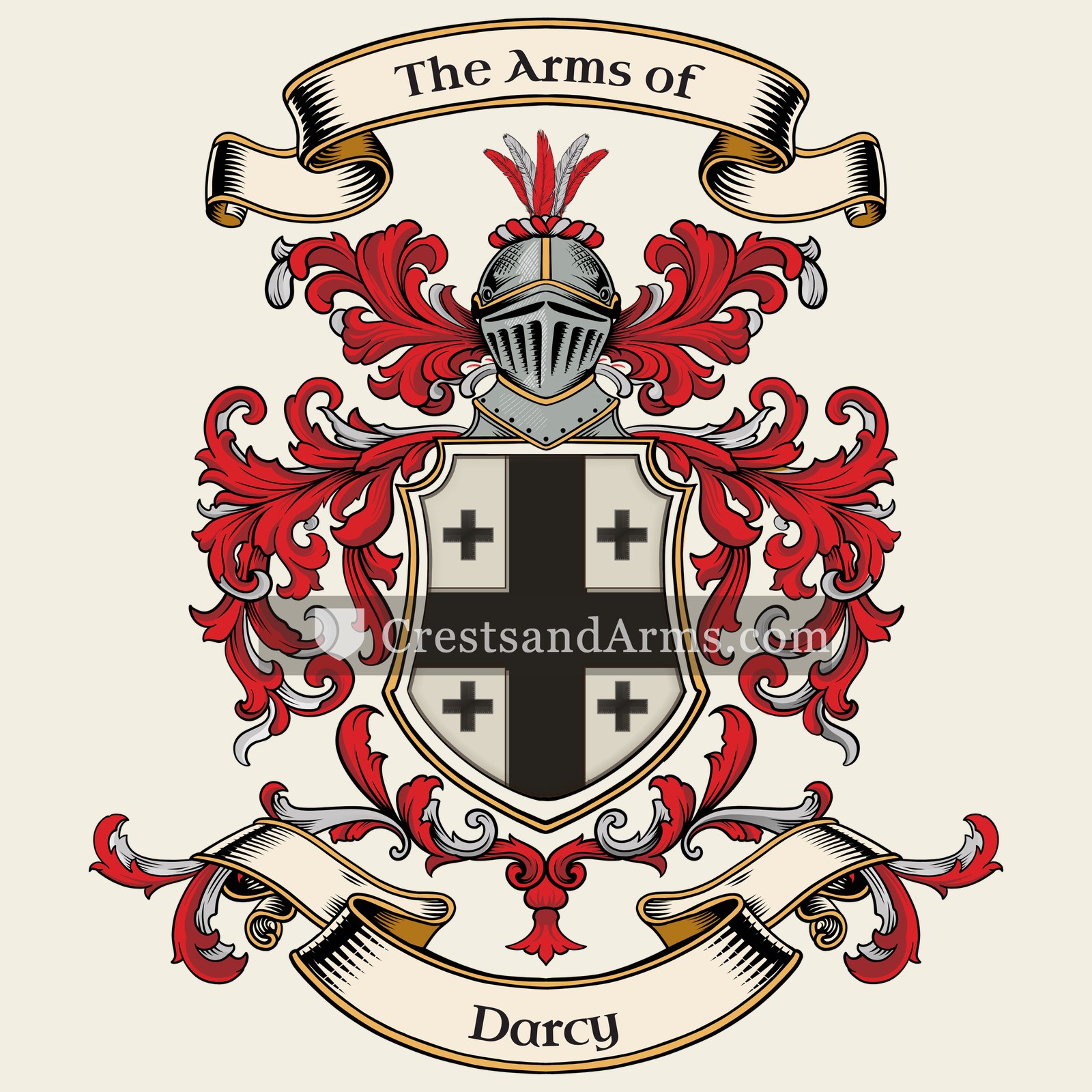
Symbols on this shield
cross symbolChristian faith and service
Colours
Silver (Argent)Means: Peace and sincerity
Black (Sable)Means: Constancy
Historical info
Source
Sir Bernard Burke, The General Armory of England, Scotland, Ireland and Wales, London: Harrison & Sons, 1884
Blazon (the actual original written record)
“Ar. a cross betw. four crosses pattée sa”
GalwayGalway, c. 1636
Digital archive packCoat of arms PNG, gold border print PDF, vector SVG and the certificate of authenticity. Sent to your email in minutes.
Map of Ireland showing where the Darcy arms are recorded
The Darcy arms were recorded in Galway, c. 1636.
Galway was western Irish country of poor land and a rich port. A small group of merchant families ran the town for centuries and held estates around it, and both kinds of property carried arms.
This is where the arms were entered in the register. Families often moved to other parts of the country, so the same name can turn up in more than one region.
The body that granted and recorded arms in Ireland in this period.
Charles I of England
Sovereign of the period
Charles I of England
1625–1649
Reigning in France when the Darcy arms are first recorded.
How Arms Worked in Ireland
The Ulster King of Arms granted coats of arms to individuals who proved their social standing and good character. These symbols were typically inherited by all legitimate descendants of the original holder. If a family branch wanted a unique look, they could apply for a specific change to their design through the office to ensure their identity remained distinct.
Granting authority
The Ulster King of Arms acted as the official body that regulated and issued all coats of arms throughout Ireland.
How they got arms
Families obtained their arms through formal grants issued by the office after proving their eligibility and paying the required fees.
Where arms were recorded
All official grants were recorded in the registers held by the Ulster King of Arms starting from the year 1552.
The family's standing
Recorded among the armigerous families of Galway.
Origin & History of the Darcy Family in Ireland
The Darcy family name in Ireland is deeply connected to the history of County Galway, where the family became prominent landowners and political figures long before the mid-seventeenth century. While the name has roots in Norman history, the Irish branch established itself as a powerful force in the west of Ireland by integrating into the local social and economic structures. By 1636, the Darcys were well-entrenched in the region, often serving as leaders in Galway city and managing significant estates. They were part of a group known as the Tribes of Galway, which consisted of fourteen merchant families who dominated the trade and governance of the area for generations. Their influence was so strong that they helped shape the political landscape of the province of Connacht during a time of great transition in Irish history. Through their involvement in local administration and commerce, the Darcys secured a lasting legacy that defined their status as one of the most important families in the west.
Darcy Meaning & Related Branches
Root word
d'Arcy
Derived from the French place name Arcy-Sainte-Restitue meaning fortress or stronghold.
This name
DarcyRefers to someone who originated from the town of Arcy in the Aisne region of France.
also spelled
Darcey
Darcie
Darsi
Darsy
Related arms
Arcyvariant spelling
Darcievariant spelling
Alredrecorded with Darcy, same area
Beaumanrecorded with Darcy, same area
Documented Sources
J. B. Rietstap, Armorial Général, Gouda: G. B. van Goor Zonen, 1884–87
Archives départementales du Cher, Série E, État civil et registres paroissiaux de la province de Berry
Boutillier, A., Histoire de la province de Berry, 1892
Lefebvre, G., La vie rurale dans le Berry au XVIIe siècle, 1954
Digital archive packCoat of arms PNG, gold border print PDF, vector SVG and the certificate of authenticity. Sent to your email in minutes.


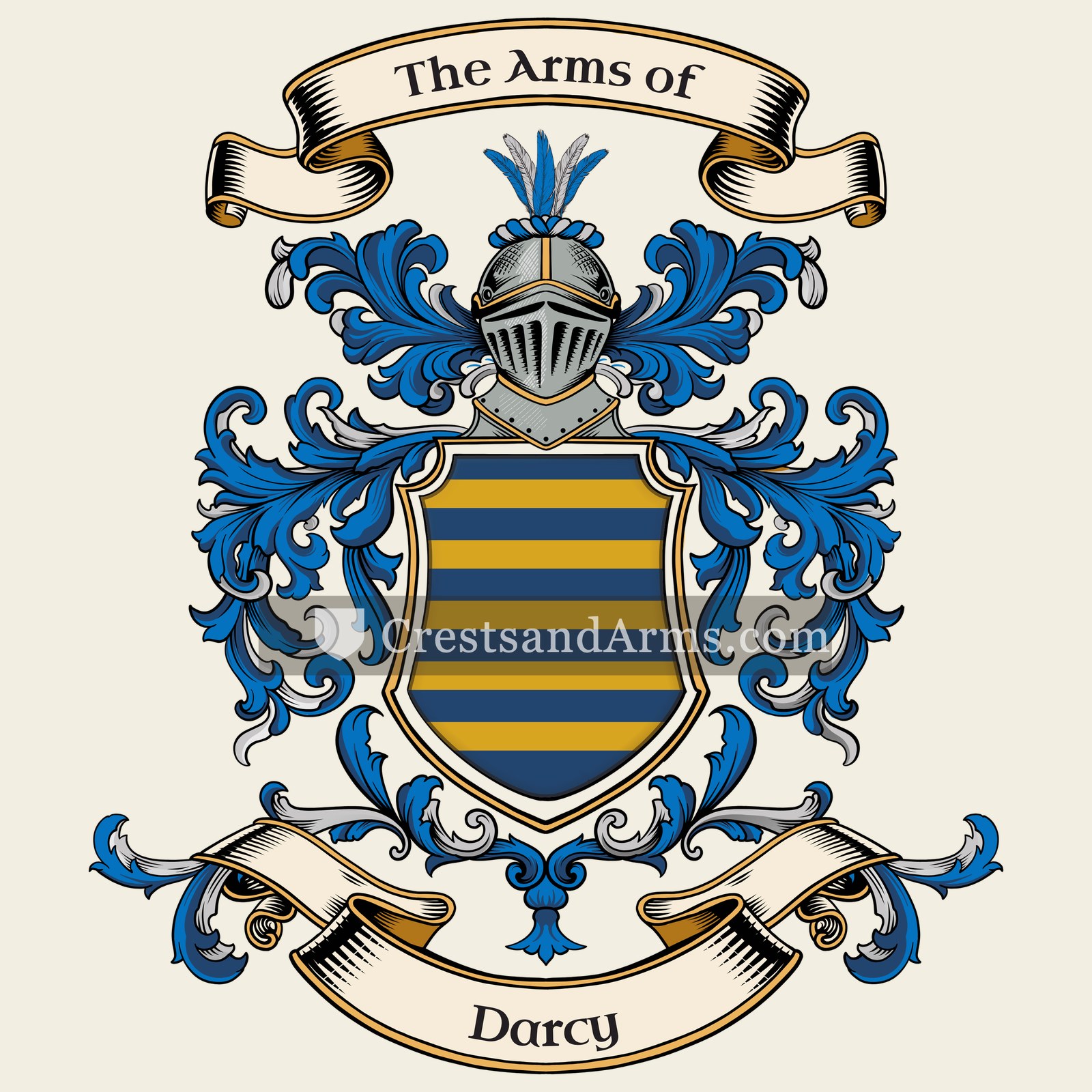


 cross symbolChristian faith and service
 cinquefoilHope and joy