A record of documented arms, meaning and origin, researched for the Dardenne family lines. Documented in 2 countries.
Reg. 9671 · Belgian, D–F
Coat of Arms & Family Crest Details
Symbols on this shield
chevronProtection, and faithful service completed
chiefAuthority, wisdom and dominion
mulletThe third son, and a divine quality from above
martletA younger son, who must win his own land
Colours
Blue (Azure)Means: Loyalty and truth
Gold (Or)Means: Generosity
Red (Gules)Means: Military strength
Historical info
Source
J. B. Rietstap, Armorial Général, Gouda: G. B. van Goor Zonen, 1884–87
Blazon (the actual original written record)
“D'azur au chev. d'or, acc. de trois molettes (6) du même; au chef du sec., ch. de trois merlettes de gu. S.: deux lions d'arg., lamp. de gu. D.: FIDELIS REGI ET PATRIÆ.”
BrabantBrabant, c. 1737
Digital archive packCoat of arms PNG, gold border print PDF, vector SVG and the certificate of authenticity. Sent to your email in minutes.
Map of Belgium showing where the Dardenne arms are recorded
The Dardenne arms were recorded in Brabant, c. 1737.
Brabant lay at the heart of the Low Countries, where the trade routes met. Its towns were wealthy and its landowners many, and both kinds of family kept arms, which is why the region is so heavily represented.
This is where the arms were entered in the register. Families often moved to other parts of the country, so the same name can turn up in more than one region.
The body that granted and recorded arms in Belgium in this period.
Charles VI, Holy Roman Emperor
Sovereign of the period
Charles VI, Holy Roman Emperor
1711–1740
Reigning in Belgium when the Dardenne arms are first recorded.
How Arms Worked in Belgium
In Belgium, a coat of arms is considered personal property that is passed down through the male line to legitimate descendants. Families often use the same shield design across generations to show their shared heritage. If a branch of the family wants to change the design, they must apply for an official update to their specific version of the arms.
Granting authority
The Conseil héraldique is the official body that regulates and approves all coats of arms in Belgium.
How they got arms
Families obtain their coats of arms through formal royal grants or by confirming their historical right to use existing designs.
Where arms were recorded
All approved coats of arms are officially recorded in the public registers of the Conseil héraldique since 1844.
The family's standing
Recorded among the armigerous families of Brabant.
Origin & History of the Dardenne Family in Belgium
The Dardenne family name has deep roots in the historical region of Brabant, where records confirm members of the family were established by 1737. The name itself is topographical in origin, likely derived from the French word "ardenne," which refers to a dense forest or woodland area. This suggests that the earliest ancestors were individuals who lived near or worked within the wooded landscapes characteristic of the Belgian countryside. During the eighteenth century, families in this region were often closely tied to the local agricultural economy and the shifting political landscape of the Southern Netherlands. As the family grew, they became part of the social fabric of Brabant, contributing to the local community through trade, farming, and the everyday life of the province. Their presence in the historical record during this period reflects the broader movement and settlement patterns of families who helped shape the rural identity of Belgium long before the country became a modern independent state.
Coat of Arms & Family Crest Details
Symbols on this shield
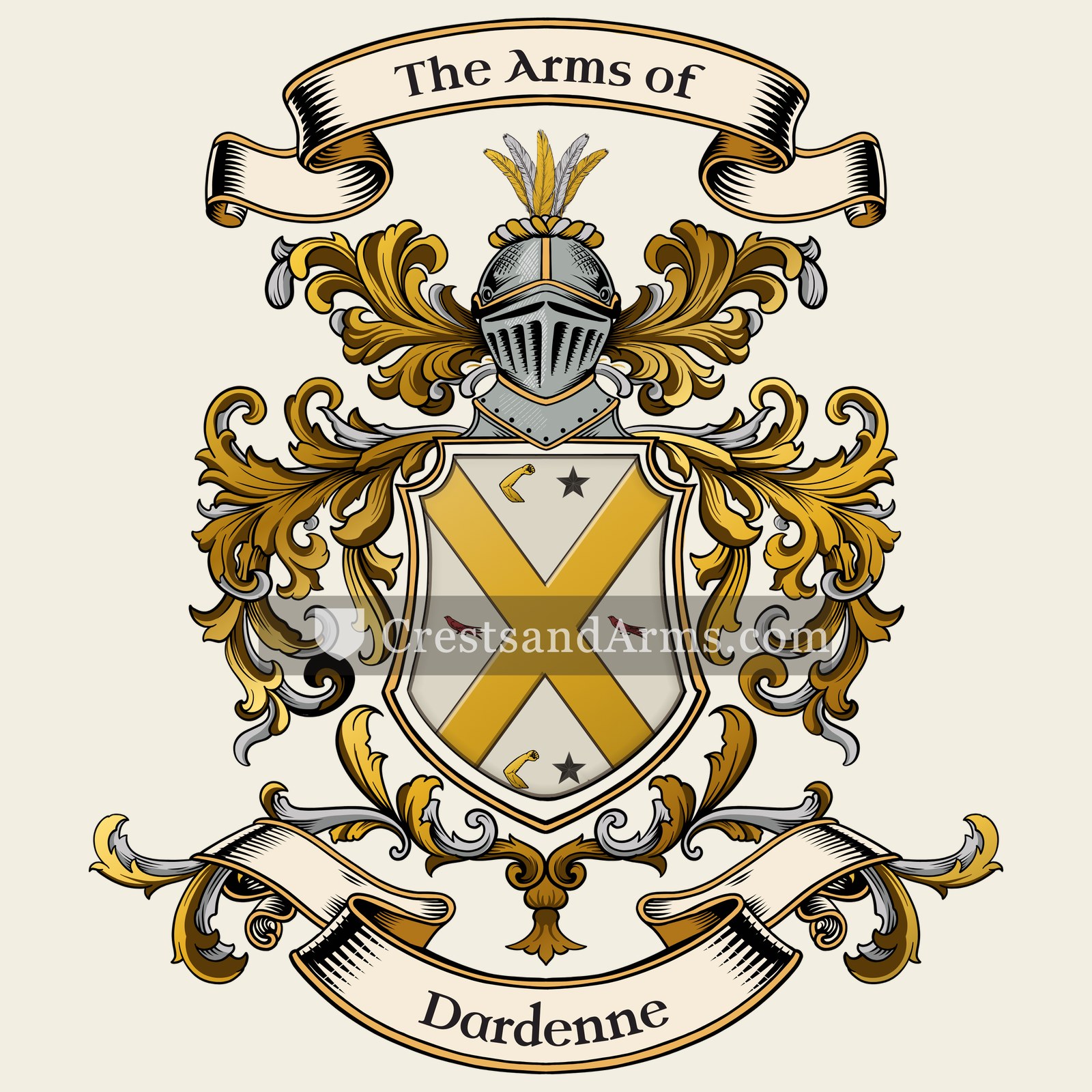
saltireResolution, and St Andrew's cross
armA person of action, industrious and laborious
martletA younger son, who must win his own land
mulletThe third son, and a divine quality from above
Colours
Silver (Argent)Means: Peace and sincerity
Gold (Or)Means: Generosity
Red (Gules)Means: Military strength
Black (Sable)Means: Constancy
Historical info
Source
J. B. Rietstap, Armorial Général, Gouda: G. B. van Goor Zonen, 1884–87
Blazon (the actual original written record)
“D'arg. à deux bras, parés d'or, passés en saut., cant. aux 1 et 4 d'une merlette de gu. et aux 2 et 3 d'une molette de sa.”
LorraineLorraine, c. 1663
Digital archive packCoat of arms PNG, gold border print PDF, vector SVG and the certificate of authenticity. Sent to your email in minutes.
Map of France showing where the Dardenne arms are recorded
The Dardenne arms were recorded in Lorraine, c. 1663.
Lorraine sat on the border between France and the German lands, and border country bred soldiers. Families here held small estates and served in arms, and a fighting man was exactly the sort who carried a shield of his own.
This is where the arms were entered in the register. Families often moved to other parts of the country, so the same name can turn up in more than one region.
The body that granted and recorded arms in France in this period.
Louis XIV of France
Sovereign of the period
Louis XIV of France
1643–1715
Reigning in Belgium when the Dardenne arms are first recorded.
How Arms Worked in France
In France, a coat of arms was a mark of honor that passed down through the male line to all legitimate descendants. Families often used the same shield without changes to show their shared heritage. If a branch wanted to stand out, they could add a small mark to their shield to show their specific place in the family tree.
Granting authority
The Juge d'armes de France acted as the official authority that regulated and verified coats of arms across the country.
How they got arms
Families typically inherited their arms from ancestors, though they could also receive them through royal grants or by proving their noble status.
Where arms were recorded
Coats of arms were officially recorded in the Armorial Général de France, which began its main collection in the year 1696.
The family's standing
Recorded among the armigerous families of Lorraine.
Origin & History of the Dardenne Family in France
The surname Dardenne traces its roots to the northeastern regions of France, with firm historical evidence placing the family in the province of Lorraine by 1663. The name is topographical in origin, likely derived from the French word "ardenne," which refers to a dense forest or a wooded highland area. This suggests that the earliest ancestors were individuals who lived near or worked within the vast, ancient forests that defined the landscape of the Ardennes region. During the seventeenth century, Lorraine was a territory marked by significant political instability and frequent border conflicts, which forced many families to remain closely tied to their local lands for survival. As members of the Dardenne family established themselves in these rural communities, they became part of the agricultural and social fabric of the region. Their presence in 1663 serves as a vital anchor point, illustrating how the family name evolved alongside the shifting borders and cultural identity of the French frontier.
Dardenne Meaning & Related Branches
Root word
ard
A Celtic or Gaulish term referring to high, wooded, or mountainous terrain.
This name
DardenneA topographic name for someone who lived near a high, forested area or ridge.
also spelled
Darden
Dardene
Related arms
Grenaisiesimilar arms
Lebaultsimilar arms
Documented Sources
J. B. Rietstap, Armorial Général, Gouda: G. B. van Goor Zonen, 1884–87
Archives: State Archives in Belgium (Archives de l'État en Belgique), Registres paroissiaux et registres de l'état civil
Delimaire, A., Dictionnaire étymologique des noms de famille de Belgique, 1998
Gysseling, M., Toponymisch Woordenboek van België, Nederland, Luxemburg, Noord-Frankrijk en West-Duitsland, 1960
Digital archive packCoat of arms PNG, gold border print PDF, vector SVG and the certificate of authenticity. Sent to your email in minutes.


 chevronProtection, and faithful service completed
 chiefAuthority, wisdom and dominion
 mulletThe third son, and a divine quality from above
 martletA younger son, who must win his own land
 chevronProtection, and faithful service completed
 chiefAuthority, wisdom and dominion
 mulletThe third son, and a divine quality from above
 martletA younger son, who must win his own land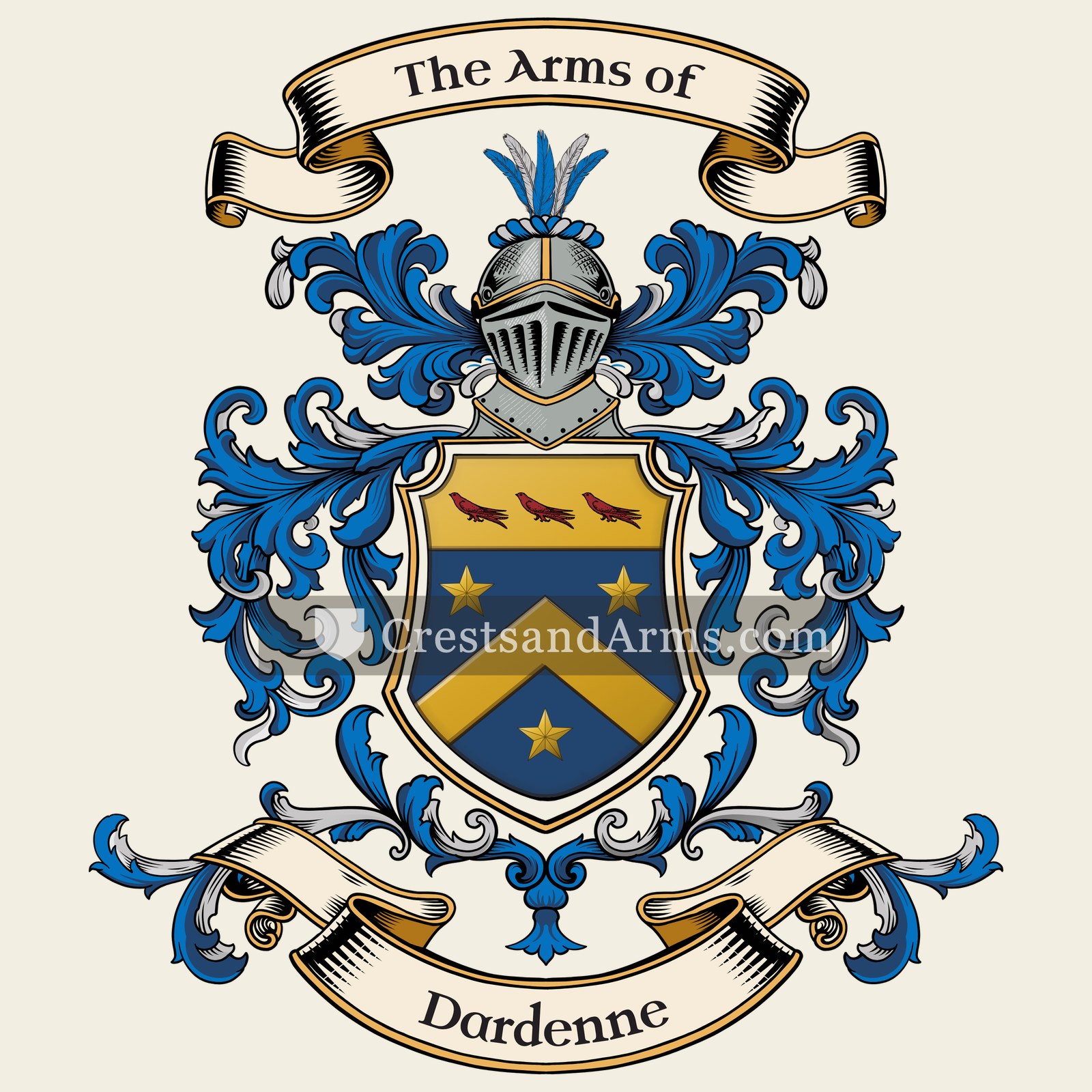


 saltireResolution, and St Andrew's cross
 armA person of action, industrious and laborious