Map of France showing where the Dare arms are recorded
The Dare arms were recorded in Tournay, c. 1663.
Arms such as these were typically recorded in Bretagne.
More families held coats of arms in Bretagne than anywhere else in France. The land was divided into many small estates rather than a few large ones, so far more households counted as gentry, and each needed a shield of its own to be told apart.
This is where the arms were entered in the register. Families often moved to other parts of the country, so the same name can turn up in more than one region.
The body that granted and recorded arms in France in this period.
Louis XIV of France
Sovereign of the period
Louis XIV of France
1643–1715
Reigning in France when the Dare arms are first recorded.
How Arms Worked in France
In France, a coat of arms was a mark of honor that passed down through the male line to all legitimate descendants. Families often used the same shield without changes to show their shared heritage. If a branch wanted to stand out, they could add a small mark to their shield to show their specific place in the family tree.
Granting authority
The Juge d'armes de France acted as the official authority that regulated and verified coats of arms across the country.
How they got arms
Families typically inherited their arms from ancestors, though they could also receive them through royal grants or by proving their noble status.
Where arms were recorded
Coats of arms were officially recorded in the Armorial Général de France, which began its main collection in the year 1696.
The family's standing
Recorded among the armigerous families of France.
Origin & History of the Dare Family in France
The family name Dare has deep roots in the rugged landscape of the Bretagne region of France. By the year 1663, records confirm that members of the family were well-established within this coastal province. During this period, the name was closely tied to the social and agricultural structures of rural French life. Families in Bretagne often lived in tight-knit communities where their surname reflected their local identity and daily work. As the seventeenth century progressed, the Dare family navigated the complex political and religious shifts occurring across France. Their presence in the region suggests a long history of connection to the land and the unique cultural traditions of the Breton people. These early ancestors helped shape the local history of their parishes through their labor and their participation in the life of their villages.
Coat of Arms & Family Crest Details
Symbols on this shield
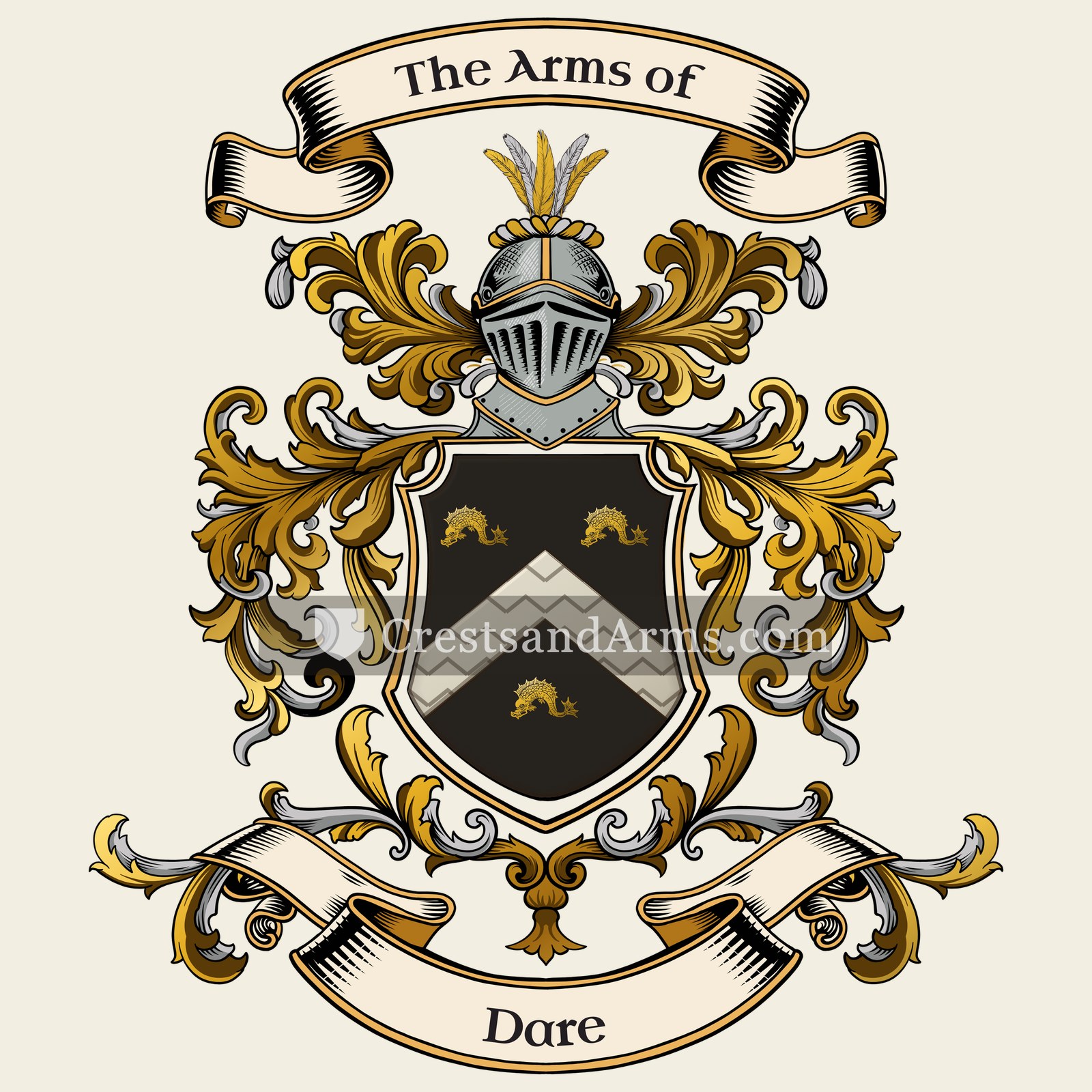
chevronProtection, and faithful service completed
dolphinSwiftness, charity and love
Colours
Black (Sable)Means: Constancy
Silver (Argent)Means: Peace and sincerity
Gold (Or)Means: Generosity
Historical info
Source
Sir Bernard Burke, The General Armory of England, Scotland, Ireland and Wales, London: Harrison & Sons, 1884
Blazon (the actual original written record)
“Sa. a chev. ar. betw. three dolphins or”
NorfolkNorfolk, c. 1620
Digital archive packCoat of arms PNG, gold border print PDF, vector SVG and the certificate of authenticity. Sent to your email in minutes.
Map of England showing where the Dare arms are recorded
The Dare arms were recorded in Norfolk, c. 1620.
Norfolk grew rich on wool and grain, and its wealth was spread among many middling families rather than a few great ones. Households of that kind bought land and took arms, and the county holds a large share of English names.
This is where the arms were entered in the register. Families often moved to other parts of the country, so the same name can turn up in more than one region.
The body that granted and recorded arms in England in this period.
James VI and I
Sovereign of the period
James VI and I
1603–1625
Reigning in France when the Dare arms are first recorded.
How Arms Worked in England
English heraldry allowed arms to be shared by all legitimate descendants of the original owner. These symbols were treated as personal property that moved through the generations to all children. While the eldest son kept the original design, other family members could use the same shield without needing to change it or register their own unique versions.
Granting authority
The College of Arms in London has regulated the use of coats of arms throughout England and Wales since 1484.
How they got arms
Families typically obtained their coats of arms through a formal grant from the Crown or by proving their ancient right to them.
Where arms were recorded
All official coats of arms are recorded in the registers kept at the College of Arms, which date back to the fifteenth century.
The family's standing
Recorded among the armigerous families of Norfolk.
Origin & History of the Dare Family in England
The surname Dare has roots that stretch deep into the English landscape, with early records placing members of the family in the county of Norfolk by the year 1620. The name itself is thought to be topographical, likely describing someone who lived near a specific landmark or a piece of land known by that name. In the centuries following the Norman Conquest, surnames often evolved from nicknames or descriptions of a person’s home, and Dare likely emerged as a way to identify families living in the rural communities of East Anglia. By the early 17th century, the Dares were established enough in Norfolk to appear in local parish registers and legal documents, which suggests they were integrated into the social and economic life of the region. These early ancestors were part of the backbone of English village life, working the land and participating in the local customs that defined the era. Their presence in Norfolk during this time highlights how families often remained in specific geographic areas for generations, building a history that is tied directly to the development of the English countryside.
Coat of Arms & Family Crest Details
Symbols on this shield
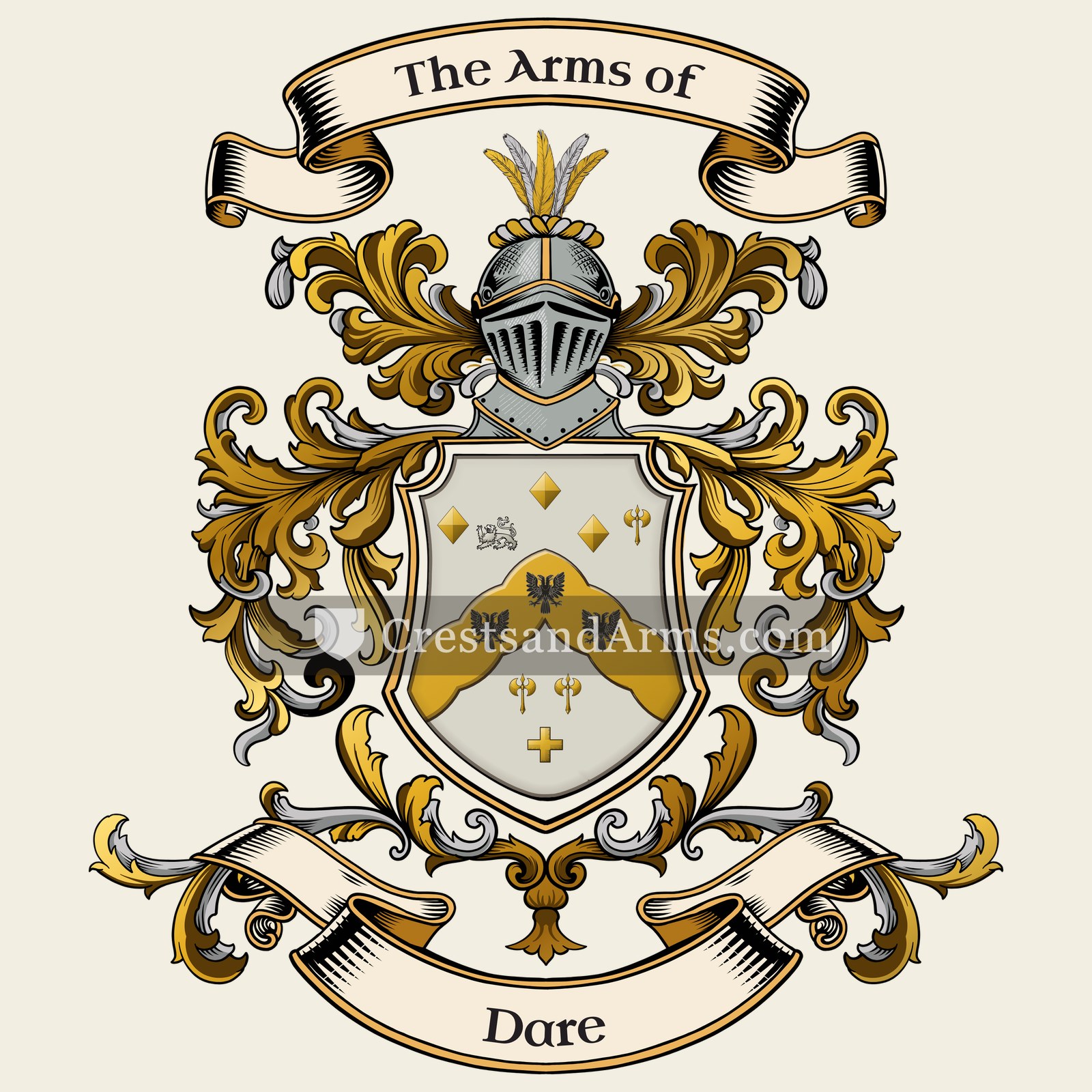
cross symbolChristian faith and service
chevronProtection, and faithful service completed
lionCourage, strength and royalty
lozengeHonour and nobility, and the arms of a woman
axeThe execution of military duty
eagleNobility, strength and a keen mind
Colours
Gold (Or)Means: Generosity
Silver (Argent)Means: Peace and sincerity
Black (Sable)Means: Constancy
Historical info
Source
Sir Bernard Burke, The General Armory of England, Scotland, Ireland and Wales, London: Harrison & Sons, 1884
Blazon (the actual original written record)
“Quarterly, 1st and 4th, az. a lion ramp. ar. betw. three lozenges or, each charged with an increscent gu. in chief a cross crosslet gold, for DARE; 2nd and 3rd, sa. on a chev. engr. betw. three battle-axes erect or, as many eagles displ. of the field, for HALL”
WexfordNewtownbarry · Wexford, c. 1645
Digital archive packCoat of arms PNG, gold border print PDF, vector SVG and the certificate of authenticity. Sent to your email in minutes.
Map of Ireland showing where the Dare arms are recorded
The Dare arms were recorded in Wexford, c. 1645.
Wexford was the corner of Ireland closest to Wales, settled early by Norman families. They held their land under arms and kept it for generations, which is why so many Wexford names carry recorded shields.
This is where the arms were entered in the register. Families often moved to other parts of the country, so the same name can turn up in more than one region.
The body that granted and recorded arms in Ireland in this period.
Charles I of England
Sovereign of the period
Charles I of England
1625–1649
Reigning in France when the Dare arms are first recorded.
How Arms Worked in Ireland
The Ulster King of Arms granted coats of arms to individuals who proved their social standing and good character. These symbols were typically inherited by all legitimate descendants of the original holder. If a family branch wanted a unique look, they could apply for a specific change to their design through the office to ensure their identity remained distinct.
Granting authority
The Ulster King of Arms acted as the official body that regulated and issued all coats of arms throughout Ireland.
How they got arms
Families obtained their arms through formal grants issued by the office after proving their eligibility and paying the required fees.
Where arms were recorded
All official grants were recorded in the registers held by the Ulster King of Arms starting from the year 1552.
The family's standing
Recorded among the armigerous families of Wexford.
Origin & History of the Dare Family in Ireland
The history of the Dare family in Ireland is deeply rooted in the coastal landscape of County Wexford, where records confirm their presence by at least 1645. During this period, Wexford served as a vital hub for trade and movement between Ireland and Britain, making it a likely point of entry for families arriving from across the sea. The name itself is thought to have evolved from Old English or Norman roots, potentially acting as a descriptive nickname for a person considered bold or courageous. As these early settlers established themselves in the southeast of Ireland, they became part of the complex social fabric of the seventeenth century. Their survival through the turbulent political shifts of the 1640s suggests that the family was resilient and well-integrated into the local agrarian or mercantile economy of the region. Over time, the Dares transitioned from newcomers to a recognized part of the Wexford community, leaving a quiet but enduring mark on the local history of the county.
Dare Meaning & Related Branches
Root word
d'Aire
Derived from the French town of Aire-sur-la-Lys.
This name
DareA locative surname indicating a person who originated from the town of Aire.
also spelled
Daire
Darr
Dar
Dair
Dayer
Related arms
Darrvariant spelling
Darresvariant spelling
Cherbeotrecorded with Dare, same area
Colemore, or Collymorerecorded with Dare, same area
Documented Sources
Sir Bernard Burke, The General Armory of England, Scotland, Ireland and Wales, London: Harrison & Sons, 1884
Archives départementales du Finistère, Série E (Registres paroissiaux et d'état civil)
Archives départementales d'Ille-et-Vilaine, Série B (Cours et juridictions)
Galllouédec, Louis, La Bretagne, 1917
Pitre-Chevalier, Pierre, La Bretagne ancienne et moderne, 1844
Digital archive packCoat of arms PNG, gold border print PDF, vector SVG and the certificate of authenticity. Sent to your email in minutes.


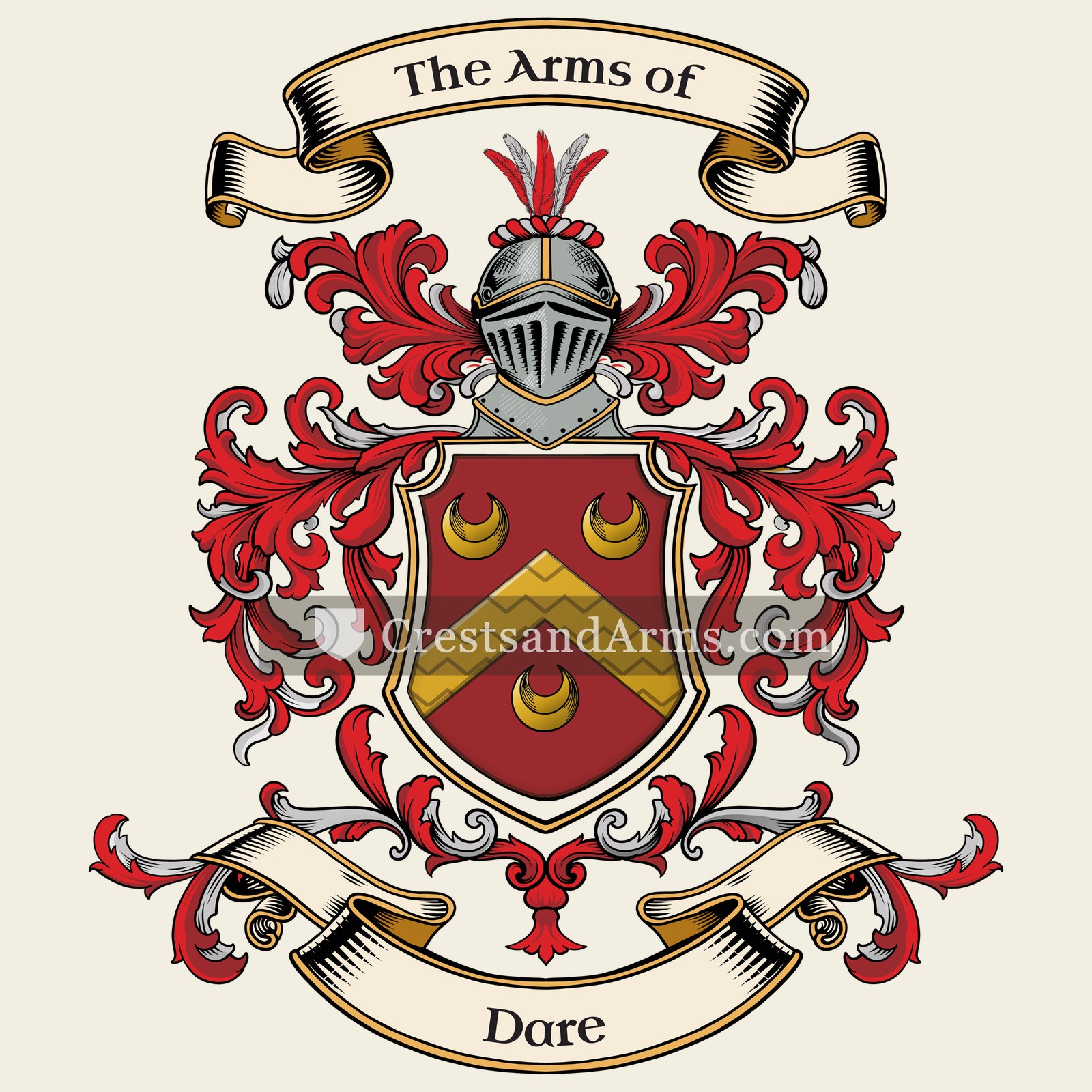
 chevronProtection, and faithful service completed
 crescentHonour by the sovereign, and the second son
 chevronProtection, and faithful service completed
 crescentHonour by the sovereign, and the second son


 dolphinSwiftness, charity and love


 cross symbolChristian faith and service
 lionCourage, strength and royalty
 lozengeHonour and nobility, and the arms of a woman
 axeThe execution of military duty
 eagleNobility, strength and a keen mind