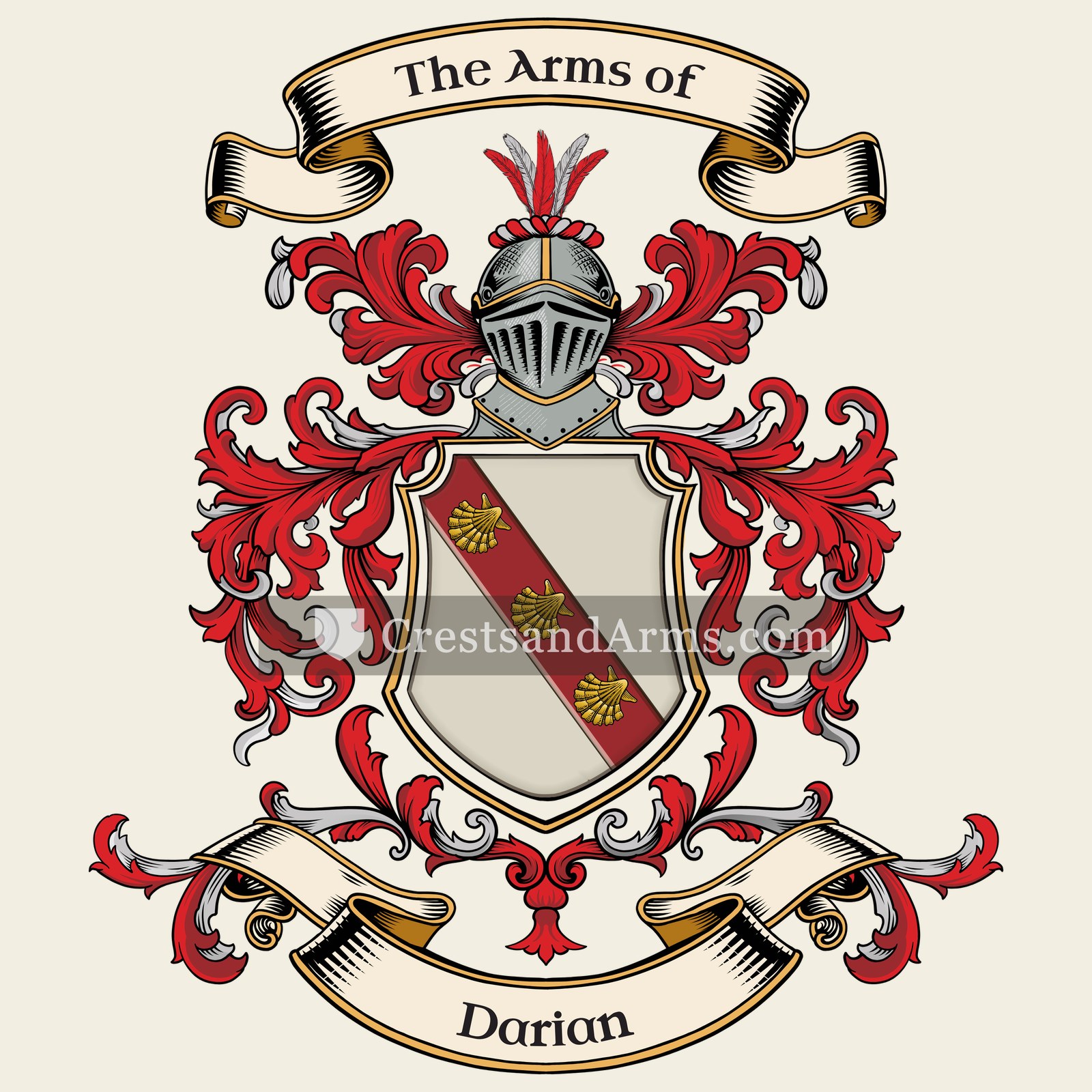
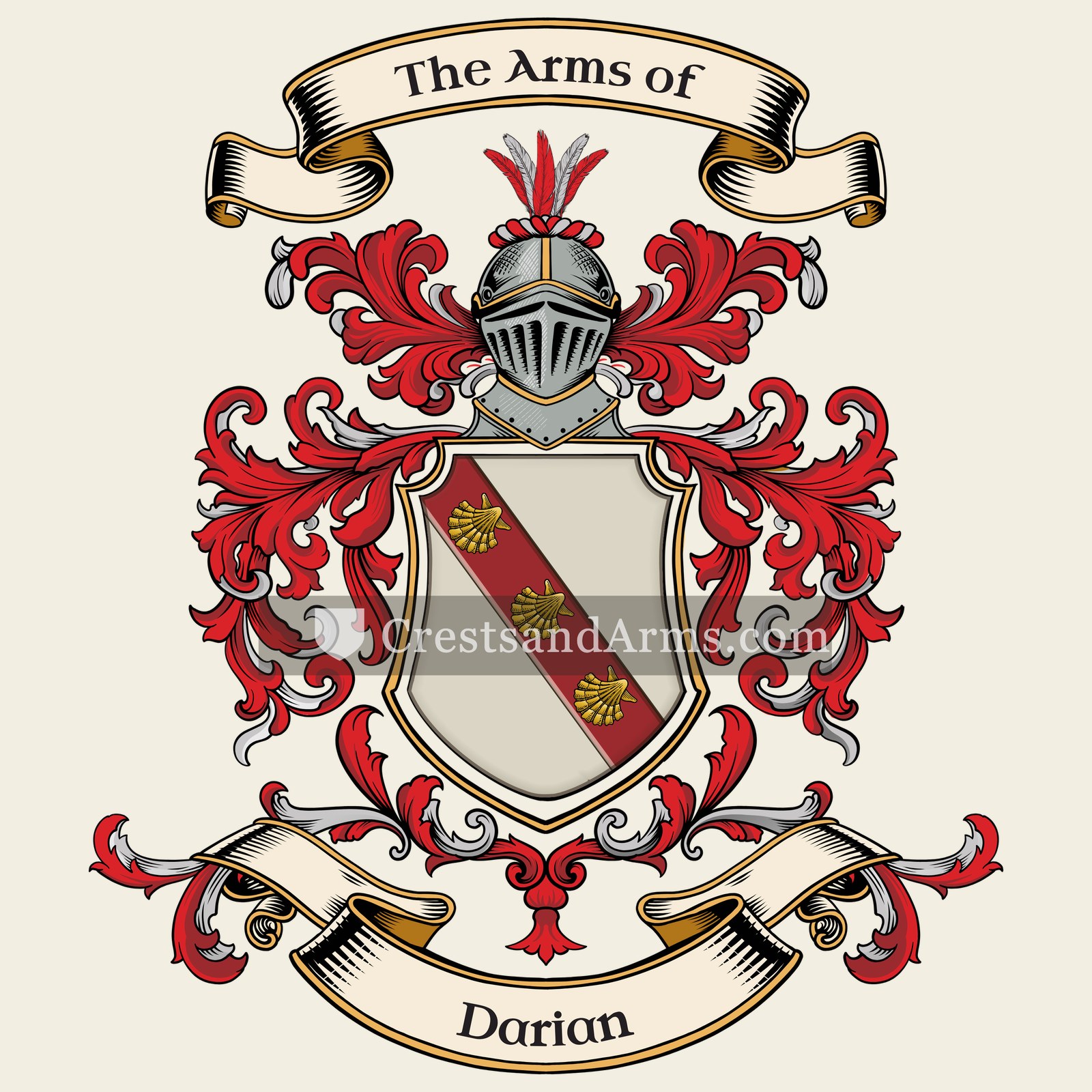
A record of documented arms, meaning and origin, researched for the Darian family lines. Documented in 2 countries.
Reg. 6015 · Britain, D–F
Coat of Arms & Family Crest Details
Symbols on this shield
bendDefence, and the scarf of a commander
escallopThe pilgrim's shell, and a long journey made
Colours
Silver (Argent)Means: Peace and sincerity
Red (Gules)Means: Military strength
Gold (Or)Means: Generosity
Historical info
Source
J. B. Rietstap, Armorial Général, Gouda: G. B. van Goor Zonen, 1884–87
Blazon (the actual original written record)
“D'arg. à la bande de gu., coticée de sin. et ch. de trois coquilles d'or, posées dans le sens de la bande. C.: un griffon iss. de sin., tenant de sa patte dextre une coquille d'or. D.: CAVE ET AUDE [Armes du naturaliste Charles Robert D.]”
KentKent, c. 1700
Digital archive packCoat of arms PNG, gold border print PDF, vector SVG and the certificate of authenticity. Sent to your email in minutes.
Map of Britain showing where the Darian arms are recorded
The Darian arms were recorded in Kent, c. 1700.
Kent sits between London and the short crossing to Europe, and the trade passing through made it wealthy. Merchant families bought land with that money, and it was landowners who took coats of arms.
This is where the arms were entered in the register. Families often moved to other parts of the country, so the same name can turn up in more than one region.
The body that granted and recorded arms in Britain in this period.
William III of England
Sovereign of the period
William III of England
1694–1702
Reigning in Britain when the Darian arms are first recorded.
How Arms Worked in Britain
English heraldry allowed arms to be shared by all legitimate descendants of the original owner. These symbols were treated as personal property that moved through the generations to all children. While the eldest son kept the original design, other family members could use the same shield without needing to change it or register their own unique versions.
Granting authority
The College of Arms in London has regulated the use of coats of arms throughout England and Wales since 1484.
How they got arms
Families typically obtained their coats of arms through a formal grant from the Crown or by proving their ancient right to them.
Where arms were recorded
All official coats of arms are recorded in the registers kept at the College of Arms, which date back to the fifteenth century.
The family's standing
Recorded among the armigerous families of Kent.
Origin & History of the Darian Family in Britain
The family name Darian first appears in the historical record of Britain within the county of Kent during the early eighteenth century. During this period, Kent was a bustling region defined by its proximity to the English Channel and its vital agricultural trade. Families living in this area were often connected to the local parish systems, which served as the primary way to track births, marriages, and deaths before modern census records existed. The name likely emerged as a localized variation of older naming traditions, reflecting the way surnames evolved as people moved between rural villages and growing market towns. By 1700, members of the Darian family were established as part of the local community, participating in the daily life and labor that sustained the regional economy of southeastern England. Their presence in Kent suggests they were part of the hardworking population that helped shape the social fabric of the English countryside during the transition into the modern era.
Coat of Arms & Family Crest Details
Symbols on this shield
bendDefence, and the scarf of a commander
escallopThe pilgrim's shell, and a long journey made
Colours
Silver (Argent)Means: Peace and sincerity
Red (Gules)Means: Military strength
Green (Vert)Means: Hope
Gold (Or)Means: Generosity
Historical info
Source
Sir Bernard Burke, The General Armory of England, Scotland, Ireland and Wales, London: Harrison & Sons, 1884
Blazon (the actual original written record)
“Ar. on a bend gu. betw. two cotises vert, three escallops or”
LincolnCleatham · Lincoln, c. 1620
Digital archive packCoat of arms PNG, gold border print PDF, vector SVG and the certificate of authenticity. Sent to your email in minutes.
Map of England showing where the Darian arms are recorded
The Darian arms were recorded in Lincoln, c. 1620.
Lincolnshire was rich farming country, and its wealth was spread across many middling families. Households of that size bought land and took arms, and the county holds a large share of English names.
This is where the arms were entered in the register. Families often moved to other parts of the country, so the same name can turn up in more than one region.
The body that granted and recorded arms in England in this period.
James VI and I
Sovereign of the period
James VI and I
1603–1625
Reigning in Britain when the Darian arms are first recorded.
How Arms Worked in England
English heraldry allowed arms to be shared by all legitimate descendants of the original owner. These symbols were treated as personal property that moved through the generations to all children. While the eldest son kept the original design, other family members could use the same shield without needing to change it or register their own unique versions.
Granting authority
The College of Arms in London has regulated the use of coats of arms throughout England and Wales since 1484.
How they got arms
Families typically obtained their coats of arms through a formal grant from the Crown or by proving their ancient right to them.
Where arms were recorded
All official coats of arms are recorded in the registers kept at the College of Arms, which date back to the fifteenth century.
The family's standing
Recorded among the armigerous families of Lincoln.
Origin & History of the Darian Family in England
The history of the Darian name in England is rooted in the social and religious shifts of the early seventeenth century. By 1620, records confirm that members of the family were established in the city of Lincoln, a location that served as a significant hub for trade and administration in the East Midlands. During this period, Lincoln was a place of great transition, as families navigated the pressures of local governance and the evolving religious landscape of the English Reformation. The presence of the Darian name in this region suggests that these early ancestors were likely part of the growing class of merchants or skilled tradespeople who helped sustain the city’s economy. While the name remains relatively rare in historical documents from this era, its appearance in Lincoln highlights the family’s integration into the local community during a time when England was preparing for the major political changes of the coming decades.
Related Branches & Arms
Root word
Darius
Derived from the Persian name Darayavahush meaning possessing goodness or holding firm.
This name
DarianA variant of the name Darren or Darius, often interpreted as meaning fertile or great.
also spelled
Darwyn
Derwin
Derwyn
Documented Sources
J. B. Rietstap, Armorial Général, Gouda: G. B. van Goor Zonen, 1884–87
Everitt, Alan, Continuity and Colonization: The Evolution of Kentish Settlement, 1986
The National Archives, Parish registers of Kent, series RG 4
Kent History and Library Centre, Archdeaconry of Canterbury marriage licences, series PRC 39
Digital archive packCoat of arms PNG, gold border print PDF, vector SVG and the certificate of authenticity. Sent to your email in minutes.


 bendDefence, and the scarf of a commander
 escallopThe pilgrim's shell, and a long journey made
 bendDefence, and the scarf of a commander
 escallopThe pilgrim's shell, and a long journey made