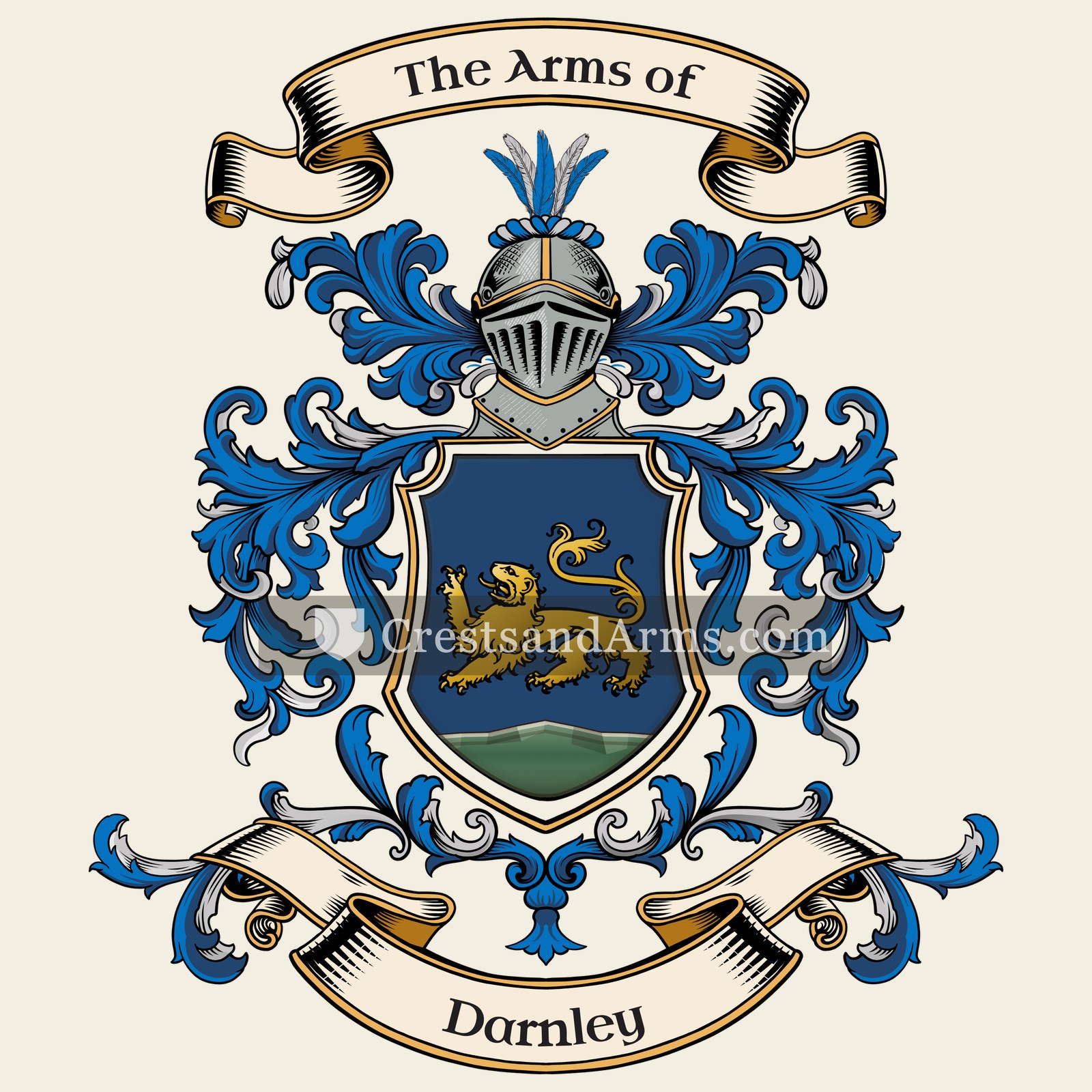
A record of documented arms, meaning and origin, researched for the Darnley family of Scotland.
Reg. 9033 · Scottish, D–F
Coat of Arms & Family Crest Details
Symbols on this shield
mountThe ground held, and steadfastness upon it
lionCourage, strength and royalty
Colours
Blue (Azure)Means: Loyalty and truth
Green (Vert)Means: Hope
Gold (Or)Means: Generosity
Historical info
Source
Sir Bernard Burke, The General Armory of England, Scotland, Ireland and Wales, London: Harrison & Sons, 1884
Blazon (the actual original written record)
“Darrell, Darell, or Dorrell (Sesay, co. York, Cale Hill and Scotney, co. Kent, Littlecote, co. Wilts, Pageham, co. Sussex, Trewornan, co. Cornwall, &c., all derived from a common ancestor, William de Orrell, one of the companions in arms of the Conqueror. The last male heir of the Darrells of Sesay, Sir George Darell, Knt., left at his decease in 1466, a dau. and heir, Joan, wife of Sir Guy Dawnay, Knt., of Cowick. The Darells of Cale Hill still preserve a male succession. The Darells of Littlecote, derived from William Darell, sub-treasurer of England temp. Richard II., and Elizabeth his wife, dau. and heir of Thomas Calston, of Littlecote, possessed that estate until the close of the 16th century, when it was alienated to Sir John Popham. The Darells of Trewornan are represented by TRELAWNY of Coldrinick, co. Cornwall). Az. a lion ramp. or, armed, langued, and crowned gu. Crest—A goat's head erased ar. attired or. Another Crest—Out of a ducal coronet or, a Saracen's head couped at the shoulders ppr. bearded sa. wreathed about the temples ar. and az. on the head a chapeau of the last, fretty of the third, tasselled gold, turned up erm.”
Scotlandc. 1466
Digital archive packCoat of arms PNG, gold border print PDF, vector SVG and the certificate of authenticity. Sent to your email in minutes.
Map of Scotland showing where the Darnley arms are recorded
The Darnley arms were recorded in Scotland, c. 1466.
Arms such as these were typically recorded in Edinburgh.
Edinburgh was the seat of Scotland's government, its courts and its heralds. Families with business there settled nearby, and being close to where arms were recorded is exactly why so many of them appear.
This is where the arms were entered in the register. Families often moved to other parts of the country, so the same name can turn up in more than one region.
The body that granted and recorded arms in Scotland in this period.
James III of Scotland
Sovereign of the period
James III of Scotland
1460–1488
Reigning in Scotland when the Darnley arms are first recorded.
How Arms Worked in Scotland
Scottish heraldry is unique because it treats a coat of arms as a piece of personal property protected by law. Only one person can own a specific design at any given time. When a family grows, the head keeps the original shield while other relatives must apply for their own distinct version with slight changes to prove their specific identity.
Granting authority
The Court of the Lord Lyon acts as the official body that regulates and controls all heraldic matters throughout Scotland.
How they got arms
Individuals obtain a legal right to their arms through a formal petition process that confirms their identity and family connection.
Where arms were recorded
All valid coats of arms are officially entered into the Public Register of All Arms and Bearings starting from 1672.
The family's standing
Recorded among the armigerous families of Scotland.
Origin & History of the Darnley Family in Scotland
The family name Darnley traces its roots to the lands of Darnley in Renfrewshire, Scotland. The name is locational, meaning it was originally taken by people who lived on or owned this specific territory. By the mid-fifteenth century, members of the family had established a significant presence in the capital city of Edinburgh. Records from 1466 confirm their involvement in the civic and social life of the city during a time of great political change in Scotland. As the family grew, they became integrated into the local nobility and played roles in the complex power struggles of the Scottish royal court. Their movement from rural landholdings to the center of urban power highlights the typical path of ambitious families during the late Middle Ages.
Darnley Meaning & Related Branches
Root word
Dernley
A meadow or clearing located in a hidden or secluded valley.
This name
DarnleyDerived from a Scottish place name referring to a hidden meadow.
also spelled
Darnlie
Darnly
Dernley
Related arms
Dernleyvariant spelling
Documented Sources
Sir Bernard Burke, The General Armory of England, Scotland, Ireland and Wales, London: Harrison & Sons, 1884
Balfour Paul, James, The Scots Peerage, 1904
National Records of Scotland, Records of the Parliaments of Scotland to 1707, 1466
McNeill, Peter G. B. and MacQueen, Hector L., Atlas of Scottish History to 1707, 1996
Digital archive packCoat of arms PNG, gold border print PDF, vector SVG and the certificate of authenticity. Sent to your email in minutes.


 mountThe ground held, and steadfastness upon it
 lionCourage, strength and royalty