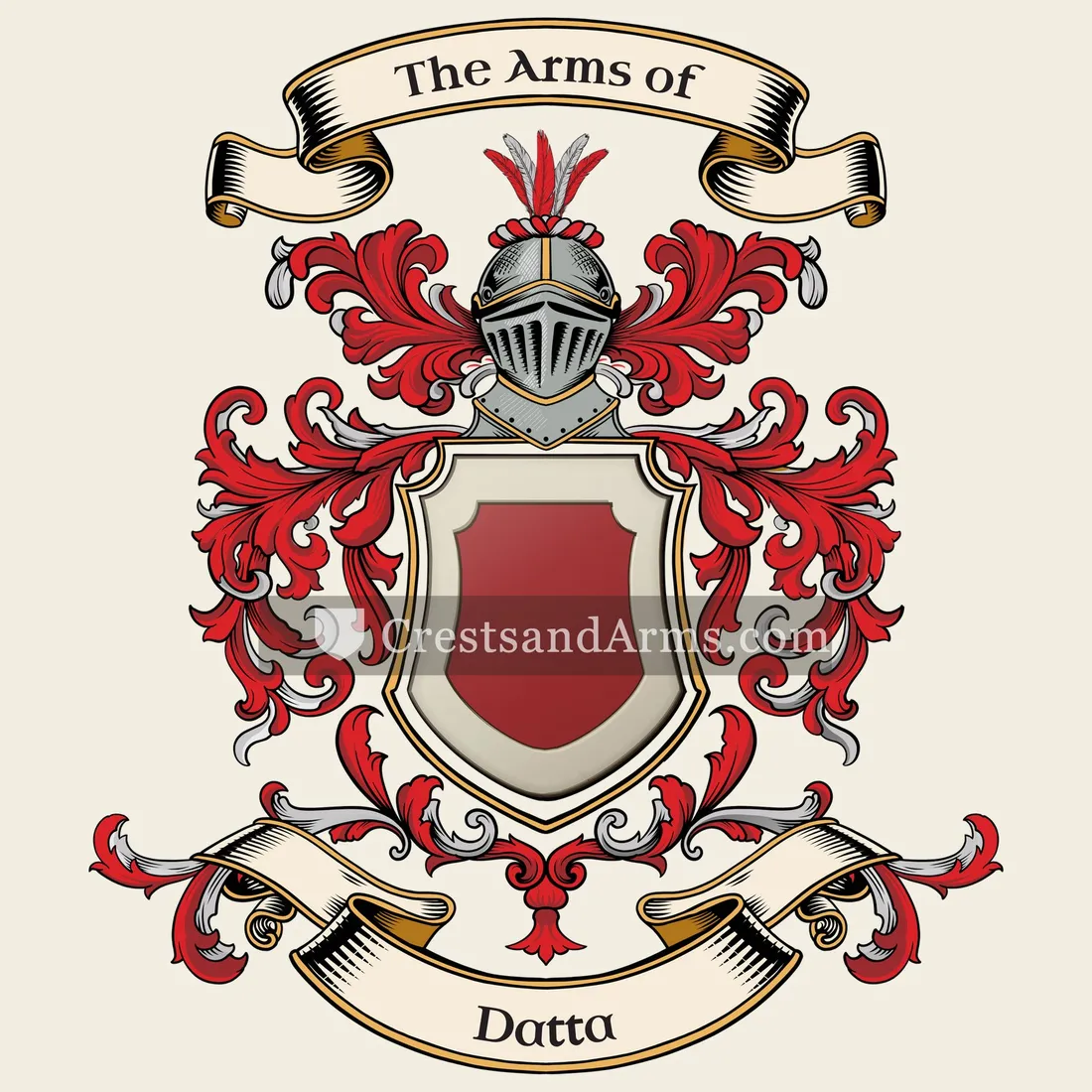
A record of documented arms, meaning and origin, researched for the Datta family of Germany.
Reg. 2554 · German, D–F
Meaning of the Datta family crest colors & symbols
Colours
Red (Gules)Means: Military strength
Historical info
Source
J. B. Rietstap, Armorial Général, Gouda: G. B. van Goor Zonen, 1884–87
Blazon (the actual original written record)
“De gu. treillissé d'or; à la bord. comp. de gu. et d'arg. Cq. cour. C.: deux chicots de gu., passés en saut., br. sur trois plumes de paon au nat. L.: à dextre d'arg. et de gu., à sen. d'or et de gu.”
SaxonySaxony, c. 1765
Digital archive packCoat of arms PNG, gold border print PDF, vector SVG and the certificate of authenticity. Sent to your email in minutes.
Map of Germany showing where the Datta arms are recorded
The Datta arms were recorded in Saxony, c. 1765.
Saxony had mines, trade and old landed families all at once. Silver made some fortunes and land held others, and both sorts of family kept arms, which is why Saxon names appear so often in the registers.
This is where the arms were entered in the register. Families often moved to other parts of the country, so the same name can turn up in more than one region.
The body that granted and recorded arms in Germany in this period.
Francis I, Holy Roman Emperor
Sovereign of the period
Francis I, Holy Roman Emperor
1745–1765
Reigning in Germany when the Datta arms are first recorded.
How Arms Worked in Germany
In the Holy Roman Empire, coats of arms were often granted to individuals by the Emperor or his representatives. These arms were then passed down through the generations to all legitimate descendants of the original holder. Younger branches of a family usually kept the same shield design without needing to change it, as the arms belonged to the entire lineage.
Granting authority
The Holy Roman Emperor held the sole power to grant new coats of arms throughout his vast imperial territories.
How they got arms
Families typically obtained their coats of arms through a formal imperial grant or by proving their noble status to the authorities.
Where arms were recorded
These grants were officially recorded in the Imperial Chancery registers, which began keeping formal records of such honors during the Middle Ages.
The family's standing
Recorded among the armigerous families of Saxony.
Origin & History of the Datta Family in Germany
The family name Datta has deep roots that connect to the cultural landscape of 18th-century Saxony. By the year 1765, records indicate that members of this family were already established within the region, living during a time of significant social and economic transition in Central Europe. The name itself is often linked to linguistic patterns common in Germanic and surrounding regions, reflecting the naming conventions of families who lived in rural or semi-urban communities during the mid-1700s. As these ancestors navigated the local administrative systems of Saxony, they became part of a long tradition of families who helped shape the local identity of their towns. While the specific origins of the name are tied to the linguistic evolution of the area, the presence of the Datta family in 1765 serves as a clear historical anchor point for their long-standing heritage in the region.
Datta Meaning & Related Branches
Root word
datus
Latin word meaning given or bestowed.
This name
DattaA surname indicating a person who is a gift or has been given by God.
also spelled
Dat
Documented Sources
J. B. Rietstap, Armorial Général, Gouda: G. B. van Goor Zonen, 1884–87
Kretschmer, Konrad, Historische Geographie von Mitteleuropa, 1904
Sächsisches Staatsarchiv, General-Landes-Archiv, Bestand 10001 (Ältere Urkunden)
Schubert, Ernst, Alltag im Mittelalter: Natürliches Lebensumfeld und menschliches Miteinander, 2002
Digital archive packCoat of arms PNG, gold border print PDF, vector SVG and the certificate of authenticity. Sent to your email in minutes.