Map of France showing where the Dattolo arms are recorded
The Dattolo arms were recorded in Lorraine, c. 1541.
Lorraine sat on the border between France and the German lands, and border country bred soldiers. Families here held small estates and served in arms, and a fighting man was exactly the sort who carried a shield of his own.
This is where the arms were entered in the register. Families often moved to other parts of the country, so the same name can turn up in more than one region.
The body that granted and recorded arms in France in this period.
Francis I of France
Sovereign of the period
Francis I of France
1515–1547
Reigning in France when the Dattolo arms are first recorded.
How Arms Worked in France
In France, a coat of arms was a mark of honor that passed down through the male line to all legitimate descendants. Families often used the same shield without changes to show their shared heritage. If a branch wanted to stand out, they could add a small mark to their shield to show their specific place in the family tree.
Granting authority
The Juge d'armes de France acted as the official authority that regulated and verified coats of arms across the country.
How they got arms
Families typically inherited their arms from ancestors, though they could also receive them through royal grants or by proving their noble status.
Where arms were recorded
Coats of arms were officially recorded in the Armorial Général de France, which began its main collection in the year 1696.
The family's standing
Recorded among the armigerous families of Lorraine.
Origin & History of the Dattolo Family in France
The family name Dattolo carries a rich history that likely traces its roots to the Mediterranean region before spreading across Europe. By the year 1541, records confirm that members of the family were firmly established in the Lorraine region of France. During this period, Lorraine served as a vital crossroads for trade and cultural exchange between Germanic and French territories. Families living in this area often adapted their names to fit local linguistic patterns while maintaining their original identity. The presence of the Dattolo name in such a strategic location suggests that these early ancestors were likely involved in the active merchant or administrative life of the duchy. As they moved through these changing borders, the family name became a lasting marker of their heritage and their long journey across the continent.
Dattolo Meaning & Related Branches
Root word
Dactylus
Latin for date or finger
This name
DattoloDerived from a nickname for someone resembling a date fruit or having distinctive fingers
also spelled
Datel
Dattell
Documented Sources
J. B. Rietstap, Armorial Général, Gouda: G. B. van Goor Zonen, 1884–87
Archives départementales de Meurthe-et-Moselle, Série B: Cours et juridictions
Bastien, Michel, Histoire de la Lorraine, 1998
Lepage, Henri, Les archives de Nancy, ou documents inédits relatifs à l'histoire de cette ville, 1865
Digital archive packCoat of arms PNG, gold border print PDF, vector SVG and the certificate of authenticity. Sent to your email in minutes.


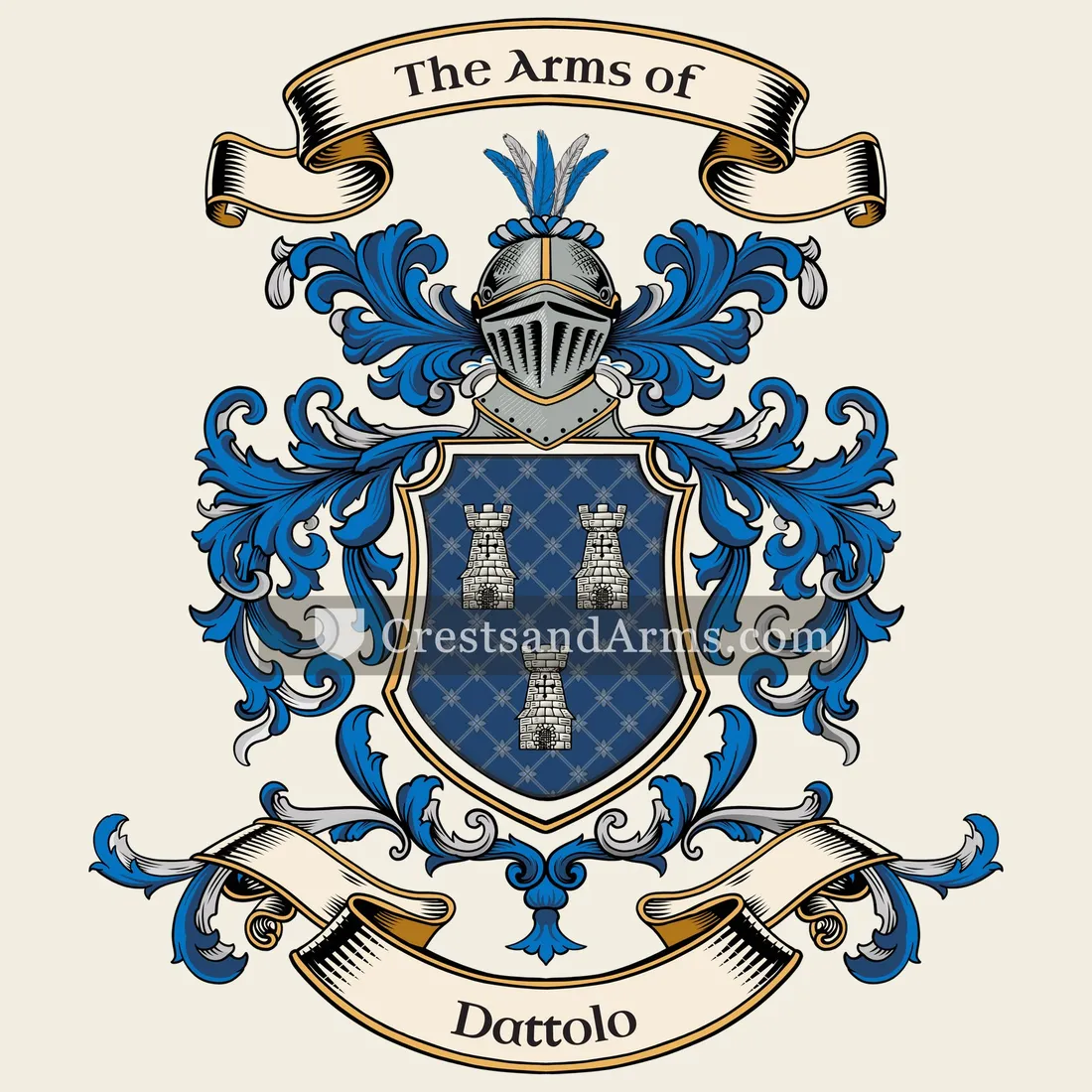
 towerGrandeur and solidity, and a stronghold defended
 towerGrandeur and solidity, and a stronghold defended