Map of England showing where the Daulton arms are recorded
The Daulton arms were recorded in Lancaster, c. 1389.
Lancashire was divided among a great many small landed families, more than most northern counties. Estates were passed down whole rather than split up, so the same names hold the same ground for centuries in the records.
This is where the arms were entered in the register. Families often moved to other parts of the country, so the same name can turn up in more than one region.
The body that granted and recorded arms in England in this period.
Richard II of England
Sovereign of the period
Richard II of England
1377–1399
Reigning in England when the Daulton arms are first recorded.
How Arms Worked in England
English heraldry allowed arms to be shared by all legitimate descendants of the original owner. These symbols were treated as personal property that moved through the generations to all children. While the eldest son kept the original design, other family members could use the same shield without needing to change it or register their own unique versions.
Granting authority
The College of Arms in London has regulated the use of coats of arms throughout England and Wales since 1484.
How they got arms
Families typically obtained their coats of arms through a formal grant from the Crown or by proving their ancient right to them.
Where arms were recorded
All official coats of arms are recorded in the registers kept at the College of Arms, which date back to the fifteenth century.
The family's standing
Recorded among the armigerous families of Lancaster.
Origin & History of the Daulton Family in England
The surname Daulton traces its roots to the northern regions of England, specifically emerging as a locative name derived from the Old English words for a valley and a settlement. By the late fourteenth century, the family had established a notable presence in Lancaster, as evidenced by records from 1389 that place members of the lineage within this growing administrative hub. During this period, the name was closely tied to the landscape of the county, reflecting the common practice of identifying individuals by the specific village or valley they inhabited. As the family grew, they moved through the social structures of medieval England, transitioning from local landowners and tenants to figures involved in the regional governance of Lancashire. This early history highlights how the Daulton name functioned as a marker of geographic origin, anchoring the family to the rugged terrain of northern England long before the name spread to other parts of the country.
Meaning of the Daulton family crest colors & symbols
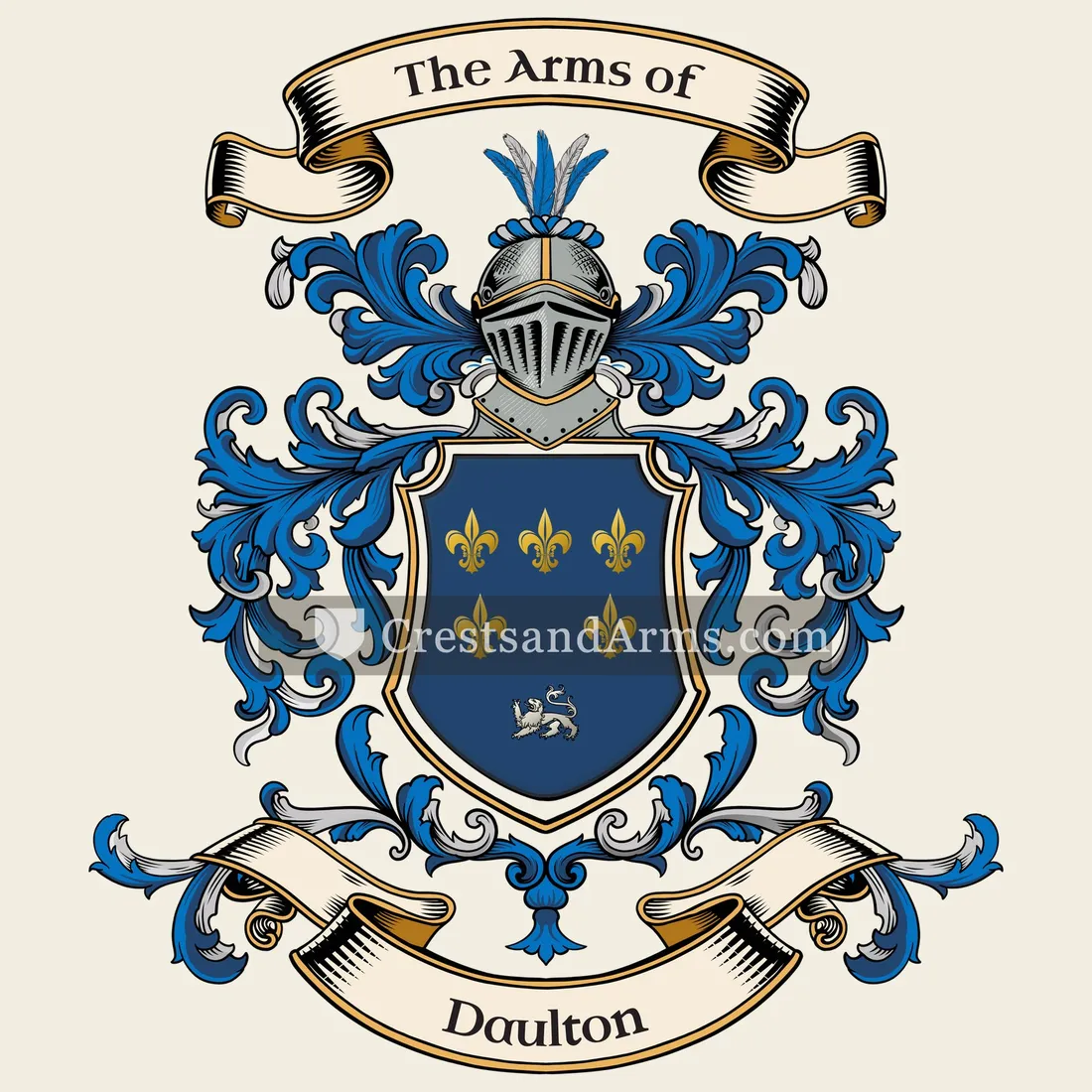
Symbols on this shield
lionCourage, strength and royalty
fleur de lisPurity, light, and the sixth son
Colours
Blue (Azure)Means: Loyalty and truth
Silver (Argent)Means: Peace and sincerity
Gold (Or)Means: Generosity
Historical info
Source
Sir Bernard Burke, The General Armory of England, Scotland, Ireland and Wales, London: Harrison & Sons, 1884
Blazon (the actual original written record)
“Az. a lion ramp. guard. ar. charged on the shoulder with a crescent sa. betw. five fleurs-de-lis or”
WestmeathDundonell · Westmeath, c. 1636
Digital archive packCoat of arms PNG, gold border print PDF, vector SVG and the certificate of authenticity. Sent to your email in minutes.
Map of Ireland showing where the Daulton arms are recorded
The Daulton arms were recorded in Westmeath, c. 1636.
Westmeath was midland grazing country in Ireland, taken by Norman families and held for centuries. Its estates were large and passed down whole, and unbroken tenure brought arms with it.
This is where the arms were entered in the register. Families often moved to other parts of the country, so the same name can turn up in more than one region.
The body that granted and recorded arms in Ireland in this period.
Charles I of England
Sovereign of the period
Charles I of England
1625–1649
Reigning in England when the Daulton arms are first recorded.
How Arms Worked in Ireland
The Ulster King of Arms granted coats of arms to individuals who proved their social standing and good character. These symbols were typically inherited by all legitimate descendants of the original holder. If a family branch wanted a unique look, they could apply for a specific change to their design through the office to ensure their identity remained distinct.
Granting authority
The Ulster King of Arms acted as the official body that regulated and issued all coats of arms throughout Ireland.
How they got arms
Families obtained their arms through formal grants issued by the office after proving their eligibility and paying the required fees.
Where arms were recorded
All official grants were recorded in the registers held by the Ulster King of Arms starting from the year 1552.
The family's standing
Recorded among the armigerous families of Westmeath.
Origin & History of the Daulton Family in Ireland
The family name Daulton has deep roots in Ireland, particularly within the midlands of the country. Historical records confirm that members of the Daulton family were established in County Westmeath by at least 1636. During this period, the family was part of the complex social landscape of seventeenth-century Ireland, a time marked by significant land shifts and political upheaval. The name is often considered an anglicized version of older Gaelic surnames, reflecting the way many families adapted their identities to fit the changing linguistic environment of the time. By settling in Westmeath, the Daultons became part of a region known for its rich agricultural land and its central role in Irish history. Over the generations, the family integrated into the local community, leaving a trace of their presence in regional administrative and legal documents that track land ownership and local governance.
Daulton Meaning & Related Branches
Root word
Dalton
Old English words for valley and settlement or town.
This name
DaultonDerived from a location meaning a settlement situated in a valley.
also spelled
Daltoun
Daltonne
Documented Sources
Sir Bernard Burke, The General Armory of England, Scotland, Ireland and Wales, London: Harrison & Sons, 1884
Farrer, William and Brownbill, John, The Victoria History of the County of Lancaster, 1906
The National Archives, Court of Common Pleas: Plea Rolls, CP 40/514
Digital archive packCoat of arms PNG, gold border print PDF, vector SVG and the certificate of authenticity. Sent to your email in minutes.


 cross symbolChristian faith and service
 lionCourage, strength and royalty
 cross symbolChristian faith and service
 lionCourage, strength and royalty
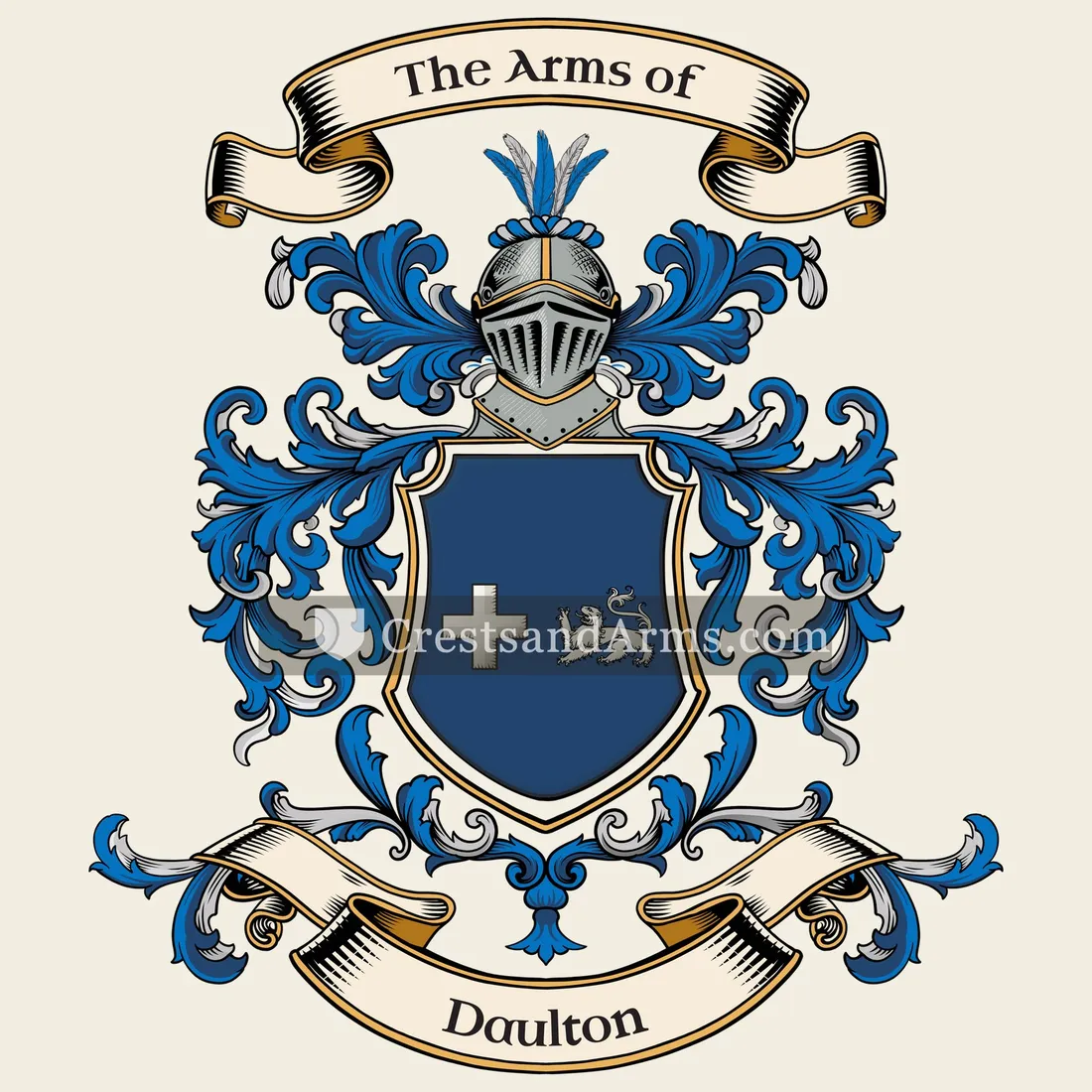


 fleur de lisPurity, light, and the sixth son