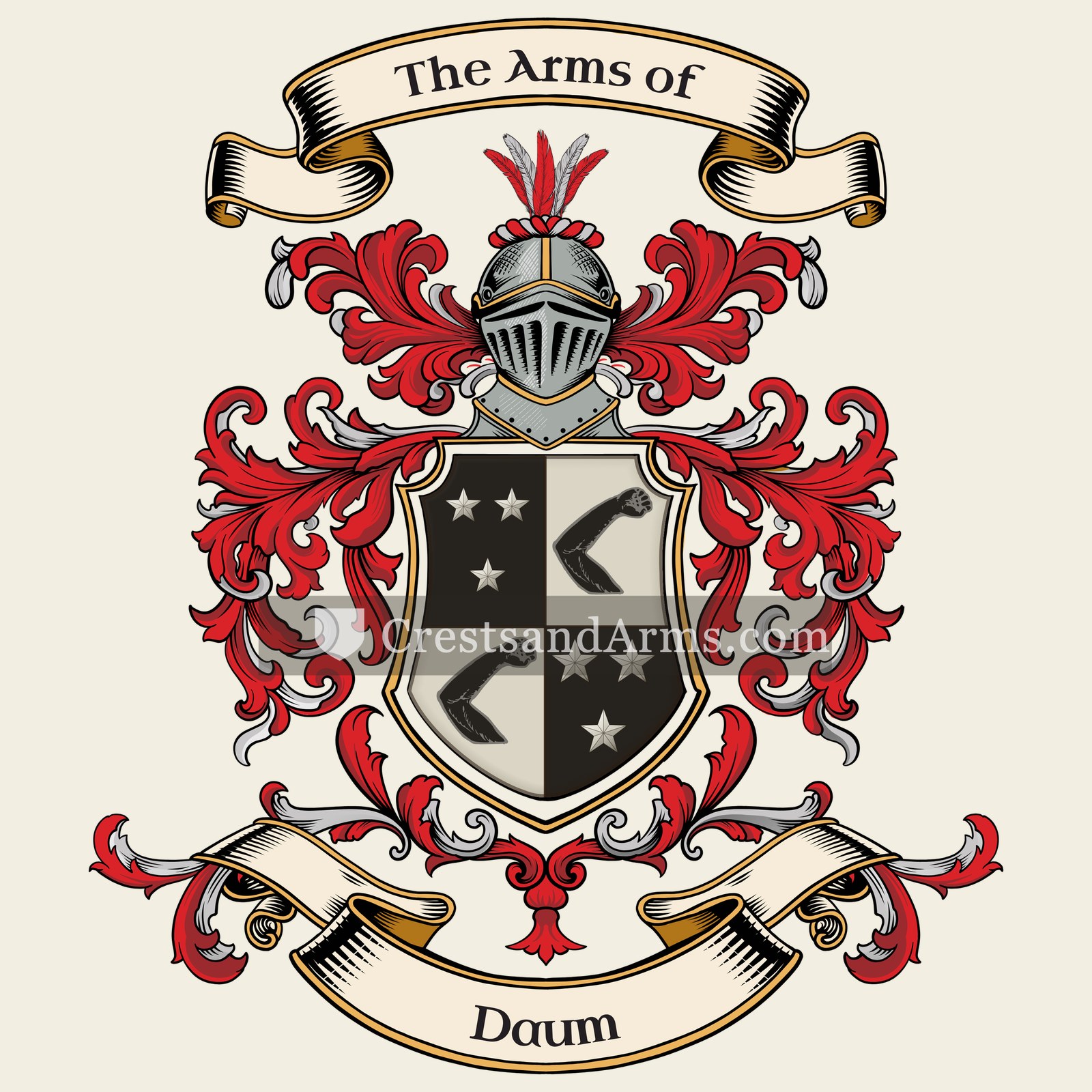
A record of documented arms, meaning and origin, researched for the Daum family of Germany.
Reg. 1197 · German, D–F
Coat of Arms & Family Crest Details
Symbols on this shield
mulletThe third son, and a divine quality from above
armA person of action, industrious and laborious
Colours
Black (Sable)Means: Constancy
Silver (Argent)Means: Peace and sincerity
Historical info
Source
J. B. Rietstap, Armorial Général, Gouda: G. B. van Goor Zonen, 1884–87
Blazon (the actual original written record)
“Ec.: aux 1 et 4 de sa. à trois étoiles d'arg., rangées en bande; aux 2 et 3 d'arg. au senestrochère, paré de gu., la main fermée de carn., le contour inférieur du bras orné de cinq pl. d'aut., alt. de gu. et d'arg. Sur le tout d'arg. au senestrochère, arm. au nat., la main de carn. empoignant un sabre d'arg., garni d'or. Deux cq. cour. C.: 1° le senestrochère du surtout; 1. d'arg. et de sa.; 2° cinq pl. d'aut., alt. de gu. et d'arg.; l. d'arg. et de gu.”
SaxonySaxony, c. 1658
Digital archive packCoat of arms PNG, gold border print PDF, vector SVG and the certificate of authenticity. Sent to your email in minutes.
Map of Germany showing where the Daum arms are recorded
The Daum arms were recorded in Saxony, c. 1658.
Saxony had mines, trade and old landed families all at once. Silver made some fortunes and land held others, and both sorts of family kept arms, which is why Saxon names appear so often in the registers.
This is where the arms were entered in the register. Families often moved to other parts of the country, so the same name can turn up in more than one region.
The body that granted and recorded arms in Germany in this period.
Leopold I, Holy Roman Emperor
Sovereign of the period
Leopold I, Holy Roman Emperor
1658–1705
Reigning in Germany when the Daum arms are first recorded.
How Arms Worked in Germany
In the Holy Roman Empire, coats of arms were often granted to individuals by the Emperor or his representatives. These arms were then passed down through the generations to all legitimate descendants of the original holder. Younger branches of a family usually kept the same shield design without needing to change it, as the arms belonged to the entire lineage.
Granting authority
The Holy Roman Emperor held the sole power to grant new coats of arms throughout his vast imperial territories.
How they got arms
Families typically obtained their coats of arms through a formal imperial grant or by proving their noble status to the authorities.
Where arms were recorded
These grants were officially recorded in the Imperial Chancery registers, which began keeping formal records of such honors during the Middle Ages.
The family's standing
Recorded among the armigerous families of Saxony.
Origin & History of the Daum Family in Germany
The family name Daum has deep roots in the German region of Saxony, where records confirm members of the family were established as early as 1658. The name itself is considered a topographic or descriptive surname, likely originating from the Middle High German word "dūme," which refers to a thumb. In medieval naming customs, such a name might have been a nickname for a person of short stature or perhaps someone who worked as a tailor or craftsman where the thumb played a vital role. As the family settled in Saxony, they became part of the local agricultural and artisan communities that defined the social structure of the seventeenth century. Over generations, the Daum family integrated into the regional culture, leaving behind a legacy tied to the evolving linguistic and social landscape of central Germany.
Daum Meaning & Related Branches
Root word
Dum
Old High German term referring to a cathedral or church building.
This name
DaumA topographic name for someone who lived near a cathedral or church.
also spelled
Daume
Daumm
Dom
Documented Sources
J. B. Rietstap, Armorial Général, Gouda: G. B. van Goor Zonen, 1884–87
Bahlow, Hans, Deutsches Namenlexikon: Familien- und Vornamen nach Ursprung und Sinn erklärt, 1967
Heintze, Albert, Die deutschen Familien-Namen: geschichtlich, geographisch, sprachlich, 1903
Sächsisches Staatsarchiv, Kirchenbücher der Evangelisch-Lutherischen Landeskirche Sachsens, 1658
Digital archive packCoat of arms PNG, gold border print PDF, vector SVG and the certificate of authenticity. Sent to your email in minutes.


 mulletThe third son, and a divine quality from above
 armA person of action, industrious and laborious
 mulletThe third son, and a divine quality from above
 armA person of action, industrious and laborious