A record of documented arms, meaning and origin, researched for the Dauwe family lines. Documented in 2 countries.
Reg. 4998 · French, D–F
Meaning of the Dauwe family crest colors & symbols
Symbols on this shield
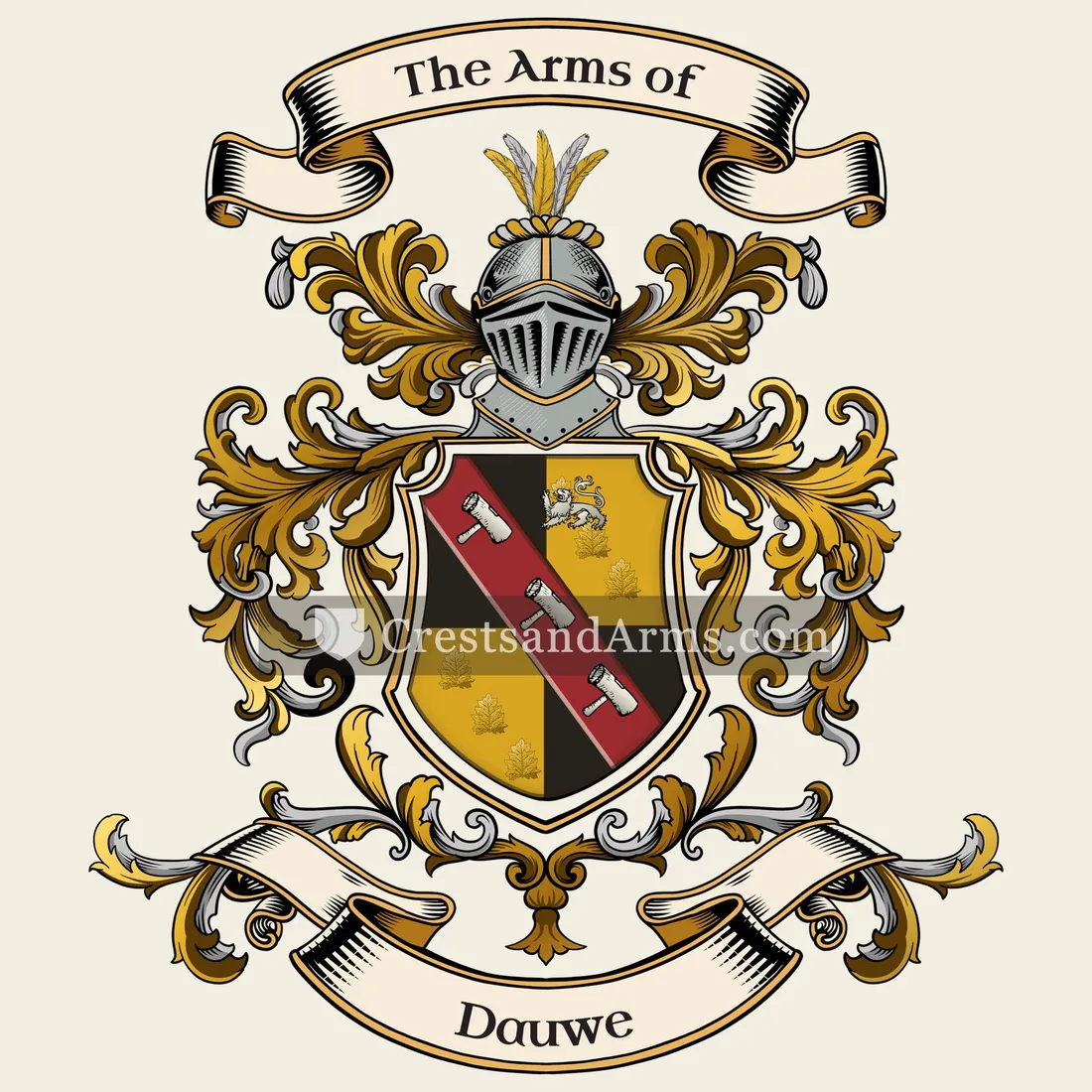
bendDefence, and the scarf of a commander
leafHappiness and abundance
hammerHonest labour, and the smith's craft
lionCourage, strength and royalty
Colours
Black (Sable)Means: Constancy
Gold (Or)Means: Generosity
Red (Gules)Means: Military strength
Silver (Argent)Means: Peace and sincerity
Historical info
Source
J. B. Rietstap, Armorial Général, Gouda: G. B. van Goor Zonen, 1884–87
Blazon (the actual original written record)
“Ec.: aux 1 et 4 de sa. à trois feuilles de rosier d'or, la tige en haut (Dauwe); aux 2 et 3 d'or à une bande de gu., ch. de trois maillets d'arg., posés dans le sens de la bande et acc. au canton sen. du chef d'un écusson de sa. au lion d'arg., arm., lamp. et cour. d'or (Heetvelde). Brl. de sa. et d'arg. C.: une feuille du 1, entre un vol de sa. L. de sa. et d'or.”
FlandreFlandre, c. 1663
Digital archive packCoat of arms PNG, gold border print PDF, vector SVG and the certificate of authenticity. Sent to your email in minutes.
Map of France showing where the Dauwe arms are recorded
The Dauwe arms were recorded in Flandre, c. 1663.
Flandre grew rich on cloth, and its towns were among the busiest in Europe. Merchant families bought land with their profits and took arms to go with it, so trade put as many names in the registers here as land did.
This is where the arms were entered in the register. Families often moved to other parts of the country, so the same name can turn up in more than one region.
The body that granted and recorded arms in France in this period.
Louis XIV of France
Sovereign of the period
Louis XIV of France
1643–1715
Reigning in France when the Dauwe arms are first recorded.
How Arms Worked in France
In France, a coat of arms was a mark of honor that passed down through the male line to all legitimate descendants. Families often used the same shield without changes to show their shared heritage. If a branch wanted to stand out, they could add a small mark to their shield to show their specific place in the family tree.
Granting authority
The Juge d'armes de France acted as the official authority that regulated and verified coats of arms across the country.
How they got arms
Families typically inherited their arms from ancestors, though they could also receive them through royal grants or by proving their noble status.
Where arms were recorded
Coats of arms were officially recorded in the Armorial Général de France, which began its main collection in the year 1696.
The family's standing
Recorded among the armigerous families of Flandre.
Origin & History of the Dauwe Family in France
The family name Dauwe finds its roots in the historical region of Flanders, a territory that shared deep cultural and linguistic ties with northern France during the seventeenth century. By 1663, records confirm that members of the Dauwe family were established in this area, which was a crossroads for trade and agriculture. The name itself is thought to be a variation of the personal name Dodo or a derivative of the Germanic word for "people," reflecting the common practice of the time to adopt names based on local heritage or ancestral nicknames. Because this region frequently shifted between French and Flemish administrative control, families like the Dauwes often navigated a blend of linguistic traditions. Their presence in the historical record during this era highlights a lineage deeply connected to the rural life and local governance of the borderlands between France and the Low Countries.
Meaning of the Dauwe family crest colors & symbols
Symbols on this shield
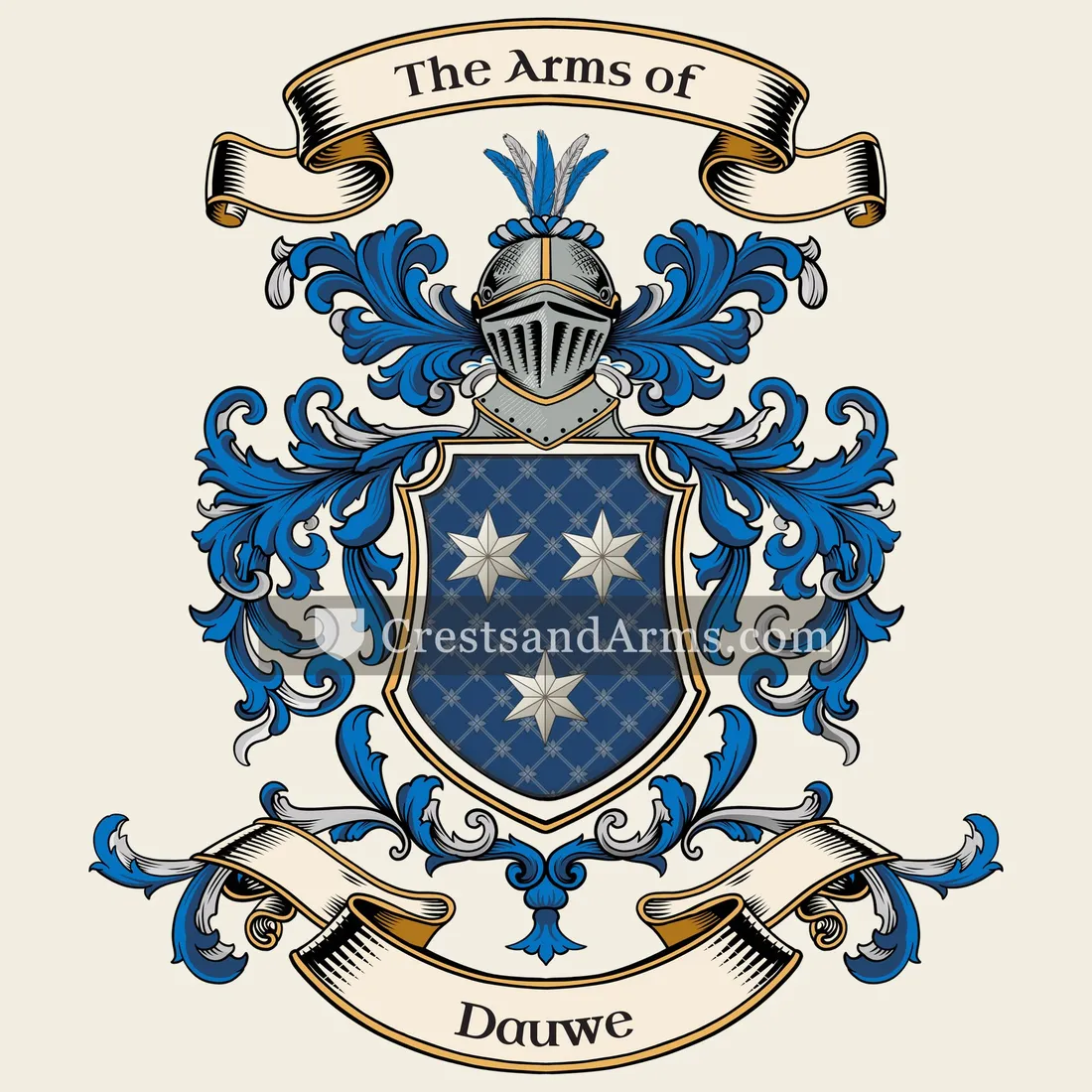
starThe celestial goddess, and nobility
Colours
Blue (Azure)Means: Loyalty and truth
Silver (Argent)Means: Peace and sincerity
Historical info
Source
J. B. Rietstap, Armorial Général, Gouda: G. B. van Goor Zonen, 1884–87
Blazon (the actual original written record)
“D'azur à trois étoiles d'arg. C.: un vol aux armes de l'écu.”
WestphaliaWestphalia, c. 1765
Digital archive packCoat of arms PNG, gold border print PDF, vector SVG and the certificate of authenticity. Sent to your email in minutes.
Map of Germany showing where the Dauwe arms are recorded
The Dauwe arms were recorded in Westphalia, c. 1765.
Westphalia was a land of small estates and fortified farmhouses in western Germany. Its families were numerous and not especially rich, but each held its own ground, and holding ground was what brought arms.
This is where the arms were entered in the register. Families often moved to other parts of the country, so the same name can turn up in more than one region.
The body that granted and recorded arms in Germany in this period.
Francis I, Holy Roman Emperor
Sovereign of the period
Francis I, Holy Roman Emperor
1745–1765
Reigning in France when the Dauwe arms are first recorded.
How Arms Worked in Germany
In the Holy Roman Empire, coats of arms were often granted to individuals by the Emperor or his representatives. These arms were then passed down through the generations to all legitimate descendants of the original holder. Younger branches of a family usually kept the same shield design without needing to change it, as the arms belonged to the entire lineage.
Granting authority
The Holy Roman Emperor held the sole power to grant new coats of arms throughout his vast imperial territories.
How they got arms
Families typically obtained their coats of arms through a formal imperial grant or by proving their noble status to the authorities.
Where arms were recorded
These grants were officially recorded in the Imperial Chancery registers, which began keeping formal records of such honors during the Middle Ages.
The family's standing
Recorded among the armigerous families of Westphalia.
Origin & History of the Dauwe Family in Germany
The family name Dauwe has deep roots in the Westphalia region of Germany, where records confirm members of the family were established by 1765. During this period, Westphalia was a landscape defined by small farming communities and a growing transition toward industrial development. The name itself likely originated as a variation of regional naming customs, possibly derived from local nicknames or shortened versions of traditional Germanic given names. Families in this area often lived in rural parishes where their daily lives revolved around the agricultural cycles of the land. As the eighteenth century progressed, the Dauwe family was part of a stable social structure that relied on local church records to track births, marriages, and deaths. These early ancestors were likely craftsmen or landholders who contributed to the steady growth of the Westphalian population during a time of significant change in the German states.
Dauwe Meaning & Related Branches
Root word
Dodo
A Germanic personal name derived from the word for rounded or plump.
This name
DauweA patronymic surname indicating descent from a person originally named Dodo.
also spelled
Dauw
Dauwee
Dowe
Related arms
Dauwvariant spelling
Documented Sources
J. B. Rietstap, Armorial Général, Gouda: G. B. van Goor Zonen, 1884–87
Debrabandere, Frans. Woordenboek van de familienamen in België en Noord-Frankrijk. 2003
Archives départementales du Nord. Registres paroissiaux et d'état civil. 1663
Digital archive packCoat of arms PNG, gold border print PDF, vector SVG and the certificate of authenticity. Sent to your email in minutes.


 bendDefence, and the scarf of a commander
 leafHappiness and abundance
 hammerHonest labour, and the smith's craft
 lionCourage, strength and royalty
 bendDefence, and the scarf of a commander
 leafHappiness and abundance
 hammerHonest labour, and the smith's craft
 lionCourage, strength and royalty


 starThe celestial goddess, and nobility