A record of documented arms, meaning and origin, researched for the David family lines. Documented in 3 countries.
Reg. 4388 · Belgian, D–F
Meaning of the David family crest colors & symbols
Symbols on this shield
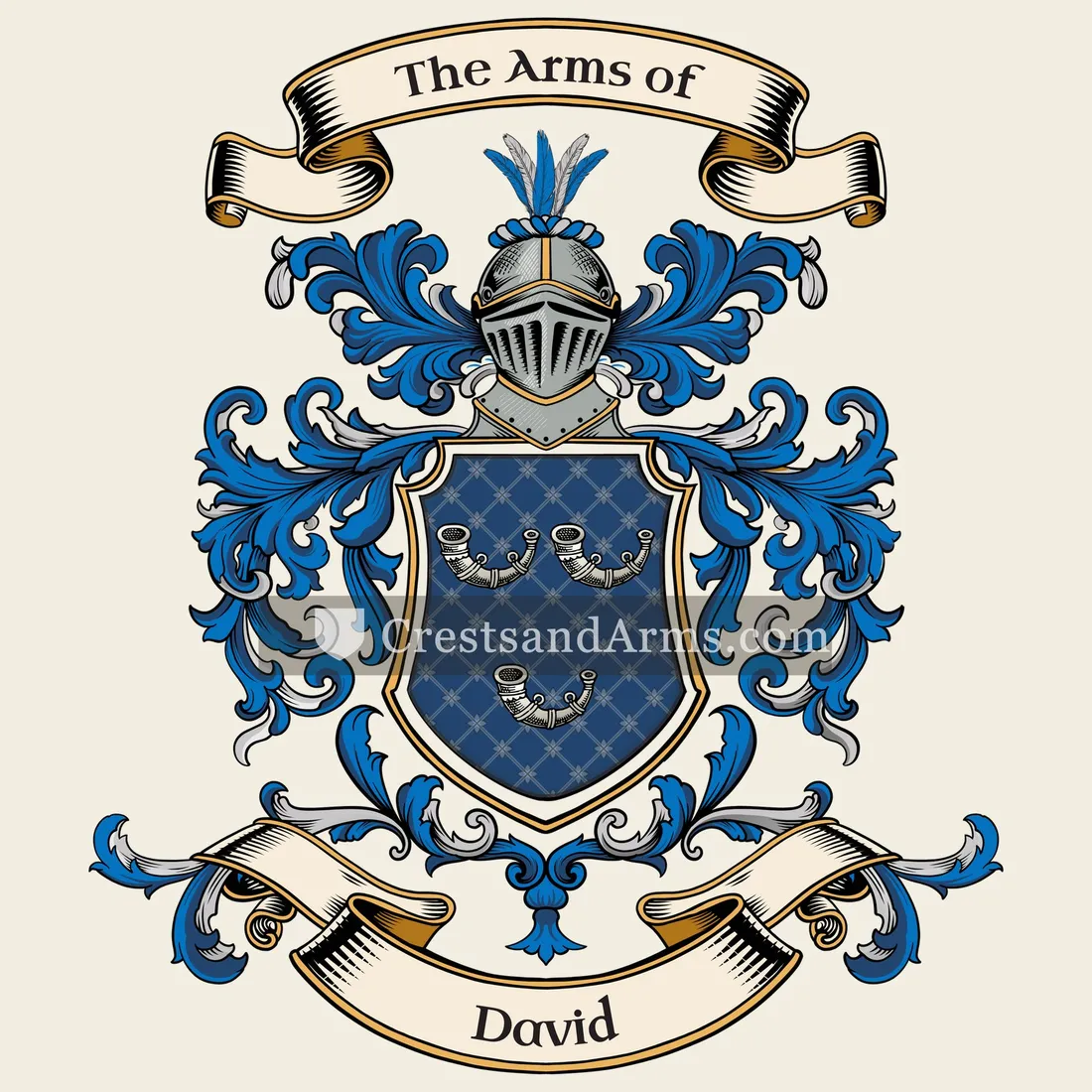
hunting horn stringedOne who delights in the chase
Colours
Blue (Azure)Means: Loyalty and truth
Silver (Argent)Means: Peace and sincerity
Historical info
Source
J. B. Rietstap, Armorial Général, Gouda: G. B. van Goor Zonen, 1884–87
Blazon (the actual original written record)
“D'azur à trois cors-de-chasse d'arg., liés, vir. et eng. d'or [Armes du peintre célèbre Gérard David, né à Oudewater, en Hollande, décédé le 13 août 1523.]”
BelgiumBruges, c. 1737
Digital archive packCoat of arms PNG, gold border print PDF, vector SVG and the certificate of authenticity. Sent to your email in minutes.
Map of Belgium showing where the David arms are recorded
The David arms were recorded in Bruges, c. 1737.
This is where the arms were entered in the register. Families often moved to other parts of the country, so the same name can turn up in more than one region.
The body that granted and recorded arms in Belgium in this period.
Charles VI, Holy Roman Emperor
Sovereign of the period
Charles VI, Holy Roman Emperor
1711–1740
Reigning in Belgium when the David arms are first recorded.
How Arms Worked in Belgium
In Belgium, a coat of arms is considered personal property that is passed down through the male line to legitimate descendants. Families often use the same shield design across generations to show their shared heritage. If a branch of the family wants to change the design, they must apply for an official update to their specific version of the arms.
Granting authority
The Conseil héraldique is the official body that regulates and approves all coats of arms in Belgium.
How they got arms
Families obtain their coats of arms through formal royal grants or by confirming their historical right to use existing designs.
Where arms were recorded
All approved coats of arms are officially recorded in the public registers of the Conseil héraldique since 1844.
The family's standing
Recorded among the armigerous families of Belgium.
Origin & History of the David Family in Belgium
The history of the David family in Belgium is deeply rooted in the vibrant urban culture of the eighteenth century, particularly within the city of Bruges. By 1737, records confirm that members of the family were already established residents, participating in the daily life and social structures of this historic trading hub. The name David itself is a patronymic, meaning it was originally adopted to honor an ancestor who bore the biblical name. In the context of Flanders, families often solidified their surnames during this era as local governments began to keep more formal registers of births, marriages, and deaths. As the David family settled into the economic landscape of Bruges, they became part of the long tradition of Flemish craftsmanship and civic engagement that defined the region. Their presence in the city during this time reflects the broader movement of families who helped maintain the stability and growth of Belgian urban centers throughout the Enlightenment period.
Meaning of the David family crest colors & symbols
Symbols on this shield
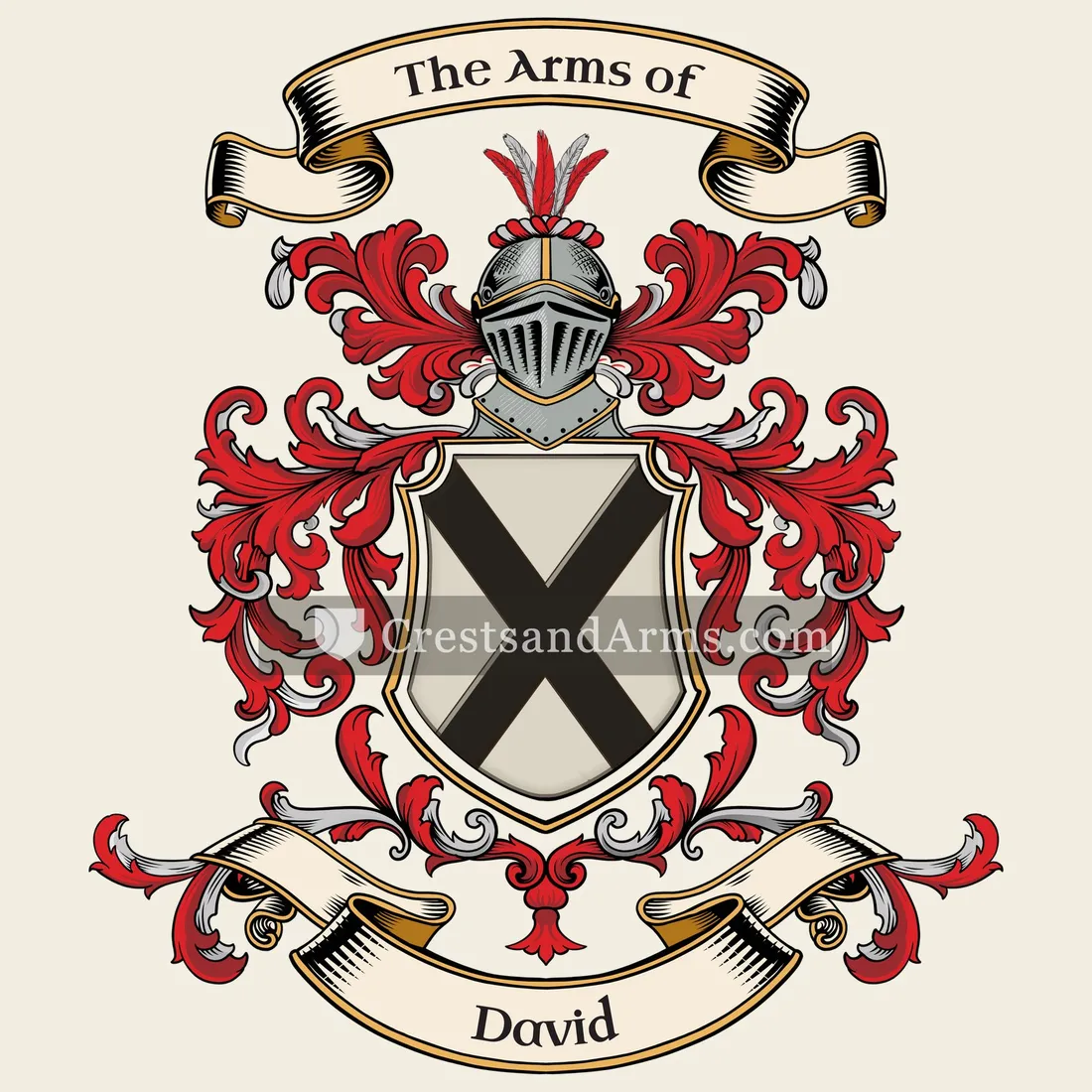
saltireResolution, and St Andrew's cross
Colours
Silver (Argent)Means: Peace and sincerity
Black (Sable)Means: Constancy
Historical info
Source
J. B. Rietstap, Armorial Général, Gouda: G. B. van Goor Zonen, 1884–87
Blazon (the actual original written record)
“D'arg. au saut. engr. de sa. ou de gu.”
FranceSalins Franche-Comté, c. 1504
Digital archive packCoat of arms PNG, gold border print PDF, vector SVG and the certificate of authenticity. Sent to your email in minutes.
Map of France showing where the David arms are recorded
The David arms were recorded in Salins Franche-Comté, c. 1504.
This is where the arms were entered in the register. Families often moved to other parts of the country, so the same name can turn up in more than one region.
The body that granted and recorded arms in France in this period.
Louis XII of France
Sovereign of the period
Louis XII of France
1498–1515
Reigning in Belgium when the David arms are first recorded.
How Arms Worked in France
In France, a coat of arms was a mark of honor that passed down through the male line to all legitimate descendants. Families often used the same shield without changes to show their shared heritage. If a branch wanted to stand out, they could add a small mark to their shield to show their specific place in the family tree.
Granting authority
The Juge d'armes de France acted as the official authority that regulated and verified coats of arms across the country.
How they got arms
Families typically inherited their arms from ancestors, though they could also receive them through royal grants or by proving their noble status.
Where arms were recorded
Coats of arms were officially recorded in the Armorial Général de France, which began its main collection in the year 1696.
The family's standing
Recorded among the armigerous families of France.
Origin & History of the David Family in France
The family name David has deep roots in the Franche-Comté region of eastern France, where records confirm members of the family were established in the town of Salins by the year 1504. During this period, Salins was a prominent center for salt production, which brought significant wealth and regional importance to the local population. Families living in this area often held roles related to the salt trade or local administration, placing them at the heart of the town’s economic life. As the name David is derived from the ancient Hebrew name meaning beloved, it became a popular choice throughout France due to the widespread influence of the Bible. In the context of Salins, the family likely integrated into the social fabric of the town as it transitioned through the complex political shifts between the Holy Roman Empire and the French crown. By maintaining a presence in such a vital industrial hub, the early David family contributed to the long-standing history of the Jura region.
Meaning of the David family crest colors & symbols
Colours
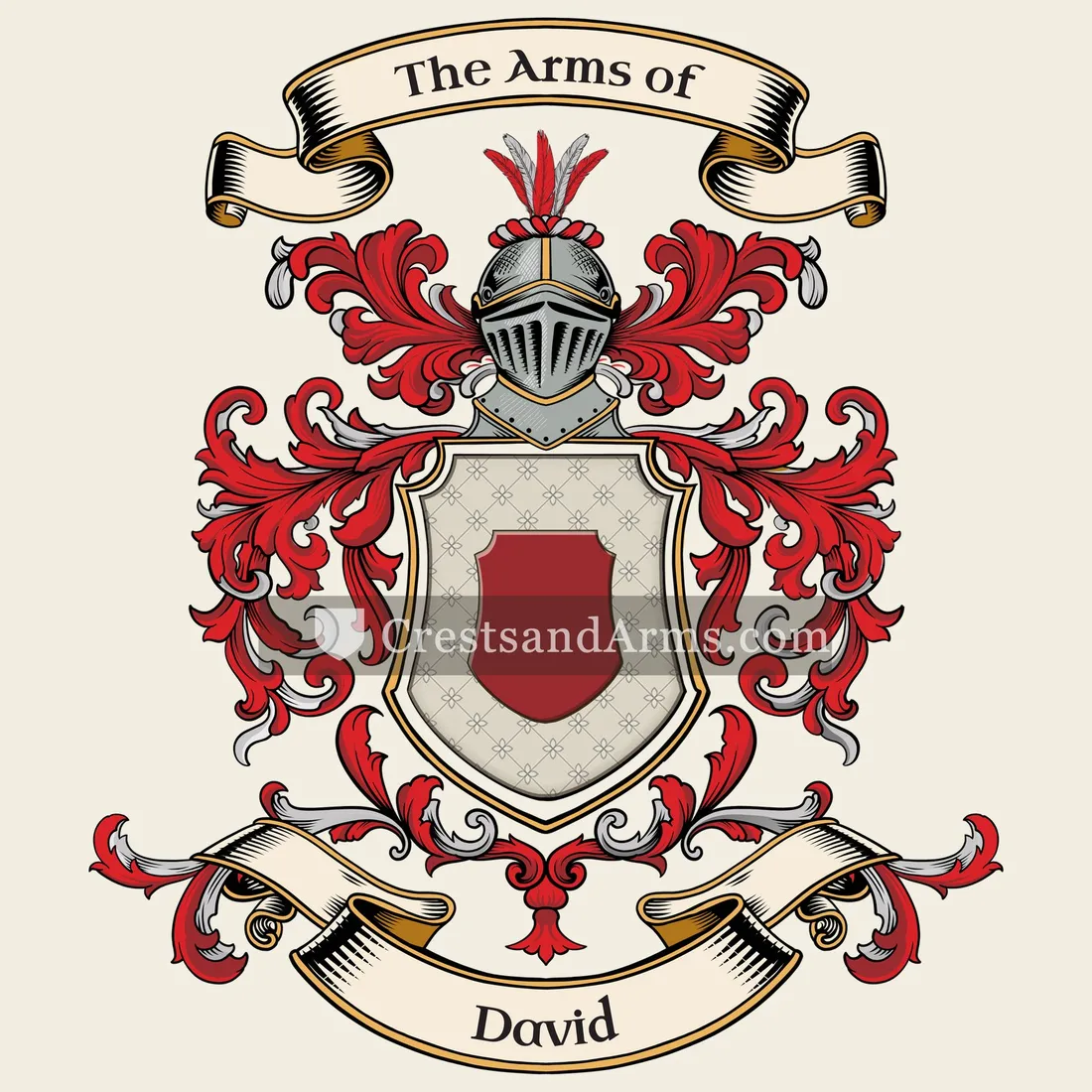
Silver (Argent)Means: Peace and sincerity
Red (Gules)Means: Military strength
Historical info
Source
Sir Bernard Burke, The General Armory of England, Scotland, Ireland and Wales, London: Harrison & Sons, 1884
Blazon (the actual original written record)
“Ar. an inescutcheon gu. within a double tressure flory counter-flory of the second”
Walesc. 1647
Digital archive packCoat of arms PNG, gold border print PDF, vector SVG and the certificate of authenticity. Sent to your email in minutes.
Map of Wales showing where the David arms are recorded
The David arms were recorded in Wales, c. 1647.
Arms such as these were typically recorded in Denbigh.
Denbighshire was north Welsh country of hills and small estates. Land was held by a great many families rather than a few, and each holding brought its own claim to a coat of arms.
This is where the arms were entered in the register. Families often moved to other parts of the country, so the same name can turn up in more than one region.
The body that granted and recorded arms in Wales in this period.
Charles I of England
Sovereign of the period
Charles I of England
1625–1649
Reigning in Belgium when the David arms are first recorded.
How Arms Worked in Wales
English heraldry allowed arms to be shared by all legitimate descendants of the original owner. These symbols were treated as personal property that moved through the generations to all children. While the eldest son kept the original design, other family members could use the same shield without needing to change it or register their own unique versions.
Granting authority
The College of Arms in London has regulated the use of coats of arms throughout England and Wales since 1484.
How they got arms
Families typically obtained their coats of arms through a formal grant from the Crown or by proving their ancient right to them.
Where arms were recorded
All official coats of arms are recorded in the registers kept at the College of Arms, which date back to the fifteenth century.
The family's standing
Recorded among the armigerous families of Wales.
Origin & History of the David Family in Wales
The surname David originates from the ancient Hebrew name meaning beloved, which gained immense popularity in Wales due to the deep reverence for Saint David, the patron saint of the country. In the Welsh tradition, surnames were not used in the modern sense for many centuries. Instead, people followed the patronymic system where a person was identified by their father’s name, often connected by the word ap. By the time the family was established in Denbigh in 1647, the influence of English administrative practices had encouraged many Welsh families to adopt fixed surnames. This transition often involved dropping the ap and simply adopting the father's given name as a permanent family title. Living in Denbigh during the mid-seventeenth century placed the family in a region defined by its strategic importance and its history of shifting cultural boundaries between the Welsh heartland and the English borderlands.
David Meaning & Related Branches
Root word
Dawid
Derived from the Hebrew word for beloved or friend.
This name
DavidA classic biblical name signifying a cherished or well-loved individual.
also spelled
Davyd
Davitt
Related arms
Hornsimilar arms
Malezieuxsimilar arms
Coquelinrecorded with David, same area
Merceretrecorded with David, same area
Documented Sources
J. B. Rietstap, Armorial Général, Gouda: G. B. van Goor Zonen, 1884–87
Stadsarchief Brugge, Parochieregisters van Brugge
Vandenbussche, L., Brugge in de 18e eeuw: Een sociaal-economische geschiedenis, 1985
Digital archive packCoat of arms PNG, gold border print PDF, vector SVG and the certificate of authenticity. Sent to your email in minutes.


 hunting horn stringedOne who delights in the chase
 hunting horn stringedOne who delights in the chase


 saltireResolution, and St Andrew's cross