Map of Belgium showing where the Davidescu arms are recorded
The Davidescu arms were recorded in Brabant, c. 1737.
Brabant lay at the heart of the Low Countries, where the trade routes met. Its towns were wealthy and its landowners many, and both kinds of family kept arms, which is why the region is so heavily represented.
This is where the arms were entered in the register. Families often moved to other parts of the country, so the same name can turn up in more than one region.
The body that granted and recorded arms in Belgium in this period.
Charles VI, Holy Roman Emperor
Sovereign of the period
Charles VI, Holy Roman Emperor
1711–1740
Reigning in Belgium when the Davidescu arms are first recorded.
How Arms Worked in Belgium
In Belgium, a coat of arms is considered personal property that is passed down through the male line to legitimate descendants. Families often use the same shield design across generations to show their shared heritage. If a branch of the family wants to change the design, they must apply for an official update to their specific version of the arms.
Granting authority
The Conseil héraldique is the official body that regulates and approves all coats of arms in Belgium.
How they got arms
Families obtain their coats of arms through formal royal grants or by confirming their historical right to use existing designs.
Where arms were recorded
All approved coats of arms are officially recorded in the public registers of the Conseil héraldique since 1844.
The family's standing
Recorded among the armigerous families of Brabant.
Origin & History of the Davidescu Family in Belgium
The family name Davidescu traces its roots to a period of significant movement and cultural integration across Europe. By the year 1737, records confirm that early members of the family were established in the region of Brabant. This area, which spans parts of modern-day Belgium and the Netherlands, served as a vital crossroads for trade and migration during the eighteenth century. The name itself follows a naming tradition common in Eastern Europe, where the suffix "-escu" typically indicates a patronymic origin, meaning "son of David." While the family was clearly active in the Low Countries by the mid-1700s, this linguistic structure suggests that their ancestors likely migrated from further east before settling into the social and economic life of Brabant. This transition highlights how families often moved across borders to find new opportunities while maintaining their unique cultural identity through their surnames.
Davidescu Meaning & Related Branches
Root word
David
Hebrew name meaning beloved or friend.
This name
DavidescuA Romanian patronymic surname indicating descent from a person named David.
also spelled
Davidtz
Davits
Davidt
Documented Sources
J. B. Rietstap, Armorial Général, Gouda: G. B. van Goor Zonen, 1884–87
Algemeen Rijksarchief (General State Archives of Belgium), Parochieregisters van Brabant (Parish Registers of Brabant)
Nationaal Archief (National Archives of the Netherlands), Collectie van de Raad van Brabant (Collection of the Council of Brabant)
Iordan, Iorgu, Dicționarul numelor de familie românești (Dictionary of Romanian Family Names), 1983
Pirenne, Henri, Histoire de Belgique (History of Belgium), 1902
Digital archive packCoat of arms PNG, gold border print PDF, vector SVG and the certificate of authenticity. Sent to your email in minutes.


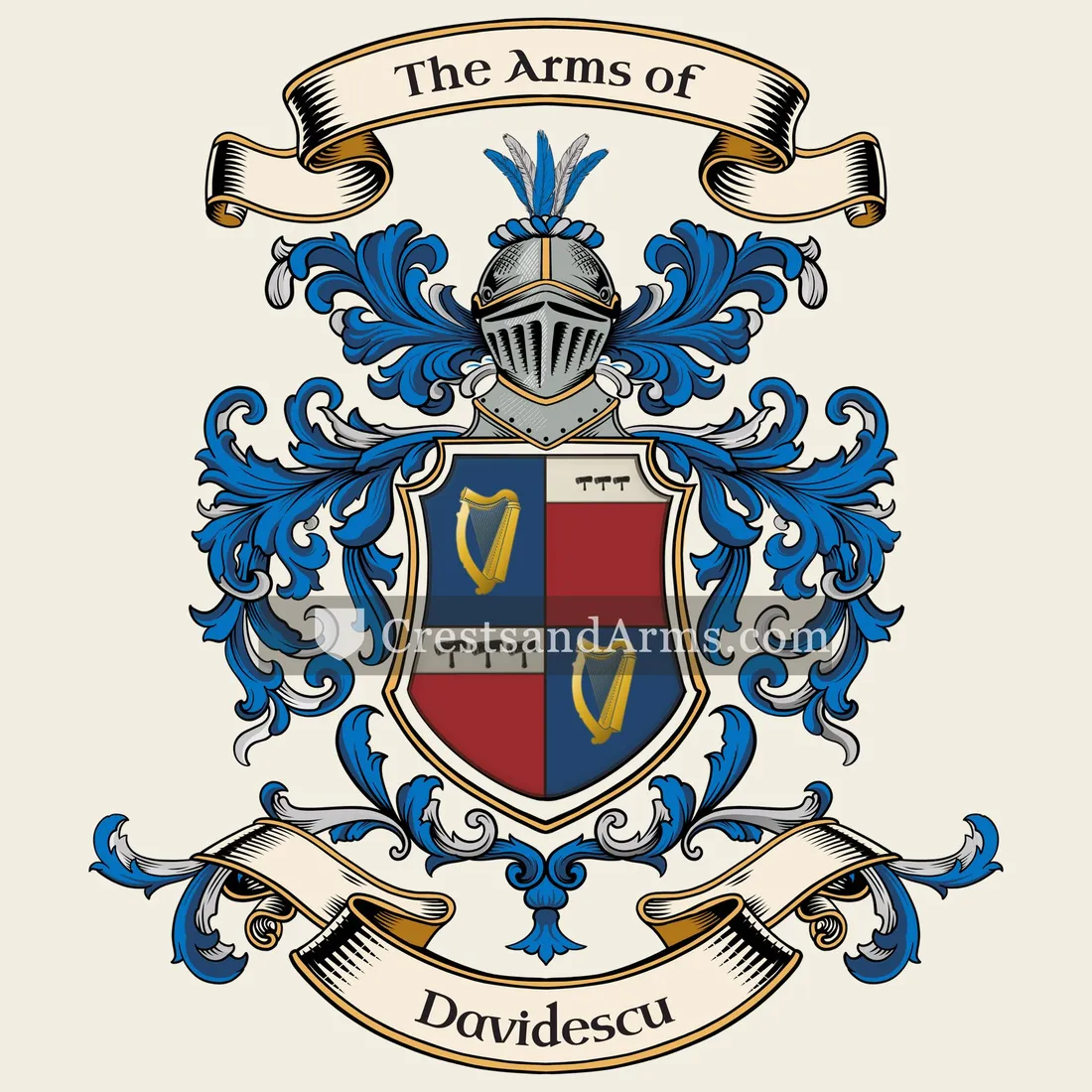
 chiefAuthority, wisdom and dominion
 harpWell-tuned governance and love of music
 hammerHonest labour, and the smith's craft
 chiefAuthority, wisdom and dominion
 harpWell-tuned governance and love of music
 hammerHonest labour, and the smith's craft