A record of documented arms, meaning and origin, researched for the Davy family lines. Documented in 2 countries.
Reg. 4860 · Britain, D–F
Coat of Arms & Family Crest Details
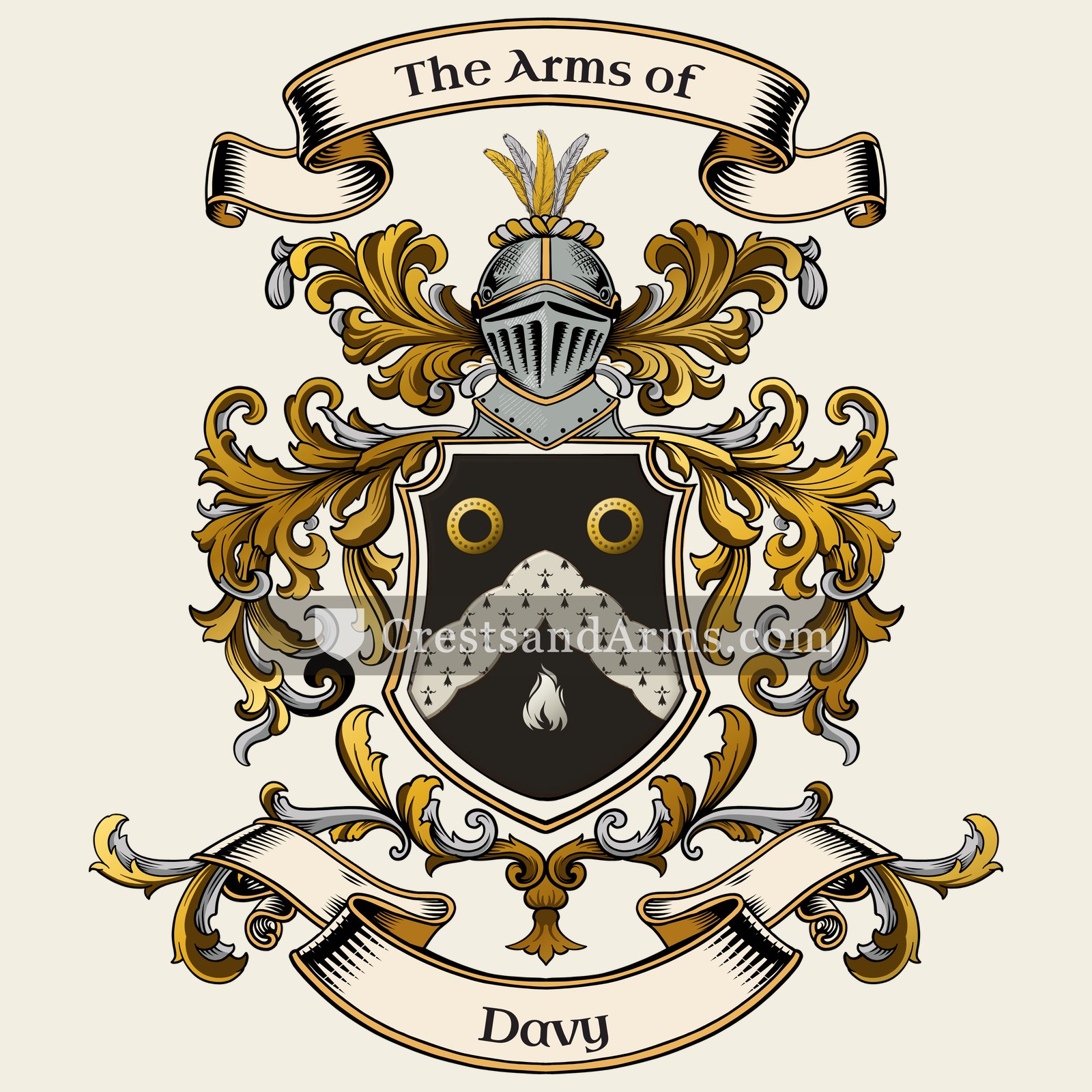
Symbols on this shield
chevronProtection, and faithful service completed
ringFidelity, and a promise kept
fireZeal and purification
Colours
Black (Sable)Means: Constancy
ErmineMeans: Dignity
Gold (Or)Means: Generosity
Historical info
Source
J. B. Rietstap, Armorial Général, Gouda: G. B. van Goor Zonen, 1884–87
Blazon (the actual original written record)
“De sa. au chev. engr. d'herm., acc. en chef de deux annelets d'or et en p. d'une flamme au nat., mouv. d'une couronne de laurier d'or en fasce et entouré d'une chaîne du même, courbée en demi-cercle. C.: une tête d'éléphant de sa., oreillée d'or, défendue d'arg., coll. d'une couronne d'or, attachée à la proboscide au moyen d'une chaîne d'or; le tout soutenu d'une couronne civique d'or. D.: IGNE CONSTRICTO VITA SECURA [Armes du célèbre savant, sir Humphrey Davy.]”
BritainLondres, c. 1818
Digital archive packCoat of arms PNG, gold border print PDF, vector SVG and the certificate of authenticity. Sent to your email in minutes.
Map of Britain showing where the Davy arms are recorded
The Davy arms were recorded in Londres, c. 1818.
Arms such as these were typically recorded in Kent.
Kent sits between London and the short crossing to Europe, and the trade passing through made it wealthy. Merchant families bought land with that money, and it was landowners who took coats of arms.
This is where the arms were entered in the register. Families often moved to other parts of the country, so the same name can turn up in more than one region.
The body that granted and recorded arms in Britain in this period.
George III of Great Britain
Sovereign of the period
George III of Great Britain
1801–1820
Reigning in Britain when the Davy arms are first recorded.
How Arms Worked in Britain
English heraldry allowed arms to be shared by all legitimate descendants of the original owner. These symbols were treated as personal property that moved through the generations to all children. While the eldest son kept the original design, other family members could use the same shield without needing to change it or register their own unique versions.
Granting authority
The College of Arms in London has regulated the use of coats of arms throughout England and Wales since 1484.
How they got arms
Families typically obtained their coats of arms through a formal grant from the Crown or by proving their ancient right to them.
Where arms were recorded
All official coats of arms are recorded in the registers kept at the College of Arms, which date back to the fifteenth century.
The family's standing
Recorded among the armigerous families of Britain.
Origin & History of the Davy Family in Britain
The surname Davy is a patronymic name, which means it originated as a way to identify a person as the son or descendant of someone named David. This name became popular across Britain following the arrival of the Normans, who brought the name David from the continent. Over many centuries, the name evolved into various spellings like Davey, Davie, and Davy as it spread through different regions. By the early 19th century, families carrying this name were well-established in the county of Kent. These early ancestors likely worked in agriculture or local trades, contributing to the steady growth of the name within the rural communities of southern England. Their presence in Kent by 1818 reflects a long history of families settling into specific counties and building lives through generations of local work and community involvement.
Coat of Arms & Family Crest Details
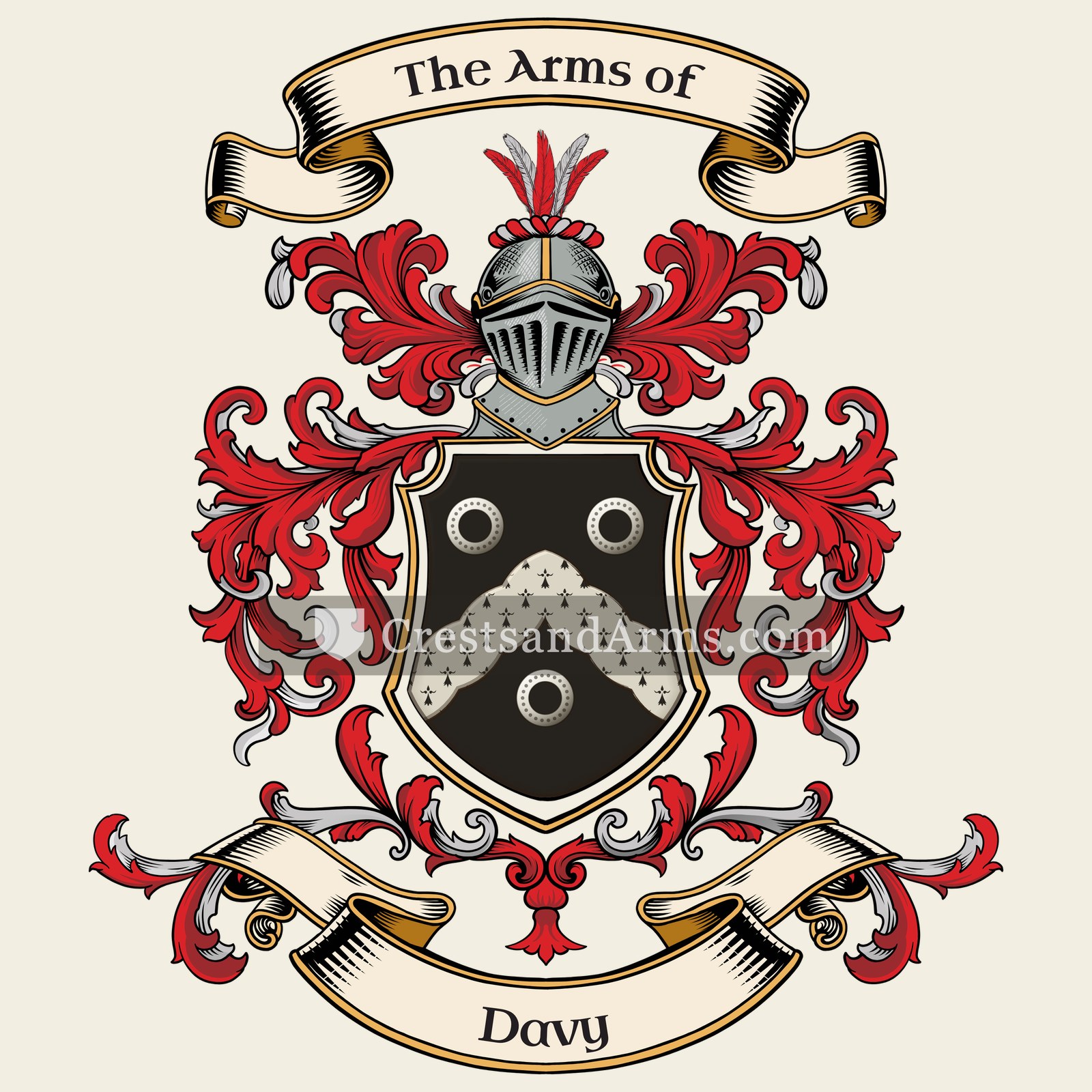
Symbols on this shield
chevronProtection, and faithful service completed
ringFidelity, and a promise kept
Colours
Black (Sable)Means: Constancy
ErmineMeans: Dignity
Silver (Argent)Means: Peace and sincerity
Historical info
Source
Sir Bernard Burke, The General Armory of England, Scotland, Ireland and Wales, London: Harrison & Sons, 1884
Blazon (the actual original written record)
“Sa. a chev. engr. erm. betw. three annulets ar”
NorfolkIngoldsthorpe · Norfolk, c. 1485
Digital archive packCoat of arms PNG, gold border print PDF, vector SVG and the certificate of authenticity. Sent to your email in minutes.
Map of England showing where the Davy arms are recorded
The Davy arms were recorded in Norfolk, c. 1485.
Norfolk grew rich on wool and grain, and its wealth was spread among many middling families rather than a few great ones. Households of that kind bought land and took arms, and the county holds a large share of English names.
This is where the arms were entered in the register. Families often moved to other parts of the country, so the same name can turn up in more than one region.
The body that granted and recorded arms in England in this period.
Richard III of England
Sovereign of the period
Richard III of England
1483–1485
Reigning in Britain when the Davy arms are first recorded.
How Arms Worked in England
English heraldry allowed arms to be shared by all legitimate descendants of the original owner. These symbols were treated as personal property that moved through the generations to all children. While the eldest son kept the original design, other family members could use the same shield without needing to change it or register their own unique versions.
Granting authority
The College of Arms in London has regulated the use of coats of arms throughout England and Wales since 1484.
How they got arms
Families typically obtained their coats of arms through a formal grant from the Crown or by proving their ancient right to them.
Where arms were recorded
All official coats of arms are recorded in the registers kept at the College of Arms, which date back to the fifteenth century.
The family's standing
Recorded among the armigerous families of Norfolk.
Origin & History of the Davy Family in England
The surname Davy traces its roots to the medieval period as a patronymic name, meaning it was derived from the given name David. In England, the name became popular following the Norman Conquest, as David was a name associated with both biblical history and the patron saint of Wales. By the late fifteenth century, the family had established a notable presence in the county of Norfolk. Records from 1485 confirm that members of the Davy family were active in this region during a time of significant political transition in England. As the name spread through rural and urban communities, it evolved into various spellings based on local dialects and the way clerks recorded names in parish registers. These early ancestors were often involved in local trade and agriculture, which helped the family name persist and grow across the English countryside over the following centuries.
Davy Meaning & Related Branches
Root word
Daw
A medieval diminutive form of the Hebrew name David meaning beloved.
This name
DavyA patronymic surname meaning son of the beloved one.
also spelled
Davie
Davee
Davey
Daivey
Davies
Related arms
Eviassimilar arms
Daviavariant spelling
Davievariant spelling
Davie de Creedyvariant spelling
Documented Sources
J. B. Rietstap, Armorial Général, Gouda: G. B. van Goor Zonen, 1884–87
Reaney, P.H., A Dictionary of English Surnames, 1958
Cottle, Basil, The Penguin Dictionary of Surnames, 1967
The National Archives, Census records for the county of Kent, HO 107
Digital archive packCoat of arms PNG, gold border print PDF, vector SVG and the certificate of authenticity. Sent to your email in minutes.


 chevronProtection, and faithful service completed
 ringFidelity, and a promise kept
 fireZeal and purification
 chevronProtection, and faithful service completed
 ringFidelity, and a promise kept
 fireZeal and purification