Map of England showing where the Day arms are recorded
The Day arms were recorded in London, c. 1582.
This is where the arms were entered in the register. Families often moved to other parts of the country, so the same name can turn up in more than one region.
The body that granted and recorded arms in England in this period.
Elizabeth I of England
Sovereign of the period
Elizabeth I of England
1558–1603
Reigning in England when the Day arms are first recorded.
How Arms Worked in England
English heraldry allowed arms to be shared by all legitimate descendants of the original owner. These symbols were treated as personal property that moved through the generations to all children. While the eldest son kept the original design, other family members could use the same shield without needing to change it or register their own unique versions.
Granting authority
The College of Arms in London has regulated the use of coats of arms throughout England and Wales since 1484.
How they got arms
Families typically obtained their coats of arms through a formal grant from the Crown or by proving their ancient right to them.
Where arms were recorded
All official coats of arms are recorded in the registers kept at the College of Arms, which date back to the fifteenth century.
The family's standing
Recorded among the armigerous families of England.
Origin & History of the Day Family in England
The surname Day has deep roots in England, where it emerged as a descriptive name long before the sixteenth century. It likely originated as a nickname for someone who worked during the daylight hours or perhaps as a shortened version of the Old English name Daeg. By the time records confirm the presence of the family in London in 1582, the name was already well-established across various social classes. During this period, London was a bustling center of trade and migration, and families named Day were often involved in the city’s growing merchant and craft guilds. These early ancestors lived through a time of significant cultural change, as the English language evolved and the city expanded rapidly. Because the name is tied to common daily life, it reflects the experiences of ordinary people who helped build the foundations of urban English society.
Coat of Arms & Family Crest Details
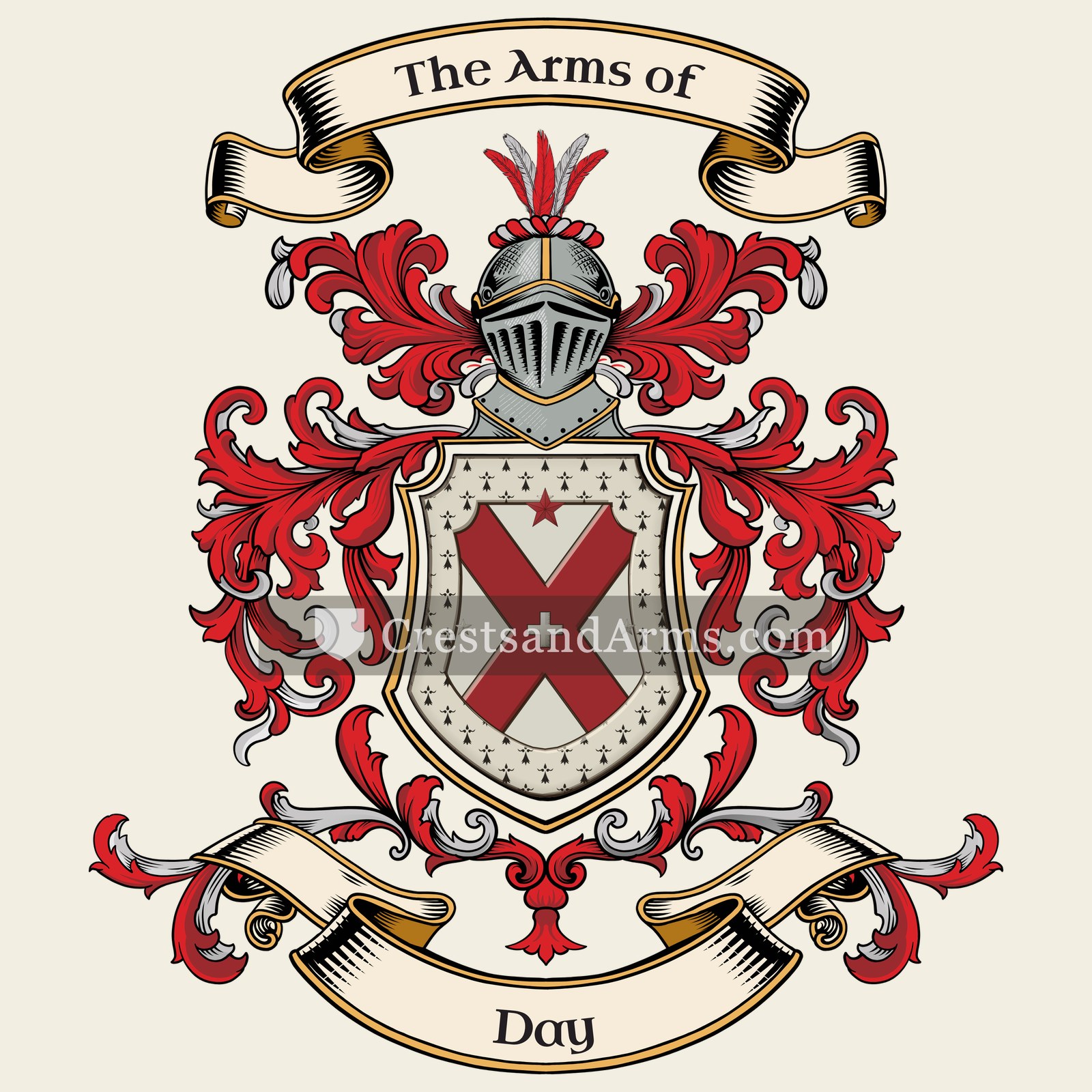
Symbols on this shield
saltireResolution, and St Andrew's cross
cross symbolChristian faith and service
bordureA difference between branches of one family
mulletThe third son, and a divine quality from above
Colours
Red (Gules)Means: Military strength
ErmineMeans: Dignity
Silver (Argent)Means: Peace and sincerity
Historical info
Source
Sir Bernard Burke, The General Armory of England, Scotland, Ireland and Wales, London: Harrison & Sons, 1884
Blazon (the actual original written record)
“Quarterly, 1st and 4th, per chev. or and az. three mullets counterchanged, in the centre chief point a mullet gu. for diff., for Day; 2nd and 3rd, erm. on a saltier gu. a cross formée ar. the whole within a bordure gobony erm. and az., for Fitzgerald”
KerryFitzgerald-Day · Kerry, c. 1841
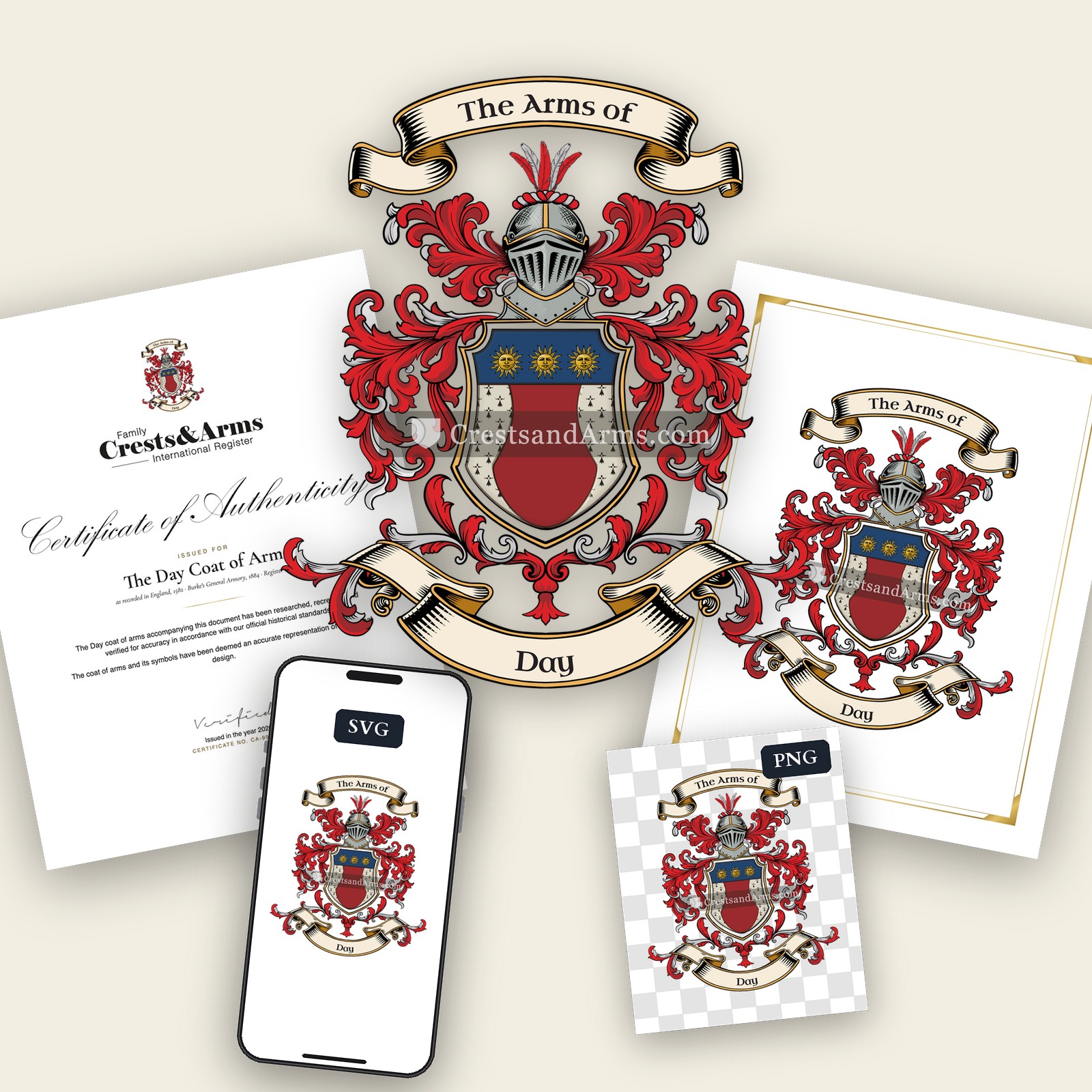
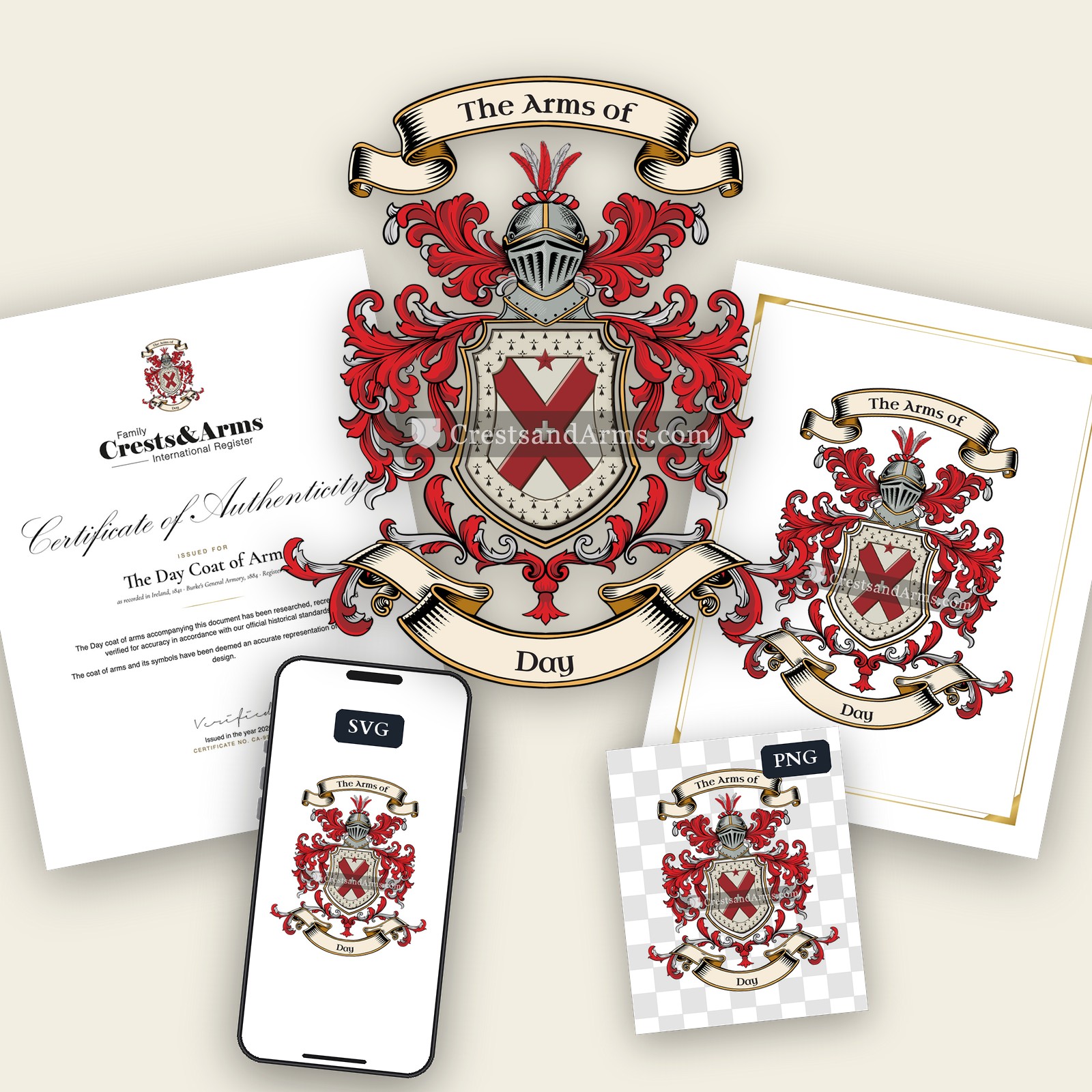
Digital archive packCoat of arms PNG, gold border print PDF, vector SVG and the certificate of authenticity. Sent to your email in minutes.
Map of Ireland showing where the Day arms are recorded
The Day arms were recorded in Kerry, c. 1841.
Kerry was mountain and coast country in the far south-west of Ireland. Its land was poor and held by a few families for a very long time, and long unbroken holding fills a register.
This is where the arms were entered in the register. Families often moved to other parts of the country, so the same name can turn up in more than one region.
The body that granted and recorded arms in Ireland in this period.
Victoria
Sovereign of the period
Victoria
1837–1901
Reigning in England when the Day arms are first recorded.
How Arms Worked in Ireland
The Ulster King of Arms granted coats of arms to individuals who proved their social standing and good character. These symbols were typically inherited by all legitimate descendants of the original holder. If a family branch wanted a unique look, they could apply for a specific change to their design through the office to ensure their identity remained distinct.
Granting authority
The Ulster King of Arms acted as the official body that regulated and issued all coats of arms throughout Ireland.
How they got arms
Families obtained their arms through formal grants issued by the office after proving their eligibility and paying the required fees.
Where arms were recorded
All official grants were recorded in the registers held by the Ulster King of Arms starting from the year 1552.
The family's standing
Recorded among the armigerous families of Kerry.
Origin & History of the Day Family in Ireland
The history of the Day family in Ireland is deeply rooted in the rugged landscape of County Kerry. While the name Day is often associated with English origins, families bearing this surname established a significant presence in the southwest of Ireland by the early nineteenth century. By 1841, records confirm that members of the Day family were well-integrated into the local community, likely working as farmers or tradespeople during a period of great social change. These early settlers in Kerry often lived in rural parishes where they contributed to the local economy and social fabric. Their presence in the region suggests that the family had either migrated from Britain or descended from earlier settlers who moved to Ireland to manage land or pursue professional opportunities. Over time, the family became a permanent fixture in the Kerry region, adapting to the unique cultural and historical challenges of life in Ireland.
Day Meaning & Related Branches
Root word
Daeg
Old English word for day or dawn.
This name
DayA nickname for someone born during the daytime or a patronymic form of David.
also spelled
Dey
Deye
Related arms
Perrysame arms
Deyvariant spelling
D'Eyevariant spelling
O'Deavariant spelling
Documented Sources
Sir Bernard Burke, The General Armory of England, Scotland, Ireland and Wales, London: Harrison & Sons, 1884
Bardsley, Charles Wareing. A Dictionary of English and Welsh Surnames. 1901
Reaney, Percy Hide. A Dictionary of British Surnames. 1958
The National Archives, Prerogative Court of Canterbury and Related Probate Jurisdictions: Will Registers, 1582
London Metropolitan Archives, City of London Parish Registers, 1582
Digital archive packCoat of arms PNG, gold border print PDF, vector SVG and the certificate of authenticity. Sent to your email in minutes.


 flaunchesA reward for virtue and learning
 chiefAuthority, wisdom and dominion
 sunGlory, splendour and the source of life
 flaunchesA reward for virtue and learning
 chiefAuthority, wisdom and dominion
 sunGlory, splendour and the source of life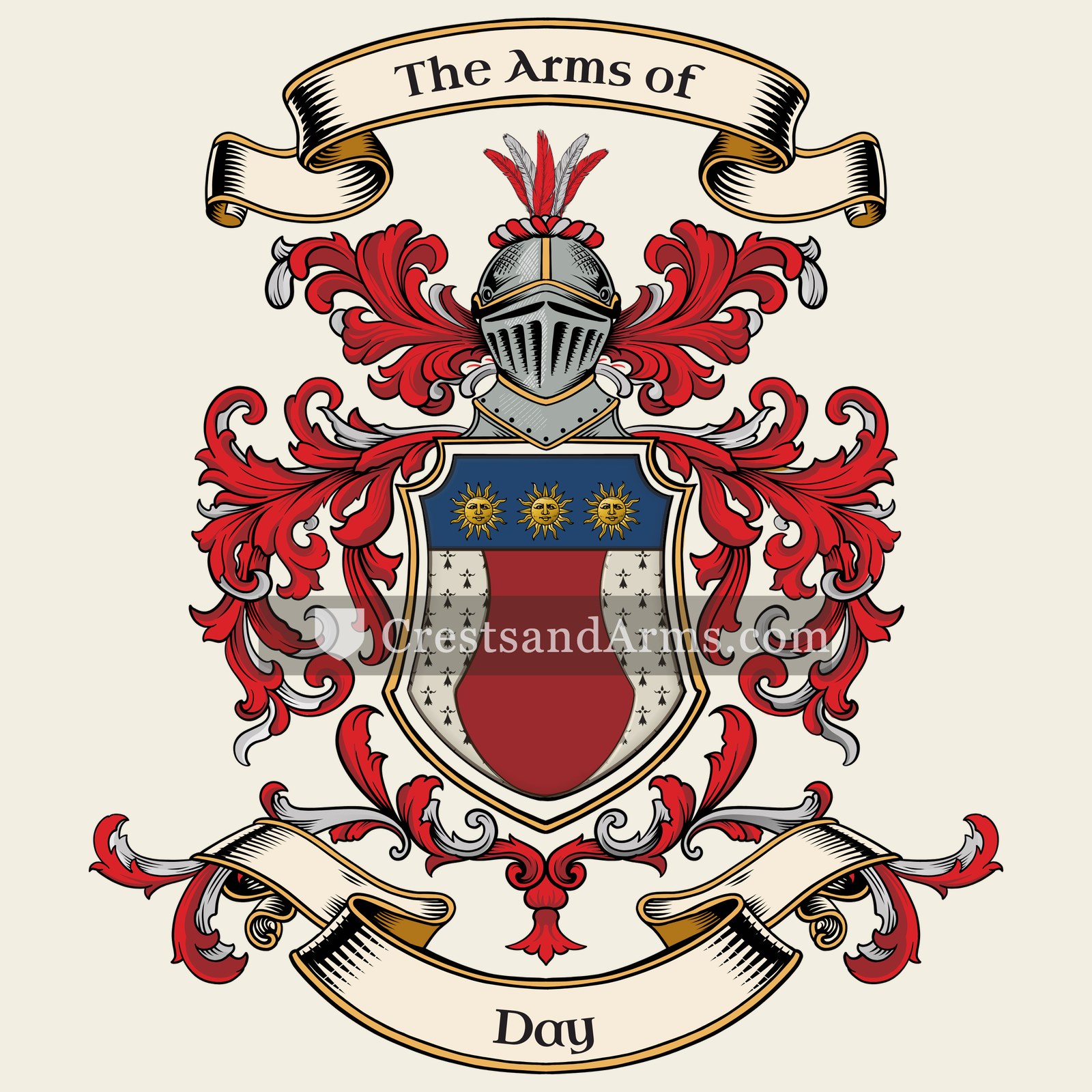


 saltireResolution, and St Andrew's cross
 cross symbolChristian faith and service
 bordureA difference between branches of one family
 mulletThe third son, and a divine quality from above