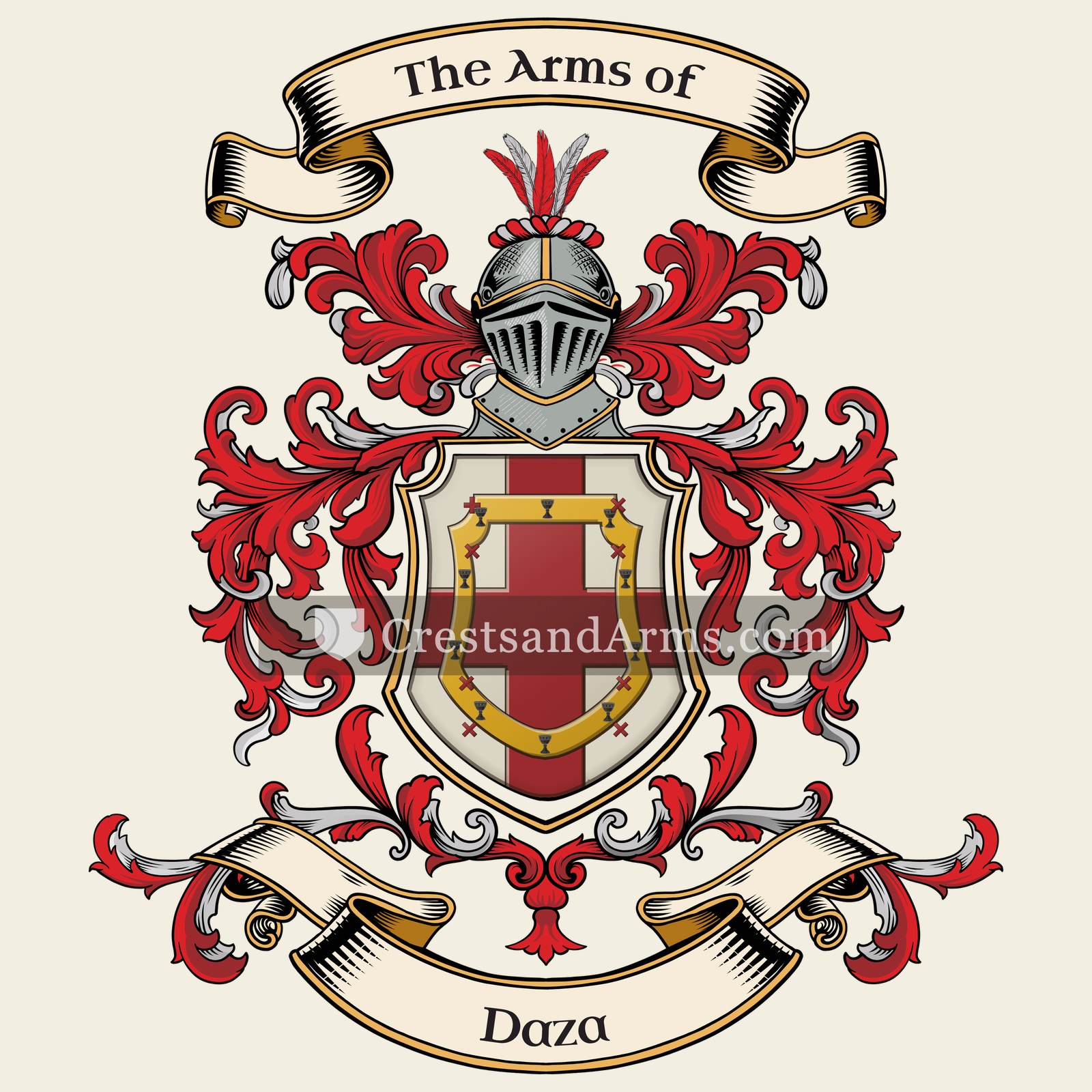
A record of documented arms, meaning and origin, researched for the Daza family of Spain.
Reg. 5912 · Spanish, D–F
Coat of Arms & Family Crest Details
Symbols on this shield
cross symbolChristian faith and service
orlePreservation, and protection in battle
saltireResolution, and St Andrew's cross
cantonA mark of honour granted by the sovereign
cupFaith, office, and a trust discharged
saltire coupedResolution, and the cross of St Andrew
Colours
Silver (Argent)Means: Peace and sincerity
Red (Gules)Means: Military strength
Gold (Or)Means: Generosity
Black (Sable)Means: Constancy
Historical info
Source
J. B. Rietstap, Armorial Général, Gouda: G. B. van Goor Zonen, 1884–87
Blazon (the actual original written record)
“D'arg. à la croix de Calatrava de gu.; à une orle d'or, ch. de dix chaudières de sa., 3 en chef, 3 en p. et 2 à chaque flanc; ladite orle entourée de sept flanchis de gu., 4 dans les cantons de l'écu, 1 à chaque flanc et 1 en p. [Comp. Aza.]”
CastileCastile, c. 1722
Where the Daza Arms Were Recorded
Castile
Map of Spain showing where the Daza arms are recorded
The Daza arms were recorded in Castile, c. 1722.
Castile was the heart of Spain and the source of most of its noble families. Land won in the long wars against the Moors was granted out to fighting men, and a man granted land was granted arms along with it.
This is where the arms were entered in the register. Families often moved to other parts of the country, so the same name can turn up in more than one region.
The body that granted and recorded arms in Spain in this period.
Philip V of Spain
Sovereign of the period
Philip V of Spain
1714–1724
Reigning in Spain when the Daza arms are first recorded.
How Arms Worked in Spain
In Spain, a coat of arms was considered a form of property that belonged to the entire family line. These arms were passed down from a father to all his children equally. Younger branches of the family usually kept the original design without needing to add any special marks to distinguish their specific line.
Granting authority
The Cronista Rey de Armas was the official body that regulated and granted coats of arms throughout Spain.
How they got arms
Families often obtained their arms through royal grants or by proving their noble status to the official heraldic authority.
Where arms were recorded
Coats of arms were officially recorded in the registers of the Cronista Rey de Armas starting in 1496.
The family's standing
Recorded among the armigerous families of Castile.
Origin & History of the Daza Family in Spain
The surname Daza has deep roots in the historical region of Castile, where it emerged as a distinct family identifier during the Middle Ages. The name is often considered a topographic or locative surname, likely originating from the phrase "de Aza," which refers to individuals who lived near the town of Aza in the province of Burgos. By the early 18th century, the family was firmly established within the social and administrative structures of the Castilian heartland. Records from 1722 confirm that members of the Daza family were active participants in local community life, serving in various civic and religious roles that were typical for established families of that era. As the family grew, they spread across different parts of Spain, carrying the name into new territories while maintaining their connection to their Castilian heritage.
Related Branches & Arms
Root word
Adaza
A Basque toponymic term referring to a place with abundant vegetation.
This name
DazaA locative surname originating from the town of Daza in the province of Burgos.
also spelled
Dazza
Dazaa
Dazae
Documented Sources
J. B. Rietstap, Armorial Général, Gouda: G. B. van Goor Zonen, 1884–87
Moll, Francesc de B., Els llinatges catalans, 1959
Pescador del Hoyo, María del Carmen, Apellidos en España, 1996
Archivo General de Simancas, Registro General del Sello, 1476–1833
Digital archive packCoat of arms PNG, gold border print PDF, vector SVG and the certificate of authenticity. Sent to your email in minutes.


 cross symbolChristian faith and service
 orlePreservation, and protection in battle
 saltireResolution, and St Andrew's cross
 cantonA mark of honour granted by the sovereign
 cupFaith, office, and a trust discharged
 saltire coupedResolution, and the cross of St Andrew
 cross symbolChristian faith and service
 orlePreservation, and protection in battle
 saltireResolution, and St Andrew's cross
 cantonA mark of honour granted by the sovereign
 cupFaith, office, and a trust discharged
 saltire coupedResolution, and the cross of St Andrew