Map of England showing where the De Angeles arms are recorded
The De Angeles arms were recorded in Poitou, c. 1363.
Poitou was western French farming country, divided among a large number of small landed families. Its gentry were numerous and modest, and even a small estate was enough to justify a shield.
This is where the arms were entered in the register. Families often moved to other parts of the country, so the same name can turn up in more than one region.
The body that granted and recorded arms in England in this period.
Edward III of England
Sovereign of the period
Edward III of England
1327–1377
Reigning in England when the De Angeles arms are first recorded.
How Arms Worked in England
English heraldry allowed arms to be shared by all legitimate descendants of the original owner. These symbols were treated as personal property that moved through the generations to all children. While the eldest son kept the original design, other family members could use the same shield without needing to change it or register their own unique versions.
Granting authority
The College of Arms in London has regulated the use of coats of arms throughout England and Wales since 1484.
How they got arms
Families typically obtained their coats of arms through a formal grant from the Crown or by proving their ancient right to them.
Where arms were recorded
All official coats of arms are recorded in the registers kept at the College of Arms, which date back to the fifteenth century.
The family's standing
Recorded among the armigerous families of Poitou.
Origin & History of the De Angeles Family in England
The family name De Angeles traces its roots back to the medieval period, with documented evidence placing members of the family in the Poitou region of France by 1363. During this time, the name likely emerged as a way to identify individuals based on their religious devotion or their association with local ecclesiastical institutions. The Poitou region was a significant area for trade and administration in the fourteenth century, which suggests that the family held a stable social position during the late Middle Ages. As the family grew, they integrated into the local culture of western France, eventually spreading across different regions while maintaining their distinct identity. This early presence in Poitou highlights the family’s long-standing connection to the history of the French provinces and their role in the social fabric of the era.
De Angeles Meaning & Related Branches
Root word
Angelus
Derived from the Greek word for a divine messenger.
This name
De AngelesRefers to someone associated with angels or living in a place dedicated to them.
also spelled
Dangell
Dangill
Dangel
Documented Sources
Sir Bernard Burke, The General Armory of England, Scotland, Ireland and Wales, London: Harrison & Sons, 1884
Archives départementales de la Vienne, Fonds de l'abbaye de Saint-Cyprien de Poitiers, 1363
Beauchet-Filleau, Henri, Dictionnaire historique et généalogique des familles du Poitou, 1891
Lebeuf, Jean, Mémoires concernant l'histoire civile et ecclésiastique d'Auxerre et de son ancien diocèse, 1743
Digital archive packCoat of arms PNG, gold border print PDF, vector SVG and the certificate of authenticity. Sent to your email in minutes.


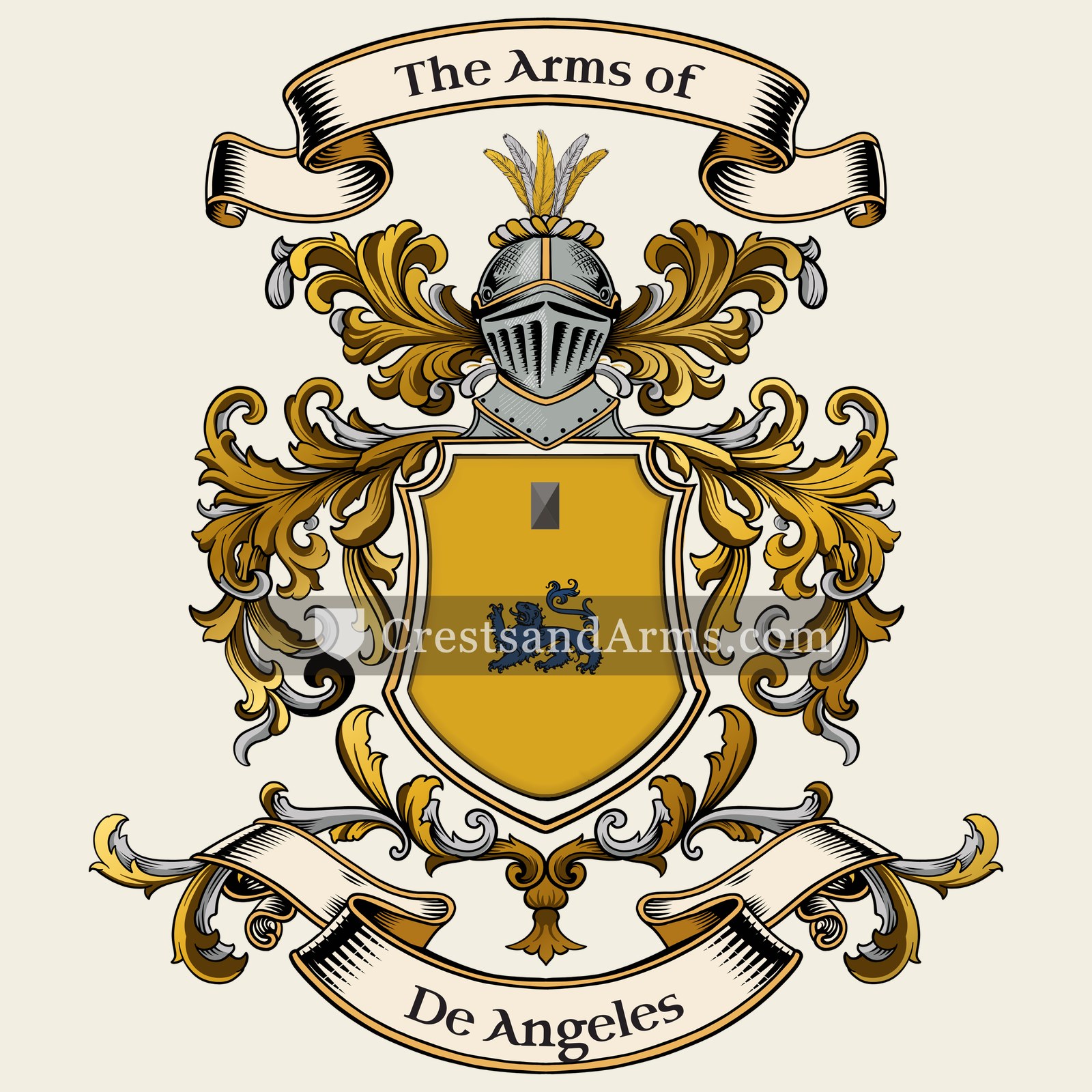
 lionCourage, strength and royalty
 billetThe sealed letter, and a message delivered
 lionCourage, strength and royalty
 billetThe sealed letter, and a message delivered