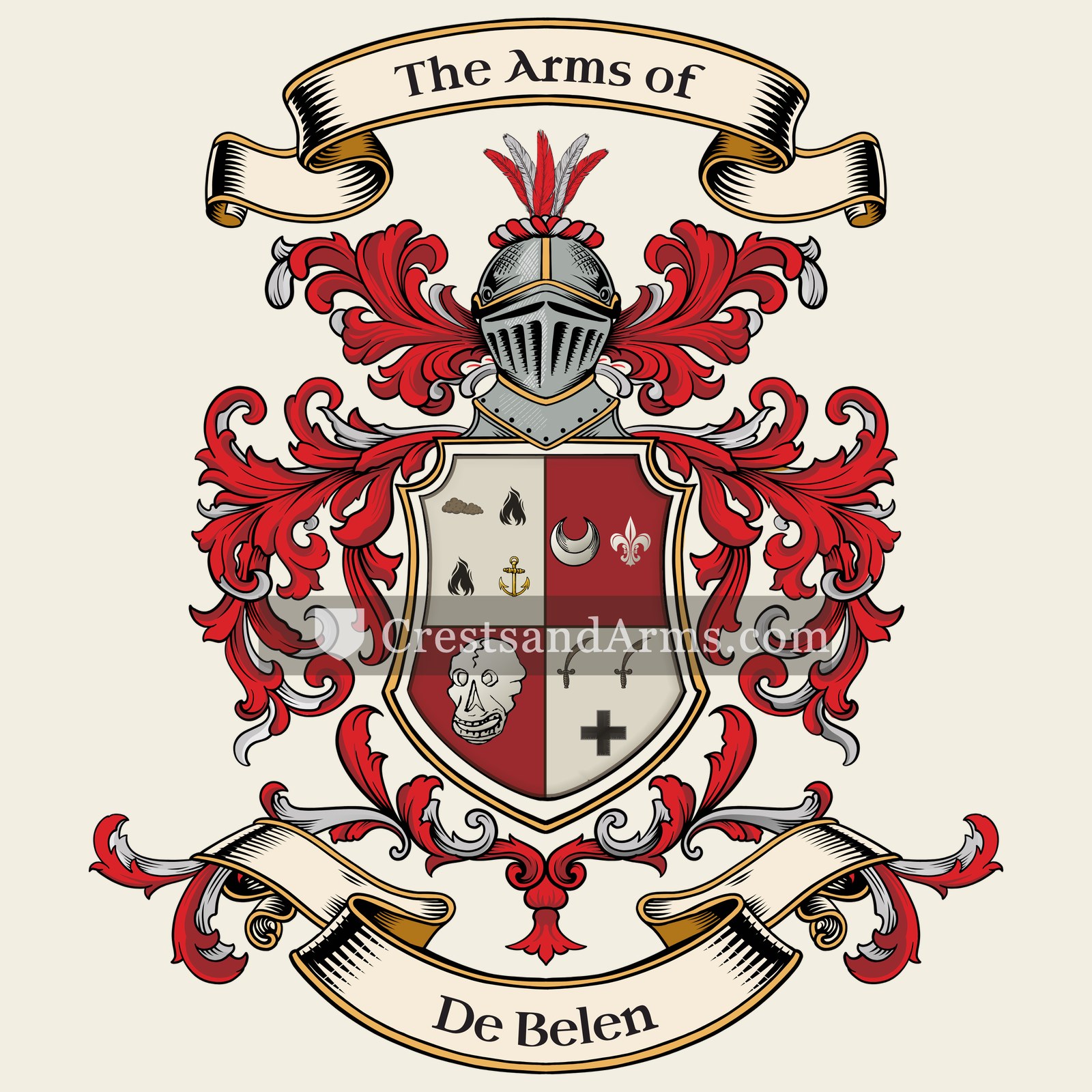
A record of documented arms, meaning and origin, researched for the De Belen family of Sweden.
Reg. 6414 · Swedish, D–F
Coat of Arms & Family Crest Details
Symbols on this shield
cross symbolChristian faith and service
cloudDivine favour, and mystery
fireZeal and purification
anchorHope, and steadfastness in trouble
crescentHonour by the sovereign, and the second son
fleur de lisPurity, light, and the sixth son
skullMortality remembered, and courage in the face of death
swordJustice, and military honour
Colours
Silver (Argent)Means: Peace and sincerity
Red (Gules)Means: Military strength
Black (Sable)Means: Constancy
Gold (Or)Means: Generosity
Historical info
Source
J. B. Rietstap, Armorial Général, Gouda: G. B. van Goor Zonen, 1884–87
Blazon (the actual original written record)
“Ec.: au 1 tranché: a. d'arg. à une nuée au nat., posée en bande, lancant deux foudres de sa. à dextre; b. de sin. à une ancre d'or; au 2 taillé: a. d'azur à un croiss. figuré et cont. d'arg.; b. de gu. à une fleur-de-lis d'arg.; au 3 coupé: a. de gu. à une manivelle d'arg., posée en fasce; b. d'arg. à deux os de mort, passés en saut., surm. d'une tête de mort, le tout au nat.; au 4 d'azur à un autel carré d'arg., supp. une croix pattée de sa., et deux épées au nat., passées en saut., les pointes en bas, br. sur l'autel. Sur le tout un écusson en losange d'arg. à la tour de gu., et au chef d'azur ch. d'un faisceau de trois flèches d'or, posé en fasce. Deux cq. cour. C.: 1º un bras, arm. au nat., la main de carn. empoignant un faisceau de trois flèches d'or, les pointes en bas; entre un vol coupé, à dextre d'arg. sur gu., à sen. d'azur sur arg.; 2º une pl. d'aut. d'arg. S.: à dextre un lion reg. au nat., tenant de sa patte dextre une épée au nat., le corps percé d'une pique au nat. en bande, la pointe en haut; à sen. un cerf reg. au nat., coll. et bouclé d'or, le corps percé d'une pique au nat. en barre, la pointe en haut. D.: ARA SKYLDIGHET OCH VILLIA.”
Swedenc. 1809
Digital archive packCoat of arms PNG, gold border print PDF, vector SVG and the certificate of authenticity. Sent to your email in minutes.
Map of Sweden showing where the De Belen arms are recorded
The De Belen arms were recorded in Sweden, c. 1809.
Arms such as these were typically recorded in Stockholm.
Stockholm held the Swedish court and the House of Nobility, where every noble family's arms were entered and kept. Families ennobled for service registered there, which is why so many are recorded around the city.
This is where the arms were entered in the register. Families often moved to other parts of the country, so the same name can turn up in more than one region.
The body that granted and recorded arms in Sweden in this period.
Gustav IV Adolf of Sweden
Sovereign of the period
Gustav IV Adolf of Sweden
1792–1809
Reigning in Sweden when the De Belen arms are first recorded.
How Arms Worked in Sweden
In Sweden, a coat of arms belonged to a noble family as a whole rather than just one individual. These arms were passed down through the generations to all legitimate descendants. Younger branches of the family used the same shield without needing to change it. This system ensured that the entire lineage shared the same identity and status under the law.
Granting authority
The Riddarhuset, or House of Nobility, regulated all noble coats of arms in Sweden under royal authority.
How they got arms
Families received their coats of arms through royal grants of nobility which were then officially registered with the House.
Where arms were recorded
Coats of arms were officially recorded in the Swedish House of Nobility register starting in the year 1626.
The family's standing
Recorded among the armigerous families of Sweden.
Origin & History of the De Belen Family in Sweden
The family name De Belen carries a distinct history that connects to the movement of people across Europe during the early nineteenth century. While the name suggests origins linked to the Romance languages, historical records confirm that members of the family were established in Stockholm by 1809. During this period, Sweden was undergoing significant political change, and the presence of families with international roots often reflected the city’s role as a growing hub for trade and diplomacy. These early ancestors likely navigated a society transitioning through the Napoleonic Wars, adapting their lives to the cultural and social landscape of the Swedish capital. By settling in Stockholm during such a pivotal year, the family became part of the city’s evolving demographic tapestry, maintaining their identity while integrating into the local community.
De Belen Meaning & Related Branches
Root word
Bethlehem
House of bread in Hebrew
This name
De BelenRefers to a person originating from the biblical city of Bethlehem.
also spelled
Doebeln
Documented Sources
J. B. Rietstap, Armorial Général, Gouda: G. B. van Goor Zonen, 1884–87
Stockholm City Archives (Stockholms stadsarkiv), Överståthållarämbetet för uppbördsärenden, Mantalslängder 1809
National Archives of Sweden (Riksarkivet), Kyrkoarkiv, Födelse- och dopböcker för Stockholms församlingar 1809
Digital archive packCoat of arms PNG, gold border print PDF, vector SVG and the certificate of authenticity. Sent to your email in minutes.


 cross symbolChristian faith and service
 cloudDivine favour, and mystery
 fireZeal and purification
 anchorHope, and steadfastness in trouble
 crescentHonour by the sovereign, and the second son
 fleur de lisPurity, light, and the sixth son
 skullMortality remembered, and courage in the face of death
 swordJustice, and military honour