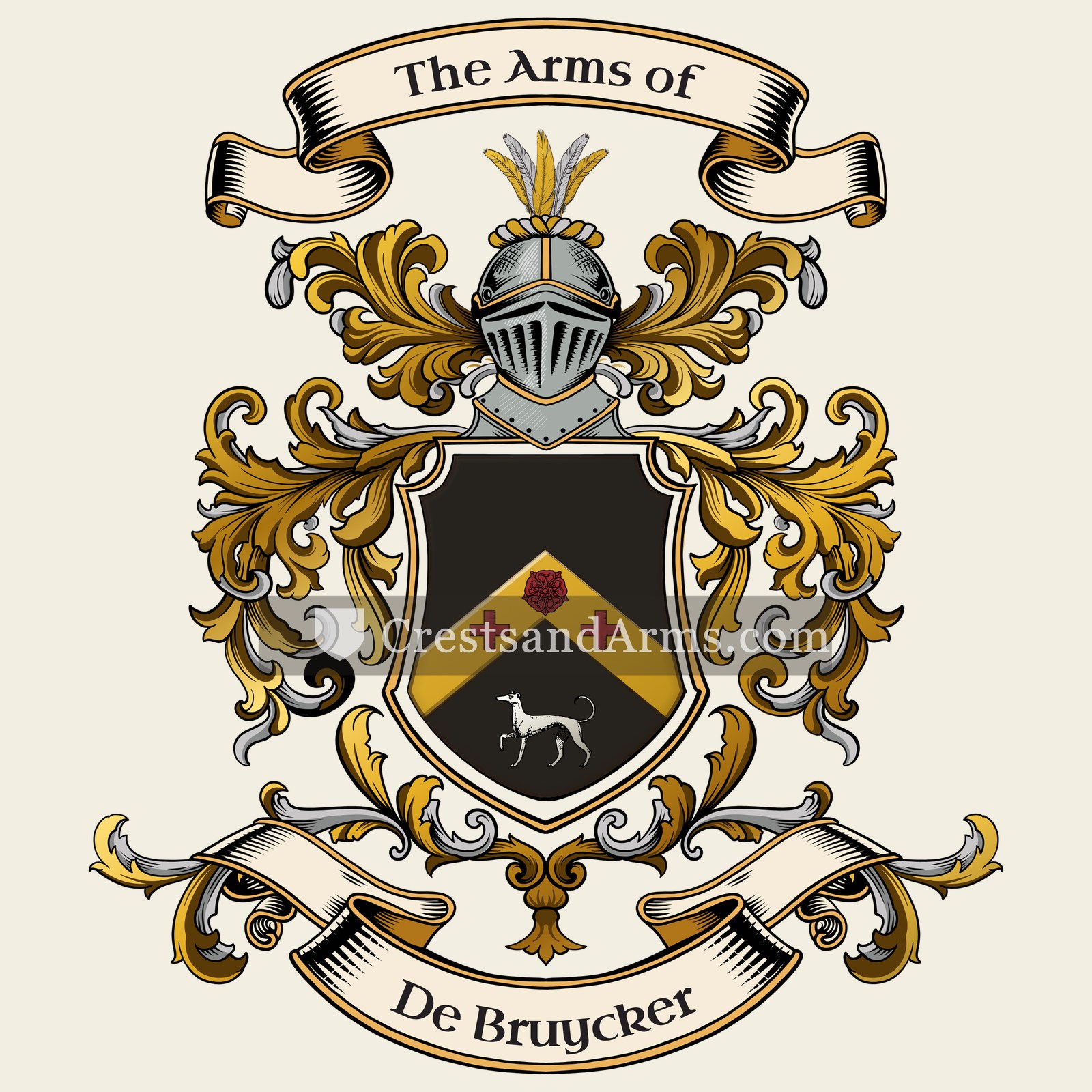
A record of documented arms, meaning and origin, researched for the De Bruycker family of Belgium.
Reg. 5116 · Belgian, D–F
Coat of Arms & Family Crest Details
Symbols on this shield
chevronProtection, and faithful service completed
cross symbolChristian faith and service
greyhoundCourage, vigilance and loyalty
roseThe seventh son, and beauty with grace
Colours
Black (Sable)Means: Constancy
Gold (Or)Means: Generosity
Silver (Argent)Means: Peace and sincerity
Red (Gules)Means: Military strength
Historical info
Source
J. B. Rietstap, Armorial Général, Gouda: G. B. van Goor Zonen, 1884–87
Blazon (the actual original written record)
“De sa. au chev. d'or, acc. en p. d'un lévrier naiss. d'arg., coll. de gu., bordé et bouclé d'or, mouv. d'une mer d'arg.; le chev. ch. sur la cime d'une rose de gu., et sur chaque jambe d'une croix pattée du même, posée chacune dans le sens de la jambe.”
BelgiumBruges, c. 1737
Digital archive packCoat of arms PNG, gold border print PDF, vector SVG and the certificate of authenticity. Sent to your email in minutes.
Map of Belgium showing where the De Bruycker arms are recorded
The De Bruycker arms were recorded in Bruges, c. 1737.
This is where the arms were entered in the register. Families often moved to other parts of the country, so the same name can turn up in more than one region.
The body that granted and recorded arms in Belgium in this period.
Charles VI, Holy Roman Emperor
Sovereign of the period
Charles VI, Holy Roman Emperor
1711–1740
Reigning in Belgium when the De Bruycker arms are first recorded.
How Arms Worked in Belgium
In Belgium, a coat of arms is considered personal property that is passed down through the male line to legitimate descendants. Families often use the same shield design across generations to show their shared heritage. If a branch of the family wants to change the design, they must apply for an official update to their specific version of the arms.
Granting authority
The Conseil héraldique is the official body that regulates and approves all coats of arms in Belgium.
How they got arms
Families obtain their coats of arms through formal royal grants or by confirming their historical right to use existing designs.
Where arms were recorded
All approved coats of arms are officially recorded in the public registers of the Conseil héraldique since 1844.
The family's standing
Recorded among the armigerous families of Belgium.
Origin & History of the De Bruycker Family in Belgium
The surname De Bruycker originates from the Dutch language and serves as a descriptive occupational name. Historically, it refers to a person who worked as a bricklayer or a builder of brick structures. By the early eighteenth century, the family was well-established in the historic city of Bruges. Records confirm their presence there by 1737, a time when the city was known for its intricate brick architecture and canal-side commerce. Families with this name were often part of the skilled artisan class, contributing to the maintenance and construction of the city's iconic medieval buildings. Over time, the name became a permanent fixture in the region, reflecting both the trade of their ancestors and their deep roots in the urban life of West Flanders.
De Bruycker Meaning & Related Branches
Root word
Brugghe
A bridge or a crossing point over a body of water.
This name
De BruyckerAn occupational surname for someone who lived near or worked at a bridge.
also spelled
Brouckere
de Brooker
Broucker
Documented Sources
J. B. Rietstap, Armorial Général, Gouda: G. B. van Goor Zonen, 1884–87
Debrabandere, Frans. Woordenboek van de familienamen in België en Noord-Frankrijk. 1993
Stadsarchief Brugge, Parochieregisters van Brugge
Digital archive packCoat of arms PNG, gold border print PDF, vector SVG and the certificate of authenticity. Sent to your email in minutes.


 chevronProtection, and faithful service completed
 cross symbolChristian faith and service
 greyhoundCourage, vigilance and loyalty
 roseThe seventh son, and beauty with grace
 chevronProtection, and faithful service completed
 cross symbolChristian faith and service
 greyhoundCourage, vigilance and loyalty
 roseThe seventh son, and beauty with grace