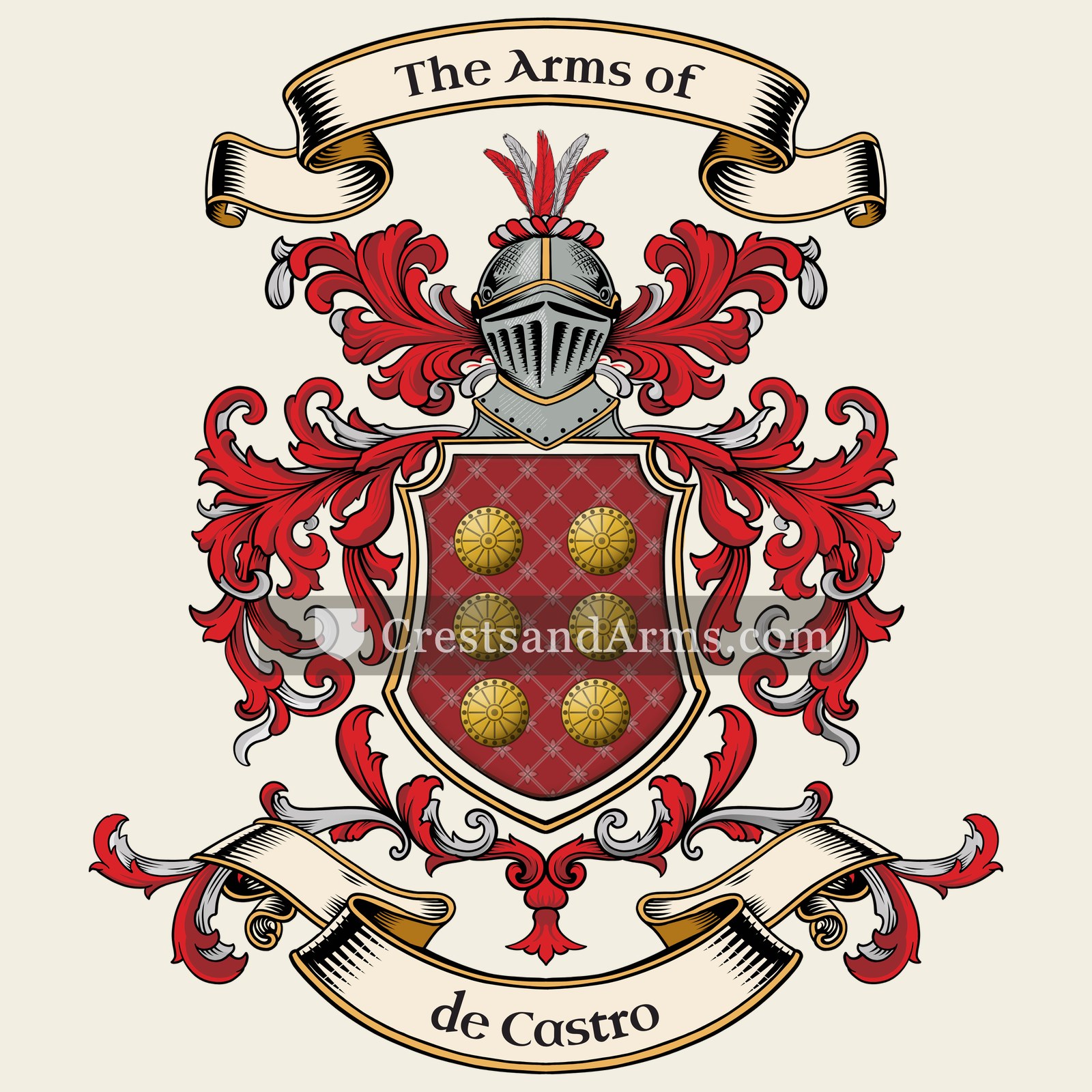
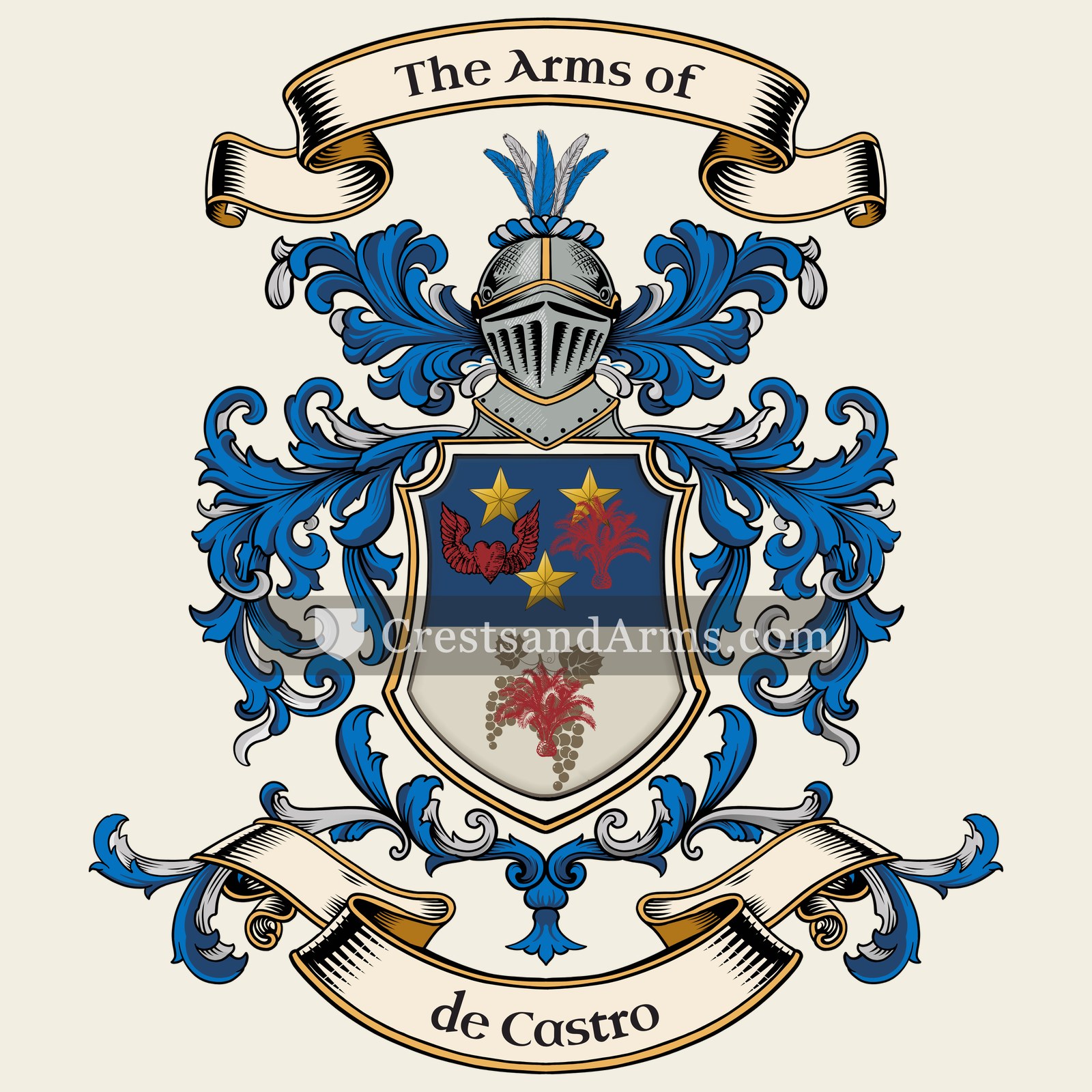
A record of documented arms, meaning and origin, researched for the de Castro family lines. Documented in 2 countries.
Reg. 5466 · Spanish, D–F
Coat of Arms & Family Crest Details
Symbols on this shield
roundelA coin, and one who has been to the crusades
Colours
Red (Gules)Means: Military strength
Gold (Or)Means: Generosity
Historical info
Source
J. B. Rietstap, Armorial Général, Gouda: G. B. van Goor Zonen, 1884–87
Blazon (the actual original written record)
“De gu. à six bes. d'or, 2, 2 et 2.”
AragonAragon, c. 1722
Where the de Castro Arms Were Recorded
Aragon
Map of Spain showing where the de Castro arms are recorded
The de Castro arms were recorded in Aragon, c. 1722.
Aragon was mountain and river country in north-eastern Spain, with a strong tradition of small independent landholders. A great many families counted as gentry there, and each one needed a shield to be told apart.
This is where the arms were entered in the register. Families often moved to other parts of the country, so the same name can turn up in more than one region.
The body that granted and recorded arms in Spain in this period.
Philip V of Spain
Sovereign of the period
Philip V of Spain
1714–1724
Reigning in Spain when the de Castro arms are first recorded.
How Arms Worked in Spain
In Spain, a coat of arms was considered a form of property that belonged to the entire family line. These arms were passed down from a father to all his children equally. Younger branches of the family usually kept the original design without needing to add any special marks to distinguish their specific line.
Granting authority
The Cronista Rey de Armas was the official body that regulated and granted coats of arms throughout Spain.
How they got arms
Families often obtained their arms through royal grants or by proving their noble status to the official heraldic authority.
Where arms were recorded
Coats of arms were officially recorded in the registers of the Cronista Rey de Armas starting in 1496.
The family's standing
Recorded among the armigerous families of Aragon.
Origin & History of the de Castro Family in Spain
The surname de Castro is a topographic name that originated in the Iberian Peninsula during the Middle Ages. It was given to families who lived near a castle or a fortified settlement, as the word castro comes from the Latin term for a military camp. By the time members of the family were documented in the Kingdom of Aragon in 1722, the name had already been established for centuries as a marker of local prominence. Families bearing this name often held positions of influence within their regional communities, serving as landowners or local administrators. Because the name was tied to the landscape rather than a single ancestor, it emerged independently in various parts of Spain as people moved into fortified towns. This history reflects the broader social shifts in Spain, where families became identified by the specific environments they helped to build and protect.
Coat of Arms & Family Crest Details
Symbols on this shield
fessThe military belt, and readiness to serve
heartSincerity, charity and true affection
palm treeVictory, and righteousness that flourishes
mulletThe third son, and a divine quality from above
grapesPlenty, and the labour of the vine
Colours
Blue (Azure)Means: Loyalty and truth
Silver (Argent)Means: Peace and sincerity
Red (Gules)Means: Military strength
Gold (Or)Means: Generosity
Historical info
Source
J. B. Rietstap, Armorial Général, Gouda: G. B. van Goor Zonen, 1884–87
Blazon (the actual original written record)
“Coupé, d'azur à trois étoiles rangées d'or, sur arg. à un pied de vigne poussant à dextre et à sen. une branche fruitée et pamprée au nat.; à la fasce d'arg., br. sur le coupé et ch. d'un coeur de gu., embrassé de deux palmes du même. C.: un coeur de gu., entre un vol à l'antique, d'azur et d'or.”
LiegeLiege, c. 1737
Where the de Castro Arms Were Recorded
Liege
Map of Belgium showing where the de Castro arms are recorded
The de Castro arms were recorded in Liege, c. 1737.
Liege was a prosperous town and its surrounding country, living on metalworking and trade. Merchant families grew rich, bought land outside the walls, and took arms as landowners rather than tradesmen.
This is where the arms were entered in the register. Families often moved to other parts of the country, so the same name can turn up in more than one region.
The body that granted and recorded arms in Belgium in this period.
Charles VI, Holy Roman Emperor
Sovereign of the period
Charles VI, Holy Roman Emperor
1711–1740
Reigning in Spain when the de Castro arms are first recorded.
How Arms Worked in Belgium
In Belgium, a coat of arms is considered personal property that is passed down through the male line to legitimate descendants. Families often use the same shield design across generations to show their shared heritage. If a branch of the family wants to change the design, they must apply for an official update to their specific version of the arms.
Granting authority
The Conseil héraldique is the official body that regulates and approves all coats of arms in Belgium.
How they got arms
Families obtain their coats of arms through formal royal grants or by confirming their historical right to use existing designs.
Where arms were recorded
All approved coats of arms are officially recorded in the public registers of the Conseil héraldique since 1844.
The family's standing
Recorded among the armigerous families of Liege.
Origin & History of the de Castro Family in Belgium
The family name de Castro carries a rich history that stretches far beyond its Iberian roots, finding a notable foothold in the Belgian city of Liège by the year 1737. During this era, the presence of the family in the Prince-Bishopric of Liège suggests they were part of a mobile class of merchants or professionals who moved across European borders to pursue new opportunities. Because Liège was a major center for industry and trade at the time, families with this surname often integrated into the local urban structure by engaging in commerce or administrative roles. While the name itself originates from the Latin word for a fortified place, its evolution in Belgium reflects the broader movement of families who settled in the Low Countries to build new lives. By establishing themselves in Liège, these early members helped weave their ancestral identity into the local social fabric, marking the beginning of a long-standing connection to the region.
Related Branches & Arms
Root word
castrum
A Latin term referring to a fortified place, castle, or camp.
This name
de CastroRefers to someone who lived near or originated from a castle or fortified settlement.
also spelled
Decastr
Castro
de Kastro
Documented Sources
J. B. Rietstap, Armorial Général, Gouda: G. B. van Goor Zonen, 1884–87
Moll, Francesc de Borja. Els llinatges catalans: Catalunya, País Valencià, Illes Balears. 1959
Pescador del Hoyo, María del Carmen. Apellidos en España: sociedad y nombres de familia. 1996
Archivo de la Corona de Aragón. Cancillería Real, Registros
Digital archive packCoat of arms PNG, gold border print PDF, vector SVG and the certificate of authenticity. Sent to your email in minutes.


 roundelA coin, and one who has been to the crusades
 roundelA coin, and one who has been to the crusades

 fessThe military belt, and readiness to serve
 heartSincerity, charity and true affection
 palm treeVictory, and righteousness that flourishes
 mulletThe third son, and a divine quality from above
 grapesPlenty, and the labour of the vine