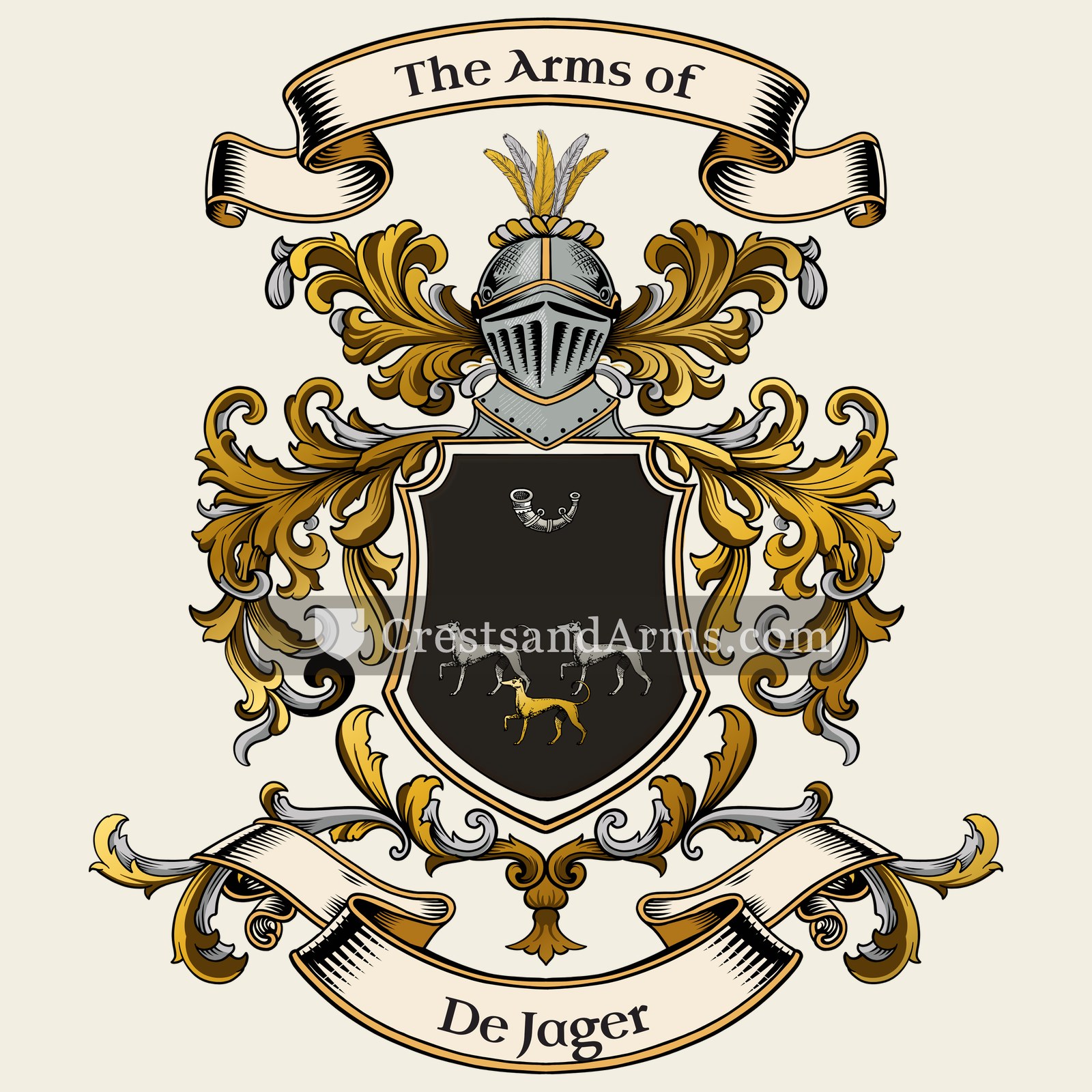
A record of documented arms, meaning and origin, researched for the De Jager family of Belgium.
Reg. 7830 · Belgian, D–F
Coat of Arms & Family Crest Details
Symbols on this shield
greyhoundCourage, vigilance and loyalty
hunting horn stringedOne who delights in the chase
Colours
Black (Sable)Means: Constancy
Silver (Argent)Means: Peace and sincerity
Gold (Or)Means: Generosity
Historical info
Source
J. B. Rietstap, Armorial Général, Gouda: G. B. van Goor Zonen, 1884–87
Blazon (the actual original written record)
“De sa. à deux lévriers courants d'arg. en chef et un chien braque courant d'or en p.; le tout acc. en chef d'un buste de vierge de carn., posé de face, hab. d'or, chevelé du même, portant au cou et attaché à un ruban de gu., un cor-de-chasse d'arg., eng. et vir. d'or. C.: le buste de vierge; entre un vol, d'or et de sa.”
BelgiumGand, c. 1737
Digital archive packCoat of arms PNG, gold border print PDF, vector SVG and the certificate of authenticity. Sent to your email in minutes.
Map of Belgium showing where the De Jager arms are recorded
The De Jager arms were recorded in Gand, c. 1737.
This is where the arms were entered in the register. Families often moved to other parts of the country, so the same name can turn up in more than one region.
The body that granted and recorded arms in Belgium in this period.
Charles VI, Holy Roman Emperor
Sovereign of the period
Charles VI, Holy Roman Emperor
1711–1740
Reigning in Belgium when the De Jager arms are first recorded.
How Arms Worked in Belgium
In Belgium, a coat of arms is considered personal property that is passed down through the male line to legitimate descendants. Families often use the same shield design across generations to show their shared heritage. If a branch of the family wants to change the design, they must apply for an official update to their specific version of the arms.
Granting authority
The Conseil héraldique is the official body that regulates and approves all coats of arms in Belgium.
How they got arms
Families obtain their coats of arms through formal royal grants or by confirming their historical right to use existing designs.
Where arms were recorded
All approved coats of arms are officially recorded in the public registers of the Conseil héraldique since 1844.
The family's standing
Recorded among the armigerous families of Belgium.
Origin & History of the De Jager Family in Belgium
The surname De Jager is a classic occupational name that originated in the Low Countries, which includes modern-day Belgium and the Netherlands. In the Dutch language, the name literally translates to the hunter. During the medieval and early modern periods, families often adopted surnames based on the trade or role of their ancestors. By the year 1737, records confirm that members of the De Jager family were well-established in the city of Ghent. At that time, Ghent was a major center for commerce and textile production. Families living in such urban hubs were often part of the growing middle class of merchants or skilled craftsmen. The presence of the family in this region suggests they were part of the Dutch-speaking population that shaped the cultural and economic landscape of Flanders for centuries.
Related Branches & Arms
Root word
jagen
A Middle Dutch verb meaning to hunt or to chase.
This name
De JagerAn occupational surname for a professional hunter or a gamekeeper.
also spelled
de Jager
de Jagher
de Jagherre
de Yagera
Jager
Documented Sources
J. B. Rietstap, Armorial Général, Gouda: G. B. van Goor Zonen, 1884–87
De Flou, Karel, Woordenboek der toponymie van westelijk Vlaanderen, Vlaamsch Artesië, het Land van den Hoek, de graafschappen Guînes en Boulogne en een gedeelte van het graafschap Ponthieu, 1914
State Archives in Belgium (Rijksarchief te Gent), Parochieregisters van Gent (Baptismal and Marriage Records), 1737
Digital archive packCoat of arms PNG, gold border print PDF, vector SVG and the certificate of authenticity. Sent to your email in minutes.


 greyhoundCourage, vigilance and loyalty
 hunting horn stringedOne who delights in the chase
 greyhoundCourage, vigilance and loyalty
 hunting horn stringedOne who delights in the chase