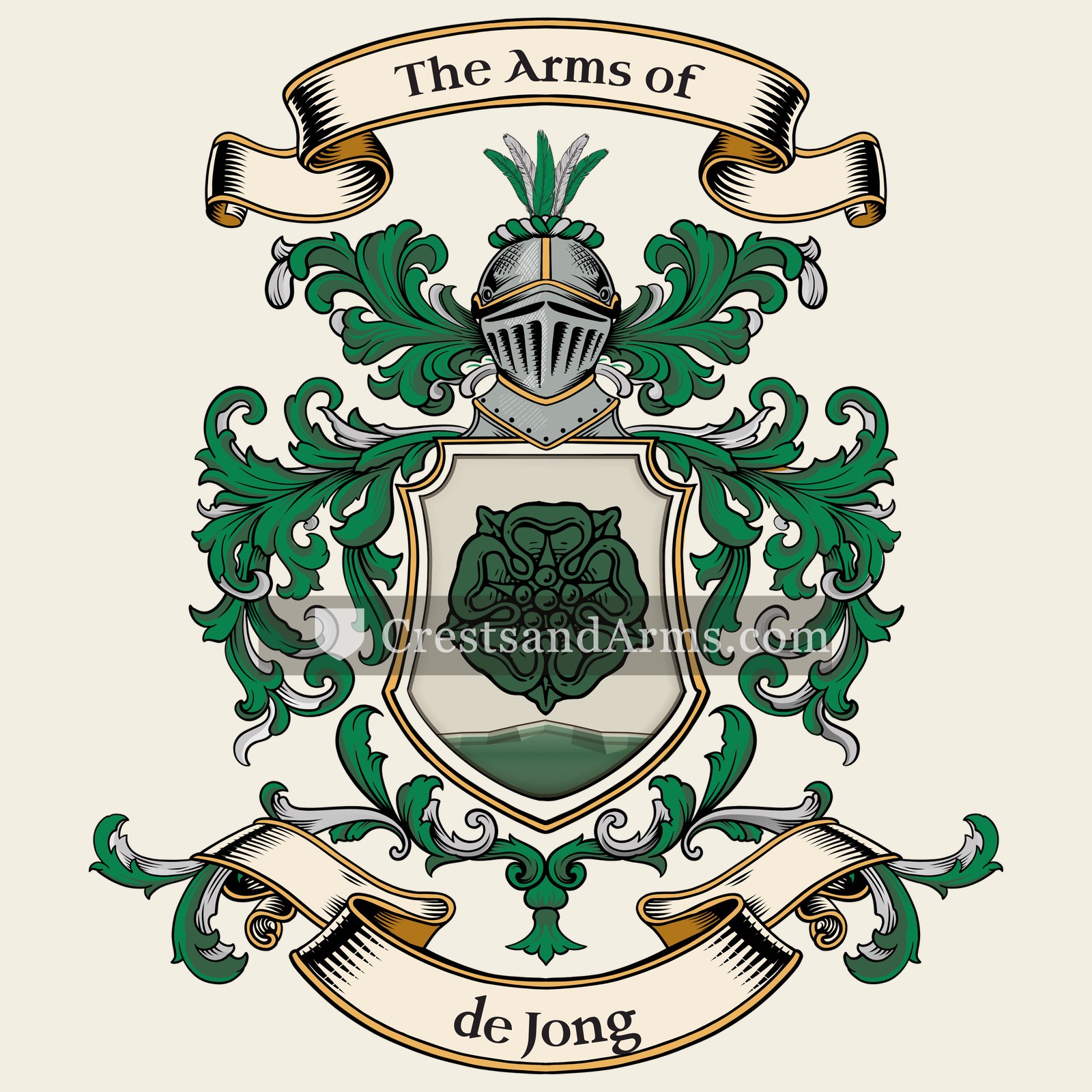
A record of documented arms, meaning and origin, researched for the de Jong family of Netherlands.
Reg. 2778 · Dutch, D–F
Coat of Arms & Family Crest Details
Symbols on this shield
mountThe ground held, and steadfastness upon it
roseThe seventh son, and beauty with grace
Colours
Silver (Argent)Means: Peace and sincerity
Green (Vert)Means: Hope
Historical info
Source
J. B. Rietstap, Armorial Général, Gouda: G. B. van Goor Zonen, 1884–87
Blazon (the actual original written record)
“D'arg. à une plante de giroflée de sin., de trois tiges, fleurie de trois pièces mal-ordonnées de gu. et posée sur un tertre de sin.”
NetherlandsBrielle, c. 1815
Where the de Jong Arms Were Recorded
Brielle
Map of Netherlands showing where the de Jong arms are recorded
The de Jong arms were recorded in Brielle, c. 1815.
This is where the arms were entered in the register. Families often moved to other parts of the country, so the same name can turn up in more than one region.
Region
Brielle
Town
Brielle
First recorded
1815
Granting Authority for the de Jong Arms
Hoge Raad van Adel
Photograph made by me · CC BY-SA 3.0
The body that granted and recorded arms in Netherlands in this period.
William I of the Netherlands
Sovereign of the period
William I of the Netherlands
1815–1840
Reigning in Netherlands when the de Jong arms are first recorded.
How Arms Worked in Netherlands
In the Netherlands, coats of arms were often used by noble families and those who held specific public offices. These arms were passed down through the generations to legitimate descendants. Younger branches of a family usually kept the original design without needing to add special marks. This system ensured that the family identity remained clear and consistent over many years.
Granting authority
The Hoge Raad van Adel is the official body that regulates and manages noble titles and coats of arms in the Netherlands.
How they got arms
Families typically obtained their coats of arms through official royal grants or by proving their long-standing historical use of the symbols.
Where arms were recorded
Coats of arms are officially recorded in the registers held by the Hoge Raad van Adel, which began its work in 1814.
The family's standing
Recorded among the armigerous families of Netherlands.
Origin & History of the de Jong Family in Netherlands
The surname de Jong is one of the most common names in the Netherlands, originating as a descriptive nickname during the Middle Ages. In Dutch, the name translates literally to "the young," and it was traditionally used to distinguish a son from his father when both men shared the same first name. By the time the family was firmly established in the fortified port city of Brielle in 1815, the name had long transitioned from a simple nickname into a permanent hereditary surname. During this period, Brielle served as a vital maritime hub, and families like the de Jongs were often deeply connected to the local trade, fishing, or administrative life of the town. Because the name was so widespread, it emerged independently in many different regions rather than from a single ancestor, reflecting the common practice of naming children after their parents to maintain family identity across generations.
Related Branches & Arms
Root word
Iuvenis
Latin term meaning young or youthful.
This name
de JongA common Dutch surname used to distinguish a younger person from an older namesake.
also spelled
de Jonge
de Jongh
de Jonghe
de Yong
Documented Sources
J. B. Rietstap, Armorial Général, Gouda: G. B. van Goor Zonen, 1884–87
Meertens, P.J., De betekenis van Nederlandse familienamen, 1970
Van der Schaar, J., Woordenboek van voornamen, 1964
Nationaal Archief, Bevolkingsregister van de gemeente Brielle, 1815
Digital archive packCoat of arms PNG, gold border print PDF, vector SVG and the certificate of authenticity. Sent to your email in minutes.


 mountThe ground held, and steadfastness upon it
 roseThe seventh son, and beauty with grace
 mountThe ground held, and steadfastness upon it
 roseThe seventh son, and beauty with grace