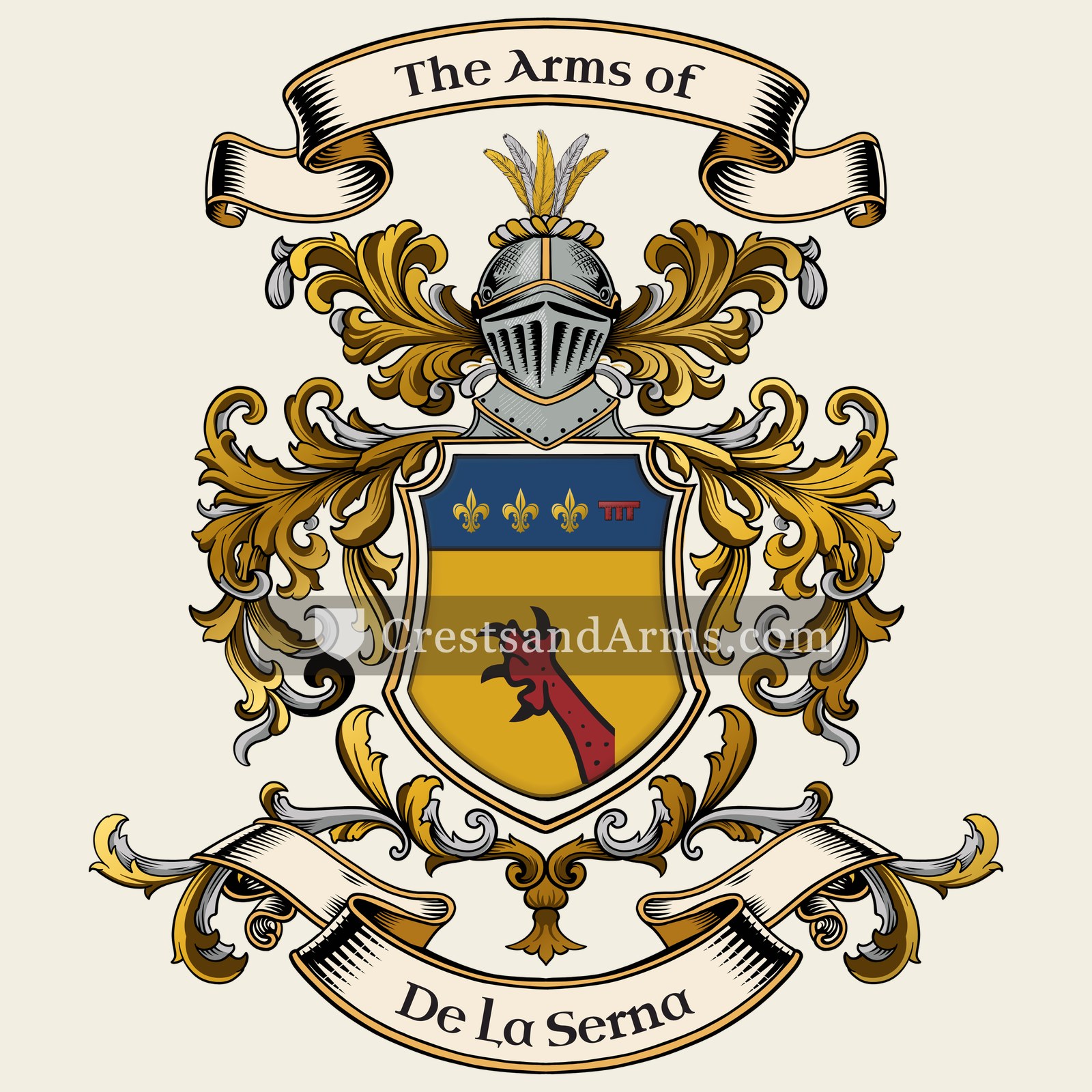
A record of documented arms, meaning and origin, researched for the De La Serna family of Italy.
Reg. 2666 · Italian, D–F
Coat of Arms & Family Crest Details
Symbols on this shield
chiefAuthority, wisdom and dominion
labelThe eldest son, during his father's life
pawStrength held ready, the beast's power in a single limb
fleur de lisPurity, light, and the sixth son
Colours
Gold (Or)Means: Generosity
Blue (Azure)Means: Loyalty and truth
Red (Gules)Means: Military strength
Historical info
Source
J. B. Rietstap, Armorial Général, Gouda: G. B. van Goor Zonen, 1884–87
Blazon (the actual original written record)
“D'or à une patte de lion de gu., en fasce, les ongles à dextre: au chef d'azur, ch. de trois fleurs-de-lis d'or, rangées entre les quatre pendants d'un lambel de gu.”
ItalyFlorence, c. 1775
Digital archive packCoat of arms PNG, gold border print PDF, vector SVG and the certificate of authenticity. Sent to your email in minutes.
Map of Italy showing where the De La Serna arms are recorded
The De La Serna arms were recorded in Florence, c. 1775.
This is where the arms were entered in the register. Families often moved to other parts of the country, so the same name can turn up in more than one region.
The body that granted and recorded arms in Italy in this period.
Alvise Giovanni Mocenigo
Sovereign of the period
Alvise Giovanni Mocenigo
1763–1778
Reigning in Italy when the De La Serna arms are first recorded.
How Arms Worked in Italy
In the Italian states, coats of arms were often used by noble families to show their status and history. These symbols were passed down through the generations to all legitimate male descendants. Younger branches of a family usually kept the original design but sometimes added small changes to distinguish their specific line from the main branch.
Granting authority
Various local rulers and city governments controlled the use of coats of arms across the different Italian states.
How they got arms
Families often assumed their own arms or received them as official grants from local lords, popes, or city councils.
Where arms were recorded
Arms were recorded in local city archives or private family books rather than in one single national register.
The family's standing
Recorded among the armigerous families of Italy.
Origin & History of the De La Serna Family in Italy
The surname De La Serna traces its linguistic roots to the northern regions of Spain, specifically deriving from the Spanish word "serna," which refers to a piece of land reserved for the exclusive use of a lord or a cultivated field. By the middle of the 18th century, members of the family had established a notable presence in Florence, Italy, by 1775. During this period, Florence was a major hub for European diplomacy and trade, attracting families of status who sought to integrate into the city’s sophisticated social and economic networks. The family likely moved to this region to participate in the vibrant administrative or merchant life of the Grand Duchy of Tuscany. Their transition from the Iberian Peninsula to the heart of the Italian Renaissance highlights the mobility of influential families during the Enlightenment, as they sought new opportunities in the cultural centers of Europe.
Related Branches & Arms
Root word
Cisterna
Latin term for an underground reservoir or water storage tank.
This name
De La SernaRefers to a family originating from a place characterized by a water cistern or reservoir.
also spelled
Delser
Documented Sources
J. B. Rietstap, Armorial Général, Gouda: G. B. van Goor Zonen, 1884–87
Mogrobejo, Endika de. Diccionario hispano de apellidos y blasones. 1995
Toscano de Puelles, Francisco. Linajes de España. 1980
Archivio di Stato di Firenze, Stato Civile della Restaurazione
Digital archive packCoat of arms PNG, gold border print PDF, vector SVG and the certificate of authenticity. Sent to your email in minutes.


 chiefAuthority, wisdom and dominion
 labelThe eldest son, during his father's life
 pawStrength held ready, the beast's power in a single limb
 fleur de lisPurity, light, and the sixth son
 chiefAuthority, wisdom and dominion
 labelThe eldest son, during his father's life
 pawStrength held ready, the beast's power in a single limb
 fleur de lisPurity, light, and the sixth son