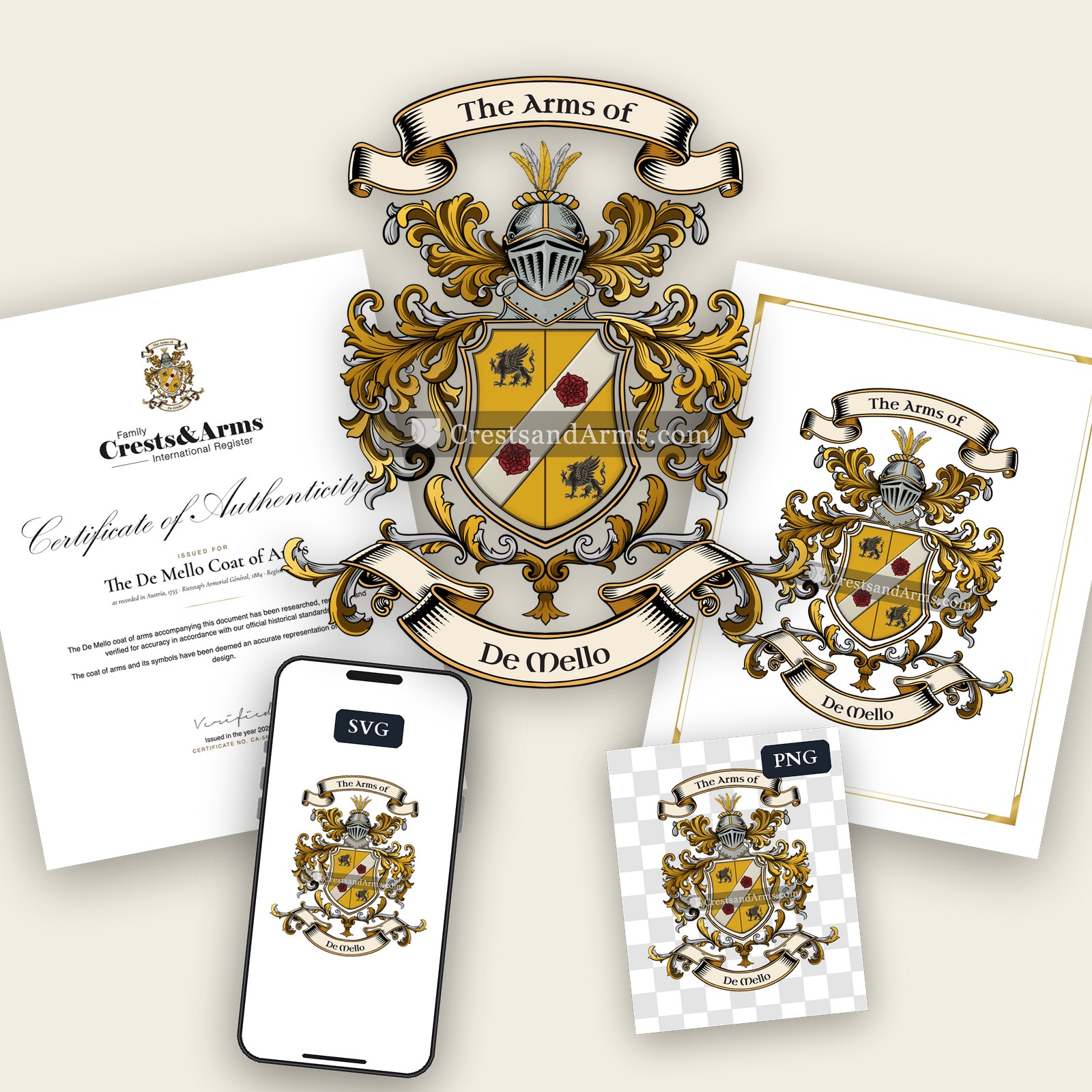
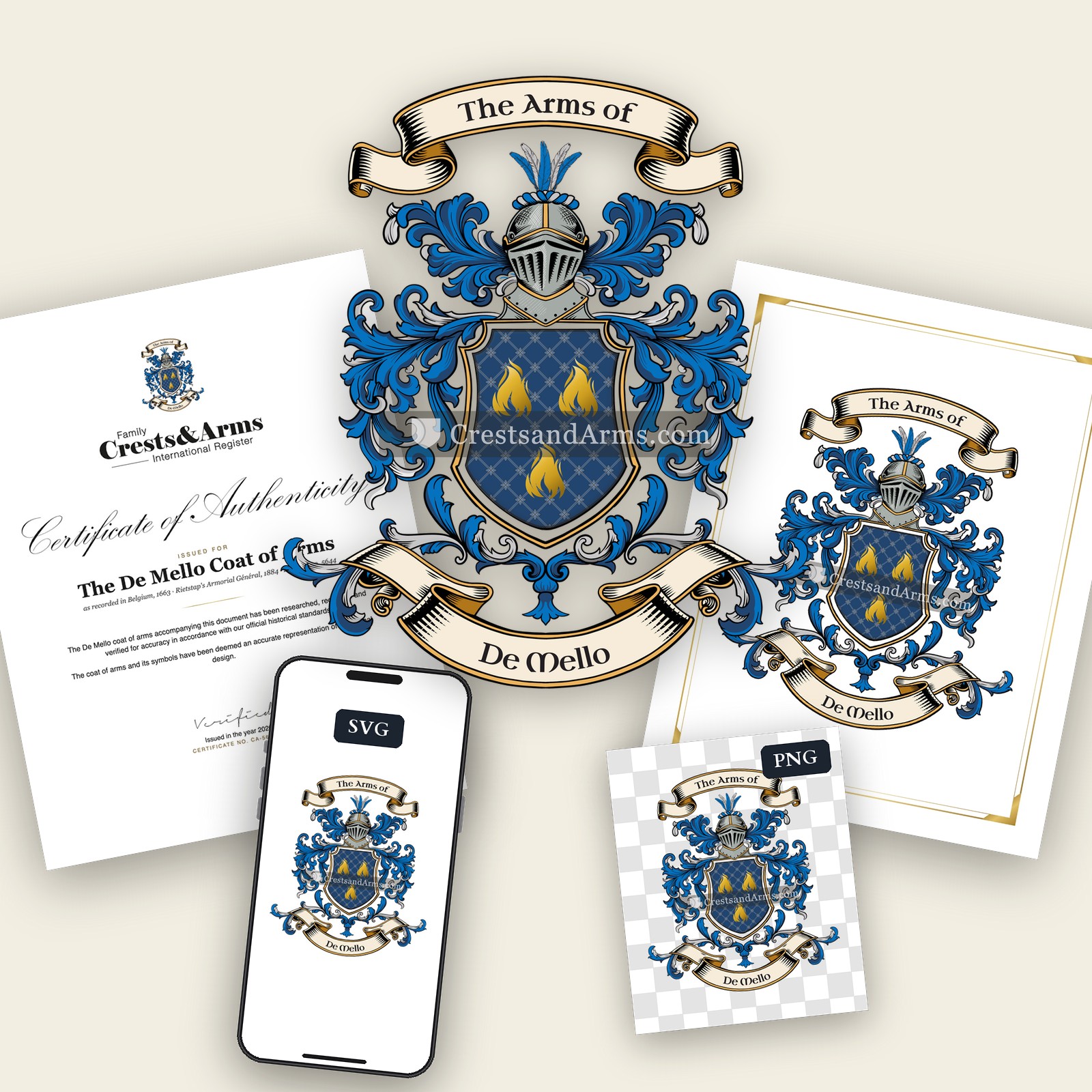
A record of documented arms, meaning and origin, researched for the De Mello family lines. Documented in 2 countries.
Reg. 5644 · Austrian, D–F
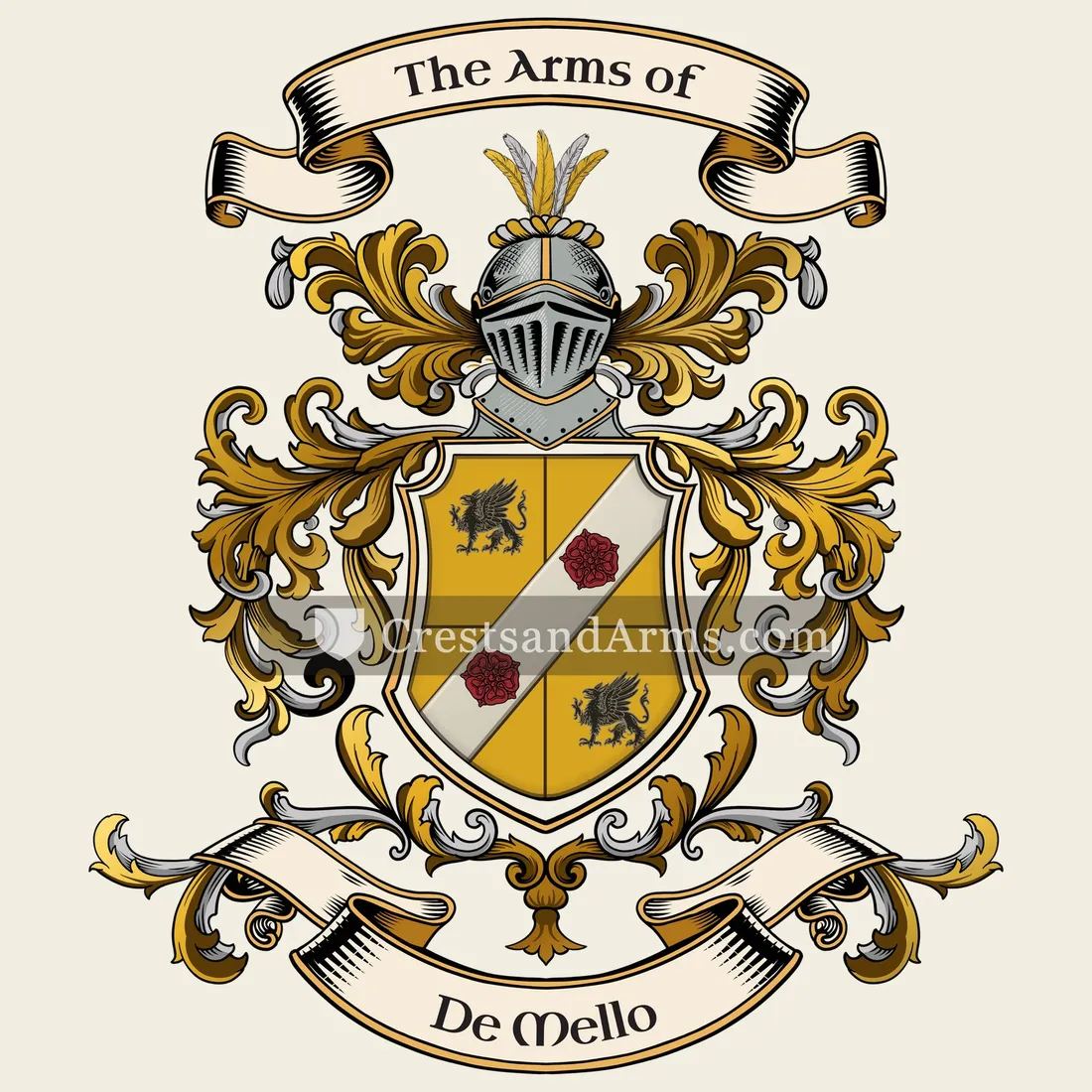
Meaning of the De Mello family crest colors & symbols
Symbols on this shield
griffinValour and vigilance, guarding great treasure
roseThe seventh son, and beauty with grace
Colours
Gold (Or)Means: Generosity
Silver (Argent)Means: Peace and sincerity
Black (Sable)Means: Constancy
Red (Gules)Means: Military strength
Historical info
Source
J. B. Rietstap, Armorial Général, Gouda: G. B. van Goor Zonen, 1884–87
Blazon (the actual original written record)
“Ec.: aux 1 et 4 d'or au griffon de sa., tenant une épée d'arg., celui du 1 cont.; aux 2 et 3 d'azur à la barre d'arg., ch. d'une rose de gu. Deux cq. cour. C.: 1° le griffon du 1, iss.; l. d'or et de sa.; 2° une grue avec sa vigilance au nat., entre un vol d'or et d'azur; l. d'arg. et d'azur.”
Austriac. 1755
Digital archive packCoat of arms PNG, gold border print PDF, vector SVG and the certificate of authenticity. Sent to your email in minutes.
Map of Austria showing where the De Mello arms are recorded
The De Mello arms were recorded in Austria, c. 1755.
Arms such as these were typically recorded in Tyrol.
Tyrol was mountain country in western Austria, where the valleys were held by families who had been there a very long time. Old tenure counted for more than money, and old families carried arms.
This is where the arms were entered in the register. Families often moved to other parts of the country, so the same name can turn up in more than one region.
Region
Tyrol
First recorded
1755
Granting Authority for the De Mello Arms
Imperial and Royal chancery
Sodacan · CC BY-SA 3.0
The body that granted and recorded arms in Austria in this period.
Francis I, Holy Roman Emperor
Sovereign of the period
Francis I, Holy Roman Emperor
1745–1765
Reigning in Austria when the De Mello arms are first recorded.
How Arms Worked in Austria
Austrian coats of arms were often linked directly to noble titles granted by the Emperor. These symbols belonged to the entire family line rather than just one individual. When a family grew, new branches kept the original design without needing to change it. This system allowed all members of a noble house to share the same identity across many generations.
Granting authority
The Imperial and Royal chancery managed all heraldic matters and controlled the official granting of arms throughout the Austrian lands.
How they got arms
Families typically received their arms through a formal imperial decree that often accompanied the elevation of a person to noble status.
Where arms were recorded
Official records of these grants were kept in the Imperial Register of Nobility which began its formal documentation process in 1453.
The family's standing
Recorded among the armigerous families of Austria.
Origin & History of the De Mello Family in Austria
The family name De Mello first appears in the historical records of the Tyrol region of Austria around 1755. While the name itself has roots that trace back to the Iberian Peninsula, its presence in the Austrian Alps suggests a fascinating story of migration and adaptation during the eighteenth century. Families with this name likely moved into the mountainous terrain of Tyrol to participate in the growing trade networks or administrative roles that defined the Habsburg Empire at the time. Life in this region required the family to integrate into a German-speaking society while maintaining their distinct cultural identity. By settling in Tyrol, these early ancestors became part of a unique borderland culture where they navigated the challenges of alpine agriculture and local commerce. Their presence in the mid-eighteenth century marks a significant chapter in the family history, showing how they established roots in a new landscape far from their original geographic origins.
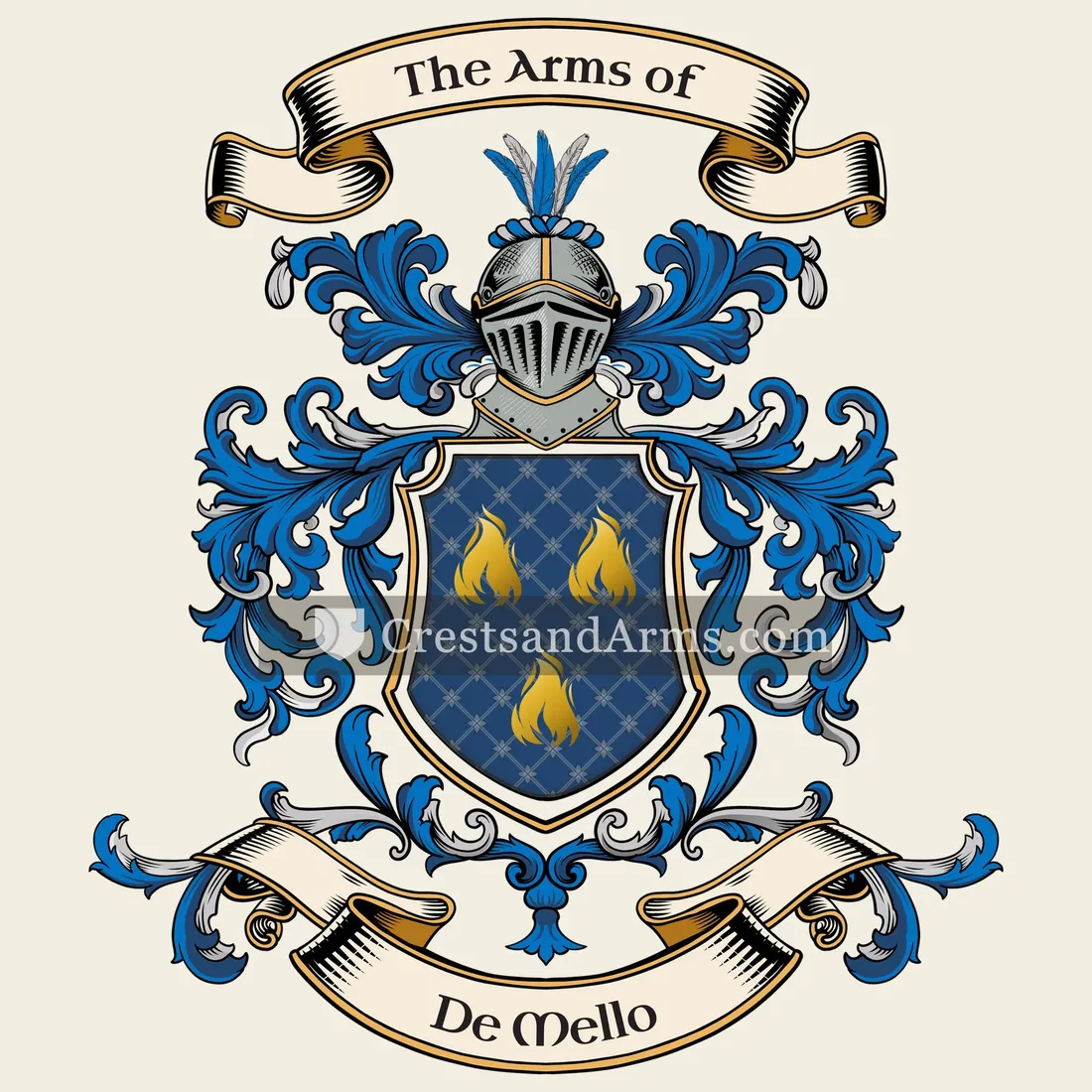
Meaning of the De Mello family crest colors & symbols
Symbols on this shield
fireZeal and purification
Colours
Blue (Azure)Means: Loyalty and truth
Gold (Or)Means: Generosity
Historical info
Source
J. B. Rietstap, Armorial Général, Gouda: G. B. van Goor Zonen, 1884–87
Blazon (the actual original written record)
“D'azur à trois flammes d'or.”
FlandreFlandre, c. 1663
Digital archive packCoat of arms PNG, gold border print PDF, vector SVG and the certificate of authenticity. Sent to your email in minutes.
Map of Belgium showing where the De Mello arms are recorded
The De Mello arms were recorded in Flandre, c. 1663.
Flandre grew rich on cloth, and its towns were among the busiest in Europe. Merchant families bought land with their profits and took arms to go with it, so trade put as many names in the registers here as land did.
This is where the arms were entered in the register. Families often moved to other parts of the country, so the same name can turn up in more than one region.
The body that granted and recorded arms in Belgium in this period.
Philip IV of Spain
Sovereign of the period
Philip IV of Spain
1621–1665
Reigning in Austria when the De Mello arms are first recorded.
How Arms Worked in Belgium
In Belgium, a coat of arms is considered personal property that is passed down through the male line to legitimate descendants. Families often use the same shield design across generations to show their shared heritage. If a branch of the family wants to change the design, they must apply for an official update to their specific version of the arms.
Granting authority
The Conseil héraldique is the official body that regulates and approves all coats of arms in Belgium.
How they got arms
Families obtain their coats of arms through formal royal grants or by confirming their historical right to use existing designs.
Where arms were recorded
All approved coats of arms are officially recorded in the public registers of the Conseil héraldique since 1844.
The family's standing
Recorded among the armigerous families of Flandre.
Origin & History of the De Mello Family in Belgium
The family name De Mello traces its roots in the region of Flanders back to at least 1663. During the seventeenth century, the southern Netherlands served as a vibrant crossroads for trade and cultural exchange, drawing families from across Europe to its bustling cities. The presence of the De Mello name in this area suggests that these early ancestors were likely part of a mobile class of merchants or skilled professionals who moved through the Low Countries to take advantage of the region's economic stability. By settling in Flanders, these individuals integrated into a society defined by its complex urban life and international connections. Their arrival during this period reflects the broader historical trend of families seeking new opportunities within the thriving commercial hubs of the Flemish territory. Over time, the name became established within the local records, marking the beginning of a long history for the family in this part of Europe.
De Mello Meaning & Related Branches
Root word
Mellum
A sandbank or coastal area of land.
This name
De MelloRefers to a person who lived near a coastal sandbank or island.
also spelled
de Mell
de Melle
de Mely
Documented Sources
J. B. Rietstap, Armorial Général, Gouda: G. B. van Goor Zonen, 1884–87
Tiroler Landesarchiv, Tiroler Standesbeschreibungen und Familienregister, 1755
Huter, Franz, Tiroler Urkundenbuch, 1937
Digital archive packCoat of arms PNG, gold border print PDF, vector SVG and the certificate of authenticity. Sent to your email in minutes.


 griffinValour and vigilance, guarding great treasure
 roseThe seventh son, and beauty with grace
 griffinValour and vigilance, guarding great treasure
 roseThe seventh son, and beauty with grace


 fireZeal and purification