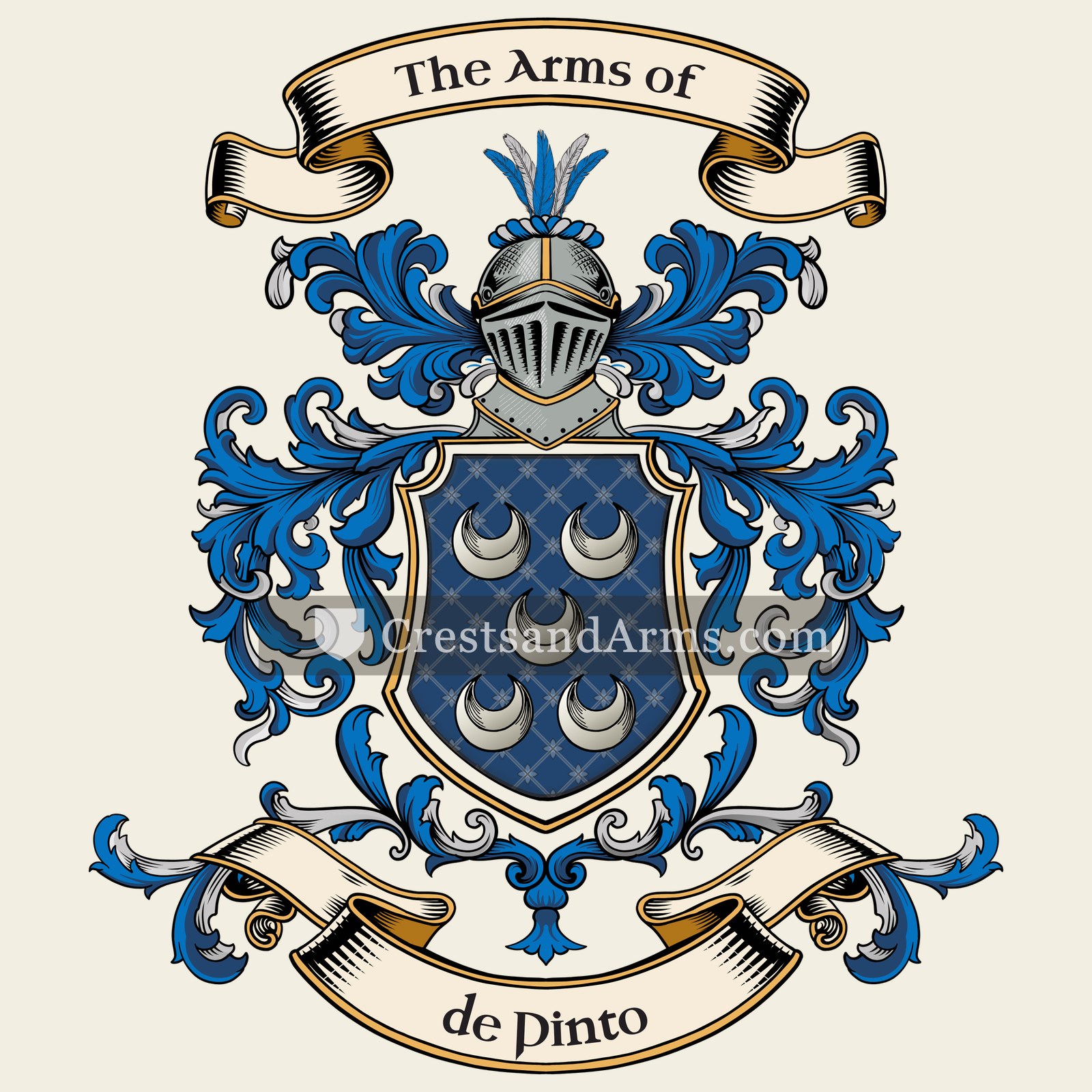
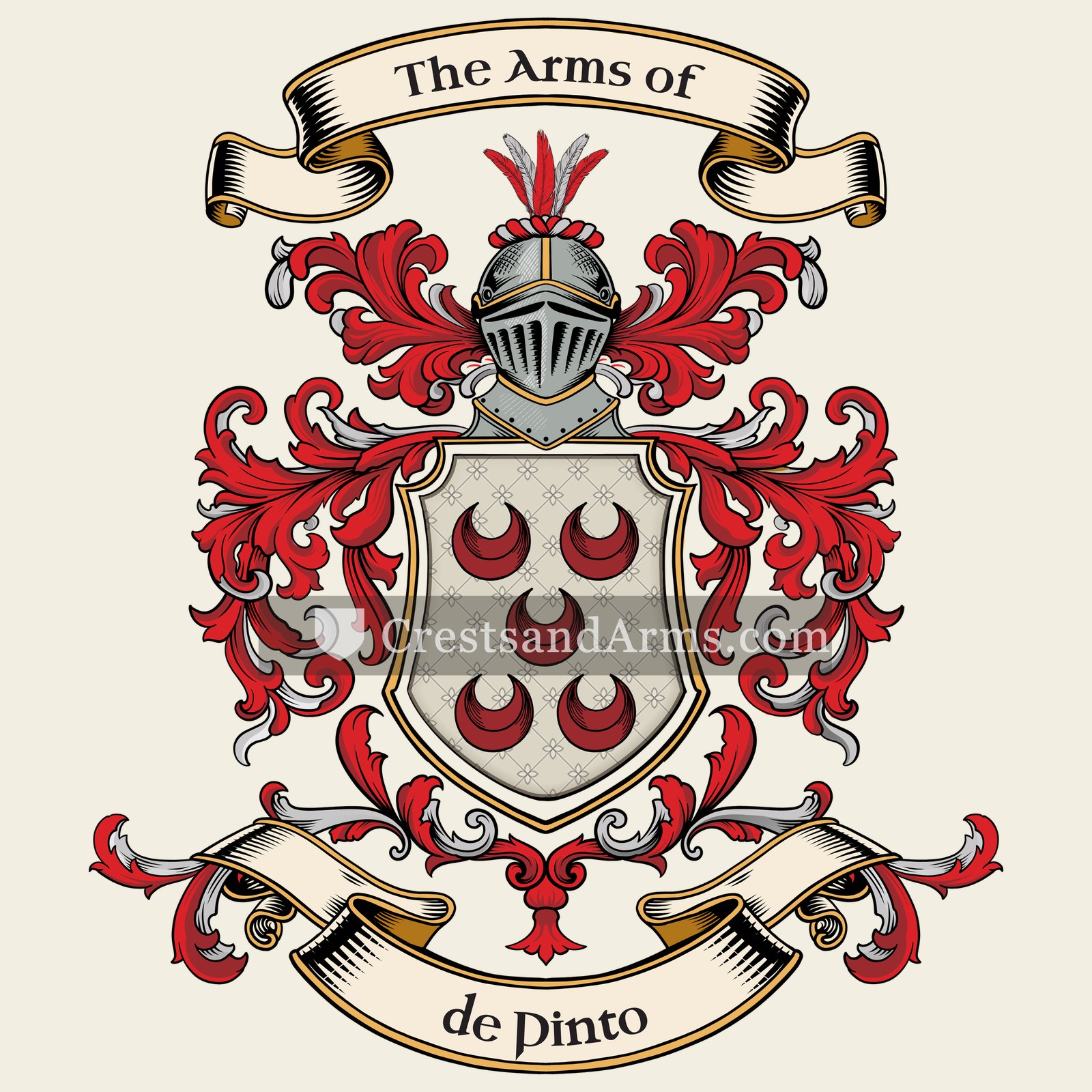
A record of documented arms, meaning and origin, researched for the de Pinto family lines. Documented in 2 countries.
Reg. 5888 · German, D–F
Coat of Arms & Family Crest Details
Symbols on this shield
crescentHonour by the sovereign, and the second son
Colours
Blue (Azure)Means: Loyalty and truth
Silver (Argent)Means: Peace and sincerity
Historical info
Source
J. B. Rietstap, Armorial Général, Gouda: G. B. van Goor Zonen, 1884–87
Blazon (the actual original written record)
“D'azur à cinq croiss. d'arg., 2, 1 et 2. C.: trois pl. d'aut. d'arg.”
Germanyc. 1765
Where the de Pinto Arms Were Recorded
Bavaria
Map of Germany showing where the de Pinto arms are recorded
The de Pinto arms were recorded in Germany, c. 1765.
Arms such as these were typically recorded in Bavaria.
Bavaria was a country of old landed families and walled market towns. Estates passed down the same line for centuries, and both the landowners and the leading townsmen kept arms, which is why so many Bavarian names sit in the registers.
This is where the arms were entered in the register. Families often moved to other parts of the country, so the same name can turn up in more than one region.
The body that granted and recorded arms in Germany in this period.
Francis I, Holy Roman Emperor
Sovereign of the period
Francis I, Holy Roman Emperor
1745–1765
Reigning in Germany when the de Pinto arms are first recorded.
How Arms Worked in Germany
In the Holy Roman Empire, coats of arms were often granted to individuals by the Emperor or his representatives. These arms were then passed down through the generations to all legitimate descendants of the original holder. Younger branches of a family usually kept the same shield design without needing to change it, as the arms belonged to the entire lineage.
Granting authority
The Holy Roman Emperor held the sole power to grant new coats of arms throughout his vast imperial territories.
How they got arms
Families typically obtained their coats of arms through a formal imperial grant or by proving their noble status to the authorities.
Where arms were recorded
These grants were officially recorded in the Imperial Chancery registers, which began keeping formal records of such honors during the Middle Ages.
The family's standing
Recorded among the armigerous families of Germany.
Origin & History of the de Pinto Family in Germany
The history of the de Pinto family in Germany is deeply connected to the social and economic shifts of the eighteenth century. By 1765, records confirm that members of the family were well-established in Bavaria, a region known for its complex administrative and trade networks. During this era, families with names like de Pinto often navigated the transition from traditional merchant roles to positions within the growing civil service and professional classes of the Holy Roman Empire. Their presence in Bavaria suggests they were part of a mobile group of families who moved across European borders to pursue new opportunities in finance, law, or royal administration. While the name itself carries roots that stretch toward the Iberian Peninsula, its adoption and persistence in German lands highlight the integration of diverse cultural backgrounds into the local society of the time. This period marked a time of significant growth for the family as they settled into the urban centers of southern Germany and began to weave their own history into the broader narrative of the region.
Coat of Arms & Family Crest Details
Symbols on this shield
crescentHonour by the sovereign, and the second son
Colours
Silver (Argent)Means: Peace and sincerity
Red (Gules)Means: Military strength
Historical info
Source
J. B. Rietstap, Armorial Général, Gouda: G. B. van Goor Zonen, 1884–87
Blazon (the actual original written record)
“D'arg. à cinq croiss. de gu., 2, 1 et 2.”
NaplesNaples, c. 1706
Where the de Pinto Arms Were Recorded
Map of Portugal showing where the de Pinto arms are recorded
The de Pinto arms were recorded in Naples, c. 1706.
Naples was the largest city in Italy and the seat of a kingdom. Its noble houses were numerous, and the kingdom kept formal lists of the families entitled to arms, which is why so many appear in the records.
This is where the arms were entered in the register. Families often moved to other parts of the country, so the same name can turn up in more than one region.
The body that granted and recorded arms in Portugal in this period.
Peter II of Portugal
Sovereign of the period
Peter II of Portugal
1683–1706
Reigning in Germany when the de Pinto arms are first recorded.
How Arms Worked in Portugal
In Portugal, a coat of arms was a family possession that passed from a father to his children. Every legitimate descendant had the right to use the family shield without needing to change it. Younger branches of the family kept the original design, though they sometimes added small symbols to distinguish their specific line from the main branch.
Granting authority
The Cartório da Nobreza acted as the official body that managed and regulated noble titles and coats of arms in Portugal.
How they got arms
Families typically inherited their arms through bloodline, though they could also receive new grants from the crown for distinguished service.
Where arms were recorded
Coats of arms were officially recorded in the books of the Cartório da Nobreza starting in the year 1512.
The family's standing
Recorded among the armigerous families of Naples.
Origin & History of the de Pinto Family in Portugal
The family name de Pinto traces its roots to the Iberian Peninsula, where it emerged as a prominent surname among Sephardic Jewish families in Portugal. During the late fifteenth and sixteenth centuries, many families with this name faced immense pressure due to the Portuguese Inquisition, which forced them to choose between exile or conversion to Christianity. Those who chose to leave Portugal often settled in major trade hubs across Europe and the Mediterranean to escape persecution and rebuild their lives. By the time members of the family were documented in Naples in 1706, they had established themselves as part of a sophisticated network of international merchants and financiers. This migration allowed the family to preserve their identity while adapting to new political landscapes, eventually becoming influential figures in the economic life of various European cities.
Related Branches & Arms
Root word
pinctus
Latin term meaning painted or colored.
This name
de PintoRefers to a person with a colorful appearance or one who worked as a painter.
also spelled
Pinto
de Pintoh
de Pintoo
de Pento
Related arms
Pintovariant spelling
Documented Sources
J. B. Rietstap, Armorial Général, Gouda: G. B. van Goor Zonen, 1884–87
Bayerisches Hauptstaatsarchiv, General-Landes-Direktion, Akten der kurfürstlichen Regierung, 1765
Friedrich, Karin, The Other Prussia: Royal Prussia, Poland and Liberty, 1569-1772, 2000
Schilling, Heinz, Konfession und Außenpolitik unter dem Haus Habsburg, 1999
Digital archive packCoat of arms PNG, gold border print PDF, vector SVG and the certificate of authenticity. Sent to your email in minutes.


 crescentHonour by the sovereign, and the second son
 crescentHonour by the sovereign, and the second son