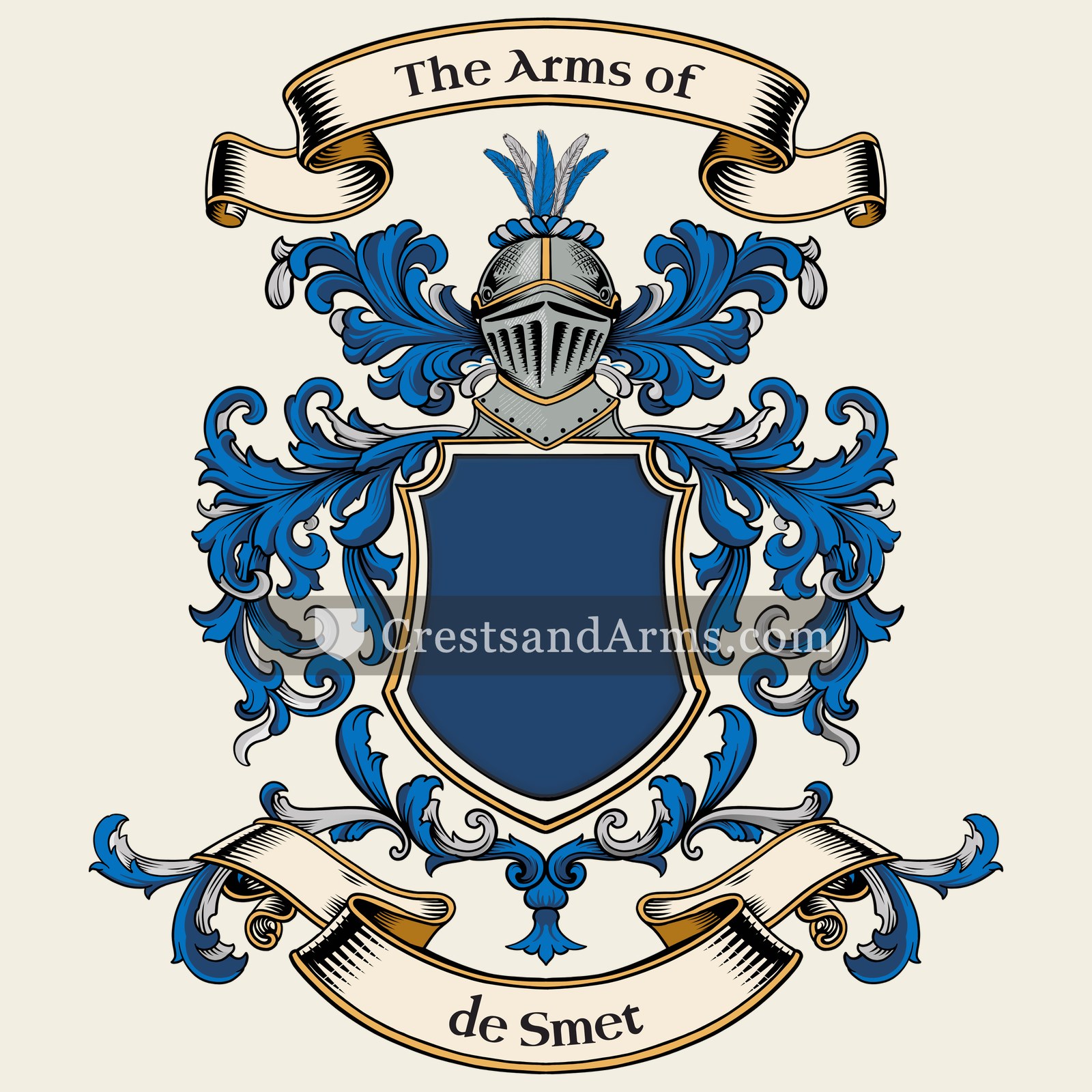
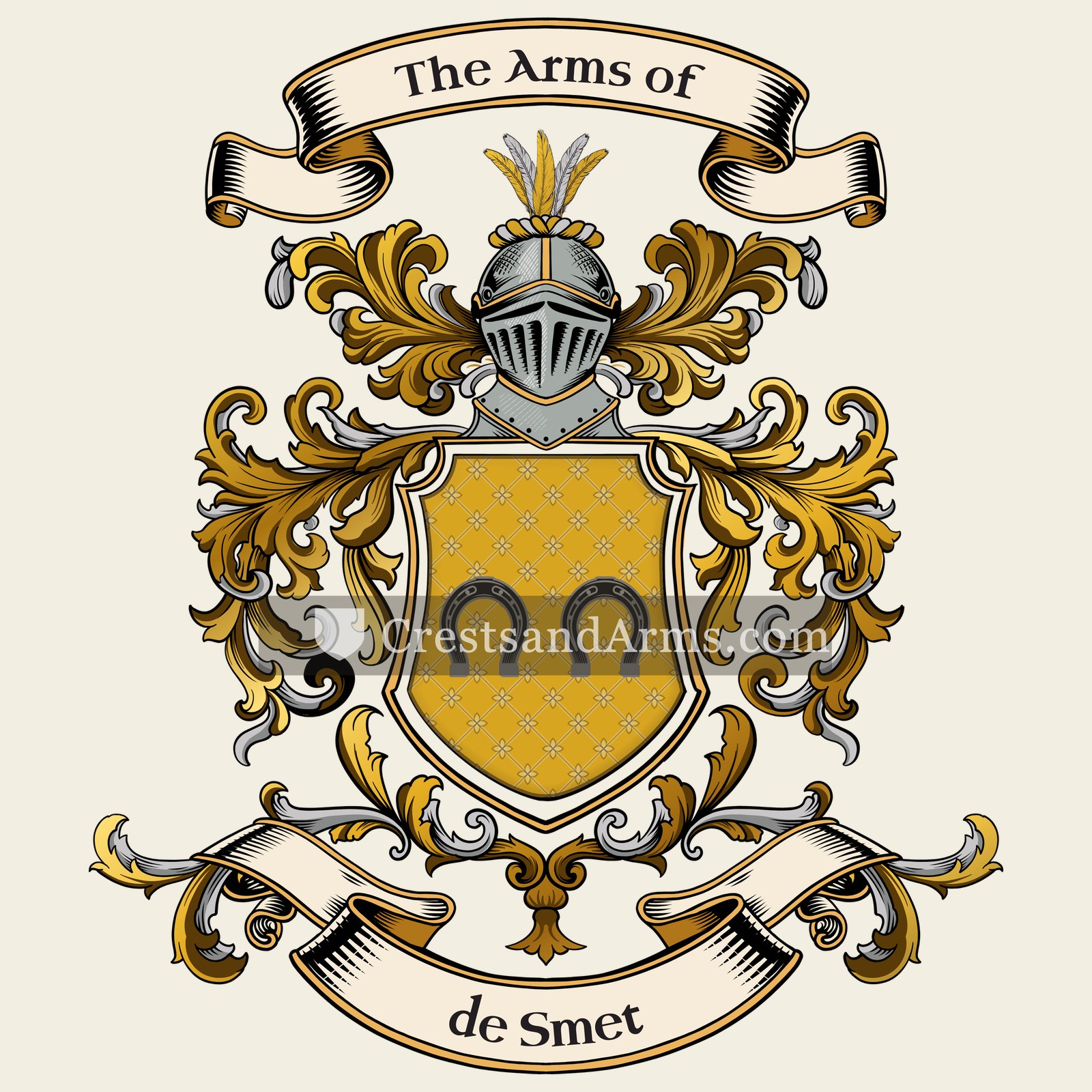
A record of documented arms, meaning and origin, researched for the de Smet family lines. Documented in 2 countries.
Reg. 6432 · Belgian, D–F
Coat of Arms & Family Crest Details
Colours
Blue (Azure)Means: Loyalty and truth
Black (Sable)Means: Constancy
Historical info
Source
J. B. Rietstap, Armorial Général, Gouda: G. B. van Goor Zonen, 1884–87
Blazon (the actual original written record)
“Coupé d'azur sur sa.; à trois anémones d'arg., bout. de sin. C.: une anémone de l'écu: entre un vol, d'azur et de sa. L.: à dextre d'arg. et d'azur, à sen. d'arg. et de sa.”
BelgiumGand, c. 1729
Where the de Smet Arms Were Recorded
Gand
Map of Belgium showing where the de Smet arms are recorded
The de Smet arms were recorded in Gand, c. 1729.
This is where the arms were entered in the register. Families often moved to other parts of the country, so the same name can turn up in more than one region.
The body that granted and recorded arms in Belgium in this period.
Charles VI, Holy Roman Emperor
Sovereign of the period
Charles VI, Holy Roman Emperor
1711–1740
Reigning in Belgium when the de Smet arms are first recorded.
How Arms Worked in Belgium
In Belgium, a coat of arms is considered personal property that is passed down through the male line to legitimate descendants. Families often use the same shield design across generations to show their shared heritage. If a branch of the family wants to change the design, they must apply for an official update to their specific version of the arms.
Granting authority
The Conseil héraldique is the official body that regulates and approves all coats of arms in Belgium.
How they got arms
Families obtain their coats of arms through formal royal grants or by confirming their historical right to use existing designs.
Where arms were recorded
All approved coats of arms are officially recorded in the public registers of the Conseil héraldique since 1844.
The family's standing
Recorded among the armigerous families of Belgium.
Origin & History of the de Smet Family in Belgium
The family name de Smet is deeply rooted in the history of the Flanders region of Belgium, where it functioned as a descriptive occupational surname derived from the Middle Dutch word for a smith or metalworker. By the year 1729, records confirm that members of the family were well-established in the city of Ghent, which was then a prominent center for trade and textile production. During this era, families with this name were often integrated into the urban fabric of the city, working as skilled craftsmen or merchants who contributed to the local economy. As the family grew, they became part of the social and civic life of Ghent, reflecting the broader transition of Belgian society from feudal structures toward a more organized urban middle class. The name remains a testament to the essential role that metalworkers played in the development of Belgian towns during the eighteenth century.
Coat of Arms & Family Crest Details
Symbols on this shield
horseshoeGood fortune and protection from harm
Colours
Gold (Or)Means: Generosity
Black (Sable)Means: Constancy
Historical info
Source
J. B. Rietstap, Armorial Général, Gouda: G. B. van Goor Zonen, 1884–87
Blazon (the actual original written record)
“D'or à deux fers-à-cheval de sa., l'un sur l'autre, les dos opposés.”
FlandreFlandre, c. 1663
Where the de Smet Arms Were Recorded
Flandre
Map of France showing where the de Smet arms are recorded
The de Smet arms were recorded in Flandre, c. 1663.
Flandre grew rich on cloth, and its towns were among the busiest in Europe. Merchant families bought land with their profits and took arms to go with it, so trade put as many names in the registers here as land did.
This is where the arms were entered in the register. Families often moved to other parts of the country, so the same name can turn up in more than one region.
The body that granted and recorded arms in France in this period.
Louis XIV of France
Sovereign of the period
Louis XIV of France
1643–1715
Reigning in Belgium when the de Smet arms are first recorded.
How Arms Worked in France
In France, a coat of arms was a mark of honor that passed down through the male line to all legitimate descendants. Families often used the same shield without changes to show their shared heritage. If a branch wanted to stand out, they could add a small mark to their shield to show their specific place in the family tree.
Granting authority
The Juge d'armes de France acted as the official authority that regulated and verified coats of arms across the country.
How they got arms
Families typically inherited their arms from ancestors, though they could also receive them through royal grants or by proving their noble status.
Where arms were recorded
Coats of arms were officially recorded in the Armorial Général de France, which began its main collection in the year 1696.
The family's standing
Recorded among the armigerous families of Flandre.
Origin & History of the de Smet Family in France
The surname de Smet originates from the Dutch word for a smith, which highlights the family's deep roots in the skilled labor and craftsmanship of the Flanders region. While the name is famously associated with the Low Countries, its history is closely tied to the shifting borders and cultural exchanges between the French-speaking territories and the Flemish lands during the seventeenth century. By 1663, the family was already well-established in the region of Flanders, where they lived during a period of intense political transition under the influence of the French crown. As the borders of France expanded northward during the reign of Louis XIV, families like the de Smets often found themselves navigating the complex legal and social systems of a changing frontier. This environment allowed the family to transition from their traditional roles as local tradespeople into positions of greater influence within the administrative and commercial life of the borderlands. Their presence in the region during this era reflects the broader movement of families who helped bridge the gap between the distinct cultures of northern France and the southern Netherlands.
Related Branches & Arms
Root word
Smid
A person who works with metal or a blacksmith.
This name
de SmetRefers to a person who worked as a blacksmith or metalworker.
also spelled
de Smett
de Smedt
Related arms
de Smedtvariant spelling
Documented Sources
J. B. Rietstap, Armorial Général, Gouda: G. B. van Goor Zonen, 1884–87
De Flou, Karel. Woordenboek der toponymie van westelijk Vlaanderen, Vlaamsch-Artois, het Land van den Hoek, de Fransche Westhoek, Staats-Vlaanderen en het Doorniksche. 1914
State Archives in Ghent (Rijksarchief te Gent), Parochieregisters van Gent. 1729
Debrabandere, Frans. Woordenboek van de familienamen in België en Noord-Frankrijk. 2003
Digital archive packCoat of arms PNG, gold border print PDF, vector SVG and the certificate of authenticity. Sent to your email in minutes.



 horseshoeGood fortune and protection from harm