Map of France showing where the de Vere arms are recorded
The de Vere arms were recorded in France, c. 1155.
Arms such as these were typically recorded in Bretagne.
More families held coats of arms in Bretagne than anywhere else in France. The land was divided into many small estates rather than a few large ones, so far more households counted as gentry, and each needed a shield of its own to be told apart.
This is where the arms were entered in the register. Families often moved to other parts of the country, so the same name can turn up in more than one region.
The body that granted and recorded arms in France in this period.
How Arms Worked in France
In France, a coat of arms was a mark of honor that passed down through the male line to all legitimate descendants. Families often used the same shield without changes to show their shared heritage. If a branch wanted to stand out, they could add a small mark to their shield to show their specific place in the family tree.
Granting authority
The Juge d'armes de France acted as the official authority that regulated and verified coats of arms across the country.
How they got arms
Families typically inherited their arms from ancestors, though they could also receive them through royal grants or by proving their noble status.
Where arms were recorded
Coats of arms were officially recorded in the Armorial Général de France, which began its main collection in the year 1696.
The family's standing
Recorded among the armigerous families of France.
Origin & History of the de Vere Family in France
The family name de Vere traces its origins to the region of Ver in the Cotentin Peninsula of Normandy, France. The name itself is a locative surname, meaning it was derived from the specific place where the family held land and influence. By the middle of the twelfth century, members of the family had established a notable presence in the neighboring region of Brittany. Records from 1155 confirm their activity in this area, highlighting their role as part of the mobile aristocracy that moved between French territories and the British Isles during the medieval period. This early history reflects a time when noble families maintained strong connections to their ancestral French roots while simultaneously building power in new territories. Their migration patterns were common for families of their status, as they sought to manage estates and political alliances across the English Channel.
Coat of Arms & Family Crest Details
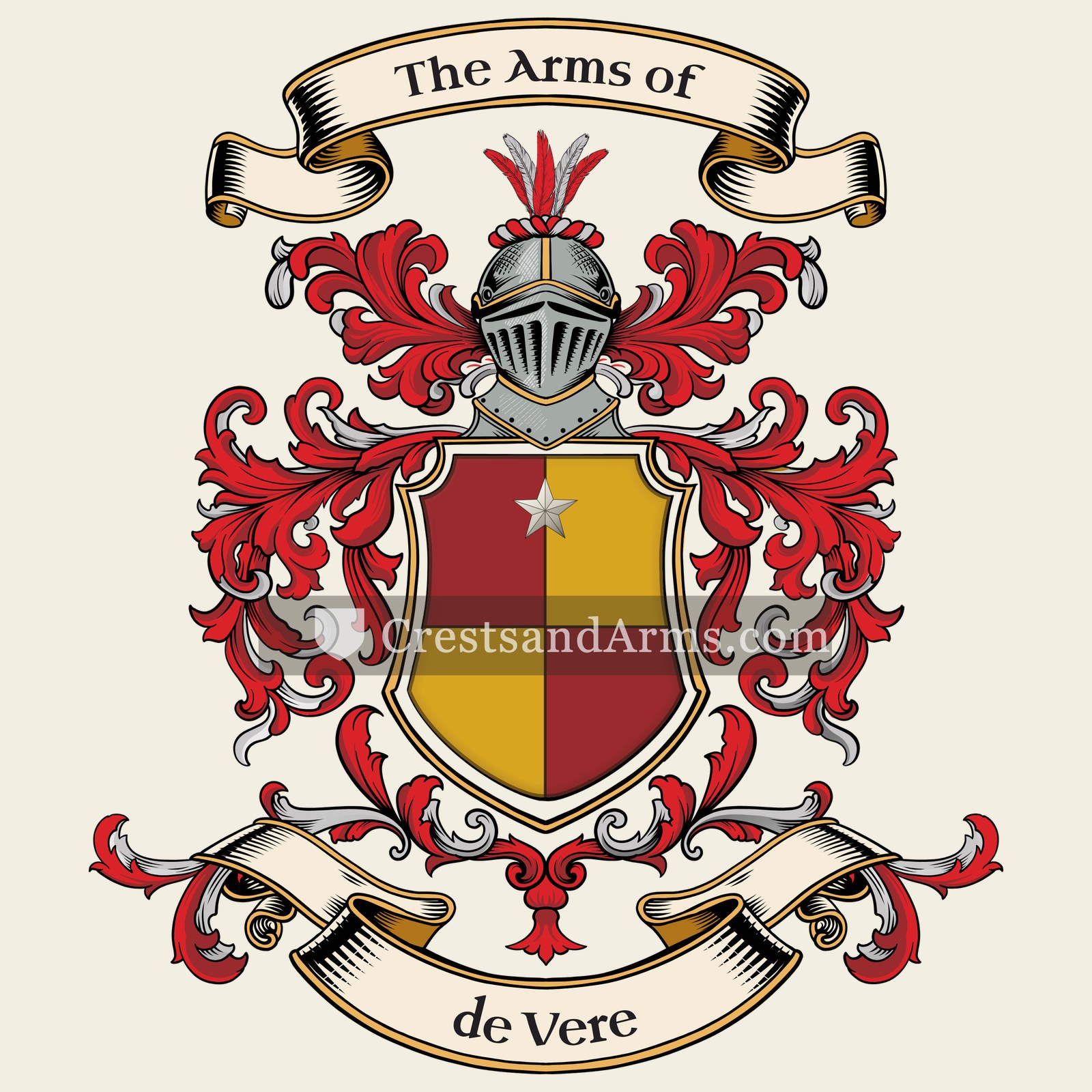
Symbols on this shield
mulletThe third son, and a divine quality from above
Colours
Red (Gules)Means: Military strength
Gold (Or)Means: Generosity
Silver (Argent)Means: Peace and sincerity
Historical info
Source
Sir Bernard Burke, The General Armory of England, Scotland, Ireland and Wales, London: Harrison & Sons, 1884
Blazon (the actual original written record)
“Quarterly, gu. and or, in the dexter chief quarter a mullet ar”
LimerickCurragh Chase · Limerick, c. 1645
Digital archive packCoat of arms PNG, gold border print PDF, vector SVG and the certificate of authenticity. Sent to your email in minutes.
Map of Ireland showing where the de Vere arms are recorded
The de Vere arms were recorded in Limerick, c. 1645.
Limerick was river country in western Ireland with a walled city at its centre. Merchant families ran the city and bought land around it, and both the trade and the land brought arms.
This is where the arms were entered in the register. Families often moved to other parts of the country, so the same name can turn up in more than one region.
The body that granted and recorded arms in Ireland in this period.
Charles I of England
Sovereign of the period
Charles I of England
1625–1649
Reigning in France when the de Vere arms are first recorded.
How Arms Worked in Ireland
The Ulster King of Arms granted coats of arms to individuals who proved their social standing and good character. These symbols were typically inherited by all legitimate descendants of the original holder. If a family branch wanted a unique look, they could apply for a specific change to their design through the office to ensure their identity remained distinct.
Granting authority
The Ulster King of Arms acted as the official body that regulated and issued all coats of arms throughout Ireland.
How they got arms
Families obtained their arms through formal grants issued by the office after proving their eligibility and paying the required fees.
Where arms were recorded
All official grants were recorded in the registers held by the Ulster King of Arms starting from the year 1552.
The family's standing
Recorded among the armigerous families of Limerick.
Origin & History of the de Vere Family in Ireland
The history of the de Vere family in Ireland is deeply connected to the turbulent events of the seventeenth century. While the name has ancient roots in Normandy and England, the Irish branch became firmly established in County Limerick by 1645. During this period, the family settled into the social and political landscape of Munster, a region marked by shifting land ownership and conflict. They integrated into the local gentry, eventually making their home at Curragh Chase, which became a significant estate. Over the generations, the family transitioned from their early roles as landowners into figures who influenced the cultural and literary life of Ireland. Their presence in Limerick serves as a clear starting point for tracing how a family of Norman descent adapted to the unique challenges and opportunities of Irish society.
de Vere Meaning & Related Branches
Root word
ver
Latin term meaning truth or true.
This name
de VereDerived from the place name Ver in Normandy, signifying someone from the true or real location.
also spelled
Deveer
de Veer
Dever
Related arms
de Veervariant spelling
van Devervariant spelling
Documented Sources
J. B. Rietstap, Armorial Général, Gouda: G. B. van Goor Zonen, 1884–87
Cokayne, George Edward, The Complete Peerage of England, Scotland, Ireland, Great Britain and the United Kingdom, 1910
Round, John Horace, Geoffrey de Mandeville: A Study of the Anarchy, 1892
The National Archives, Kew, Pipe Rolls, Series E 372
Digital archive packCoat of arms PNG, gold border print PDF, vector SVG and the certificate of authenticity. Sent to your email in minutes.


 starThe celestial goddess, and nobility
 starThe celestial goddess, and nobility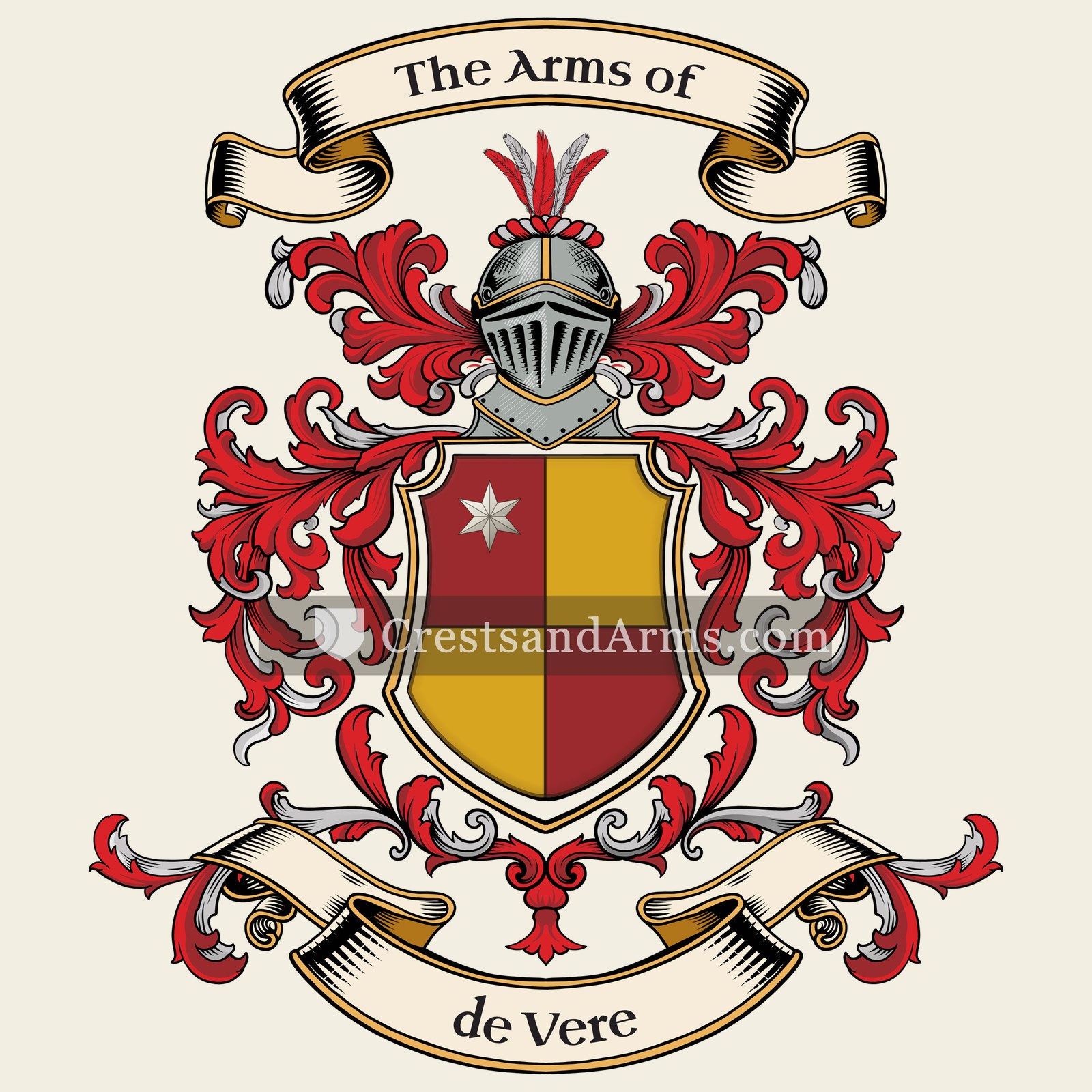

 mulletThe third son, and a divine quality from above