Map of England showing where the Dean arms are recorded
The Dean arms were recorded in Northampton, c. 1620.
Northamptonshire was grazing and hunting country in the middle of England, thick with manor houses. Its families were numerous and long-settled, and a settled landed family almost always ended up with arms.
This is where the arms were entered in the register. Families often moved to other parts of the country, so the same name can turn up in more than one region.
The body that granted and recorded arms in England in this period.
James VI and I
Sovereign of the period
James VI and I
1603–1625
Reigning in England when the Dean arms are first recorded.
How Arms Worked in England
English heraldry allowed arms to be shared by all legitimate descendants of the original owner. These symbols were treated as personal property that moved through the generations to all children. While the eldest son kept the original design, other family members could use the same shield without needing to change it or register their own unique versions.
Granting authority
The College of Arms in London has regulated the use of coats of arms throughout England and Wales since 1484.
How they got arms
Families typically obtained their coats of arms through a formal grant from the Crown or by proving their ancient right to them.
Where arms were recorded
All official coats of arms are recorded in the registers kept at the College of Arms, which date back to the fifteenth century.
The family's standing
Recorded among the armigerous families of Northampton.
Origin & History of the Dean Family in England
The surname Dean is a topographical name that originated in medieval England to describe someone who lived near a valley or a wooded hollow. The word itself comes from the Old English term denu, which means a deep, narrow valley. As people began to adopt permanent surnames during the Middle Ages, those who resided in or near these natural features were often identified by their surroundings. By the time the family was established in Northampton in 1620, the name had been in use for several centuries across various English counties. Families bearing this name were typically part of the local community, often working as farmers or tradespeople who were deeply connected to the land. Because the name was tied to a common landscape feature, it emerged independently in different regions, reflecting the geography of the English countryside where these early ancestors lived and worked.
Coat of Arms & Family Crest Details
Symbols on this shield
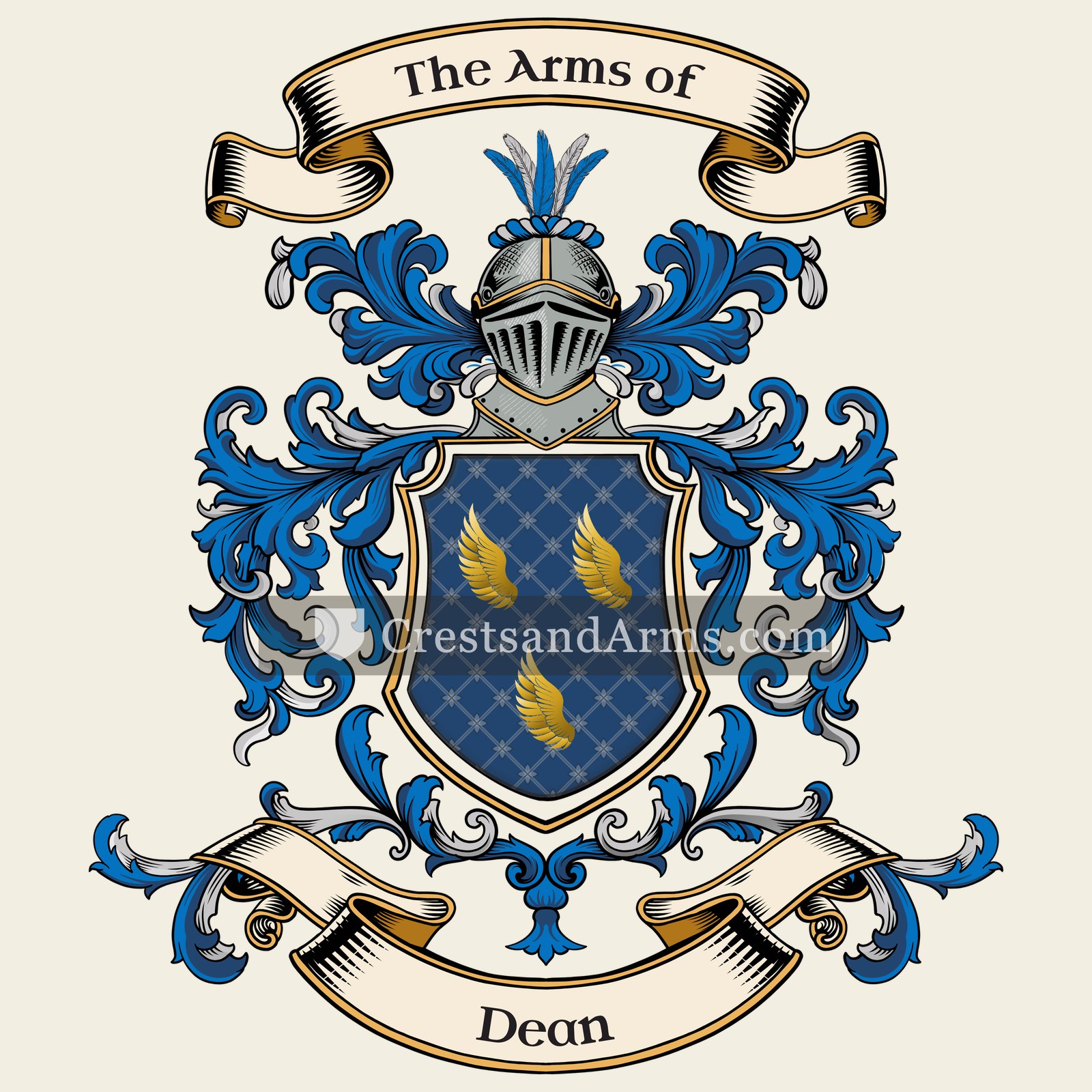
wingSwiftness, and protection under a raised wing
Colours
Blue (Azure)Means: Loyalty and truth
Gold (Or)Means: Generosity
Historical info
Source
Sir Bernard Burke, The General Armory of England, Scotland, Ireland and Wales, London: Harrison & Sons, 1884
Blazon (the actual original written record)
“Az. three wings or”
GalwayGalway, c. 1645
Digital archive packCoat of arms PNG, gold border print PDF, vector SVG and the certificate of authenticity. Sent to your email in minutes.
Map of Ireland showing where the Dean arms are recorded
The Dean arms were recorded in Galway, c. 1645.
Galway was western Irish country of poor land and a rich port. A small group of merchant families ran the town for centuries and held estates around it, and both kinds of property carried arms.
This is where the arms were entered in the register. Families often moved to other parts of the country, so the same name can turn up in more than one region.
The body that granted and recorded arms in Ireland in this period.
Charles I of England
Sovereign of the period
Charles I of England
1625–1649
Reigning in England when the Dean arms are first recorded.
How Arms Worked in Ireland
The Ulster King of Arms granted coats of arms to individuals who proved their social standing and good character. These symbols were typically inherited by all legitimate descendants of the original holder. If a family branch wanted a unique look, they could apply for a specific change to their design through the office to ensure their identity remained distinct.
Granting authority
The Ulster King of Arms acted as the official body that regulated and issued all coats of arms throughout Ireland.
How they got arms
Families obtained their arms through formal grants issued by the office after proving their eligibility and paying the required fees.
Where arms were recorded
All official grants were recorded in the registers held by the Ulster King of Arms starting from the year 1552.
The family's standing
Recorded among the armigerous families of Galway.
Origin & History of the Dean Family in Ireland
The family name Dean has deep roots in Ireland, particularly within the western region of Galway where members were documented as early as 1645. The name itself is derived from the Middle English word *dean*, which originally referred to a high-ranking official in the church or a leader of a collegiate group. During the seventeenth century, families bearing this name often settled in urban centers like Galway, which served as a major hub for trade and administration. Because Galway was a prominent port city with strong ties to continental Europe, the Deans were likely involved in the merchant classes or local governance. Over time, the name became firmly established in the social fabric of the region, transitioning from a title of office into a hereditary surname that passed through generations of Irish families.
Dean Meaning & Related Branches
Root word
denu
Old English word meaning a valley or deep wooded hollow.
This name
DeanAn occupational name for a church official or a topographic name for someone living near a valley.
also spelled
Dene
Deen
Related arms
Carhillsimilar arms
Carlillsimilar arms
Urren, alias Currencesimilar arms
Deenvariant spelling
Documented Sources
Sir Bernard Burke, The General Armory of England, Scotland, Ireland and Wales, London: Harrison & Sons, 1884
Reaney, P.H., A Dictionary of English Surnames, 1958
Bardsley, Charles Wareing, A Dictionary of English and Welsh Surnames, 1901


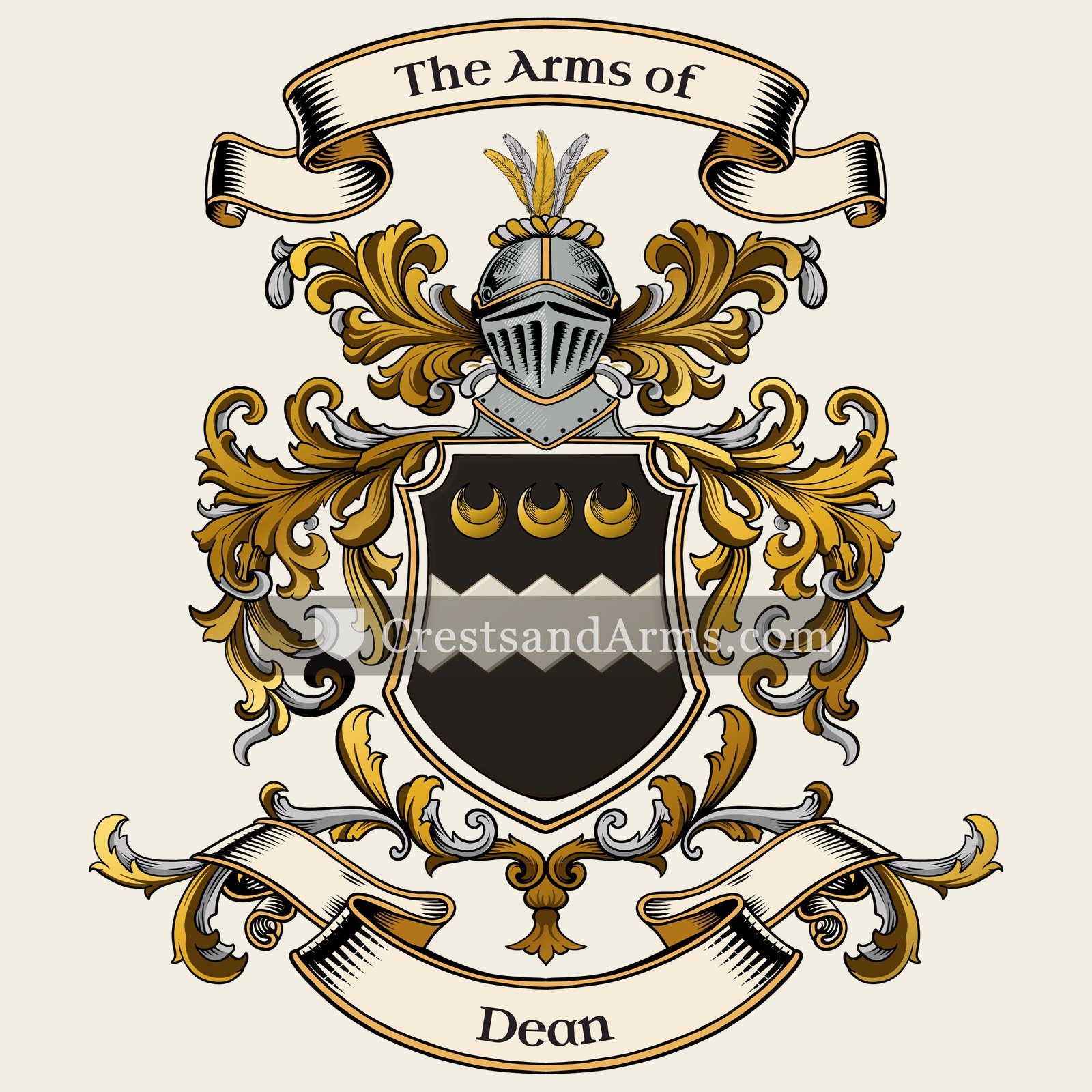
 fessThe military belt, and readiness to serve
 crescentHonour by the sovereign, and the second son
 fessThe military belt, and readiness to serve
 crescentHonour by the sovereign, and the second son


 wingSwiftness, and protection under a raised wing