Map of England showing where the Deanda arms are recorded
The Deanda arms were recorded in Nottingham, c. 1575.
Nottinghamshire had coal under it and forest across it, and both were worth money. Families who profited bought manors, and a manor was the ordinary reason for a family to take a coat of arms.
This is where the arms were entered in the register. Families often moved to other parts of the country, so the same name can turn up in more than one region.
The body that granted and recorded arms in England in this period.
Elizabeth I of England
Sovereign of the period
Elizabeth I of England
1558–1603
Reigning in England when the Deanda arms are first recorded.
How Arms Worked in England
English heraldry allowed arms to be shared by all legitimate descendants of the original owner. These symbols were treated as personal property that moved through the generations to all children. While the eldest son kept the original design, other family members could use the same shield without needing to change it or register their own unique versions.
Granting authority
The College of Arms in London has regulated the use of coats of arms throughout England and Wales since 1484.
How they got arms
Families typically obtained their coats of arms through a formal grant from the Crown or by proving their ancient right to them.
Where arms were recorded
All official coats of arms are recorded in the registers kept at the College of Arms, which date back to the fifteenth century.
The family's standing
Recorded among the armigerous families of Nottingham.
Origin & History of the Deanda Family in England
The family name Deanda has deep roots in the historical landscape of England, with documented evidence placing early members in Nottingham as far back as 1575. During the late sixteenth century, Nottingham was a bustling market town defined by its trade guilds and the growing influence of the textile industry. Families living in this region often identified themselves through their local parish communities, where records of births, marriages, and deaths were meticulously kept by church officials. The presence of the Deanda name in these early registers suggests that the family was well-integrated into the social and economic life of the East Midlands during the Elizabethan era. As the town evolved, these early ancestors likely contributed to the local economy through skilled labor or commerce, helping to establish the name as a permanent fixture in the region’s long and complex history.
Related Branches & Arms
Root word
de Anda
Derived from the Spanish preposition de meaning of and Anda meaning path.
This name
DeandaRefers to a person who lived near a specific path or thoroughfare.
also spelled
Dant
Daund
Documented Sources
Sir Bernard Burke, The General Armory of England, Scotland, Ireland and Wales, London: Harrison & Sons, 1884
Nottinghamshire Archives, Nottingham St Mary’s Parish Registers, 1575
Thoroton, Robert, The Antiquities of Nottinghamshire, 1677
Digital archive packCoat of arms PNG, gold border print PDF, vector SVG and the certificate of authenticity. Sent to your email in minutes.


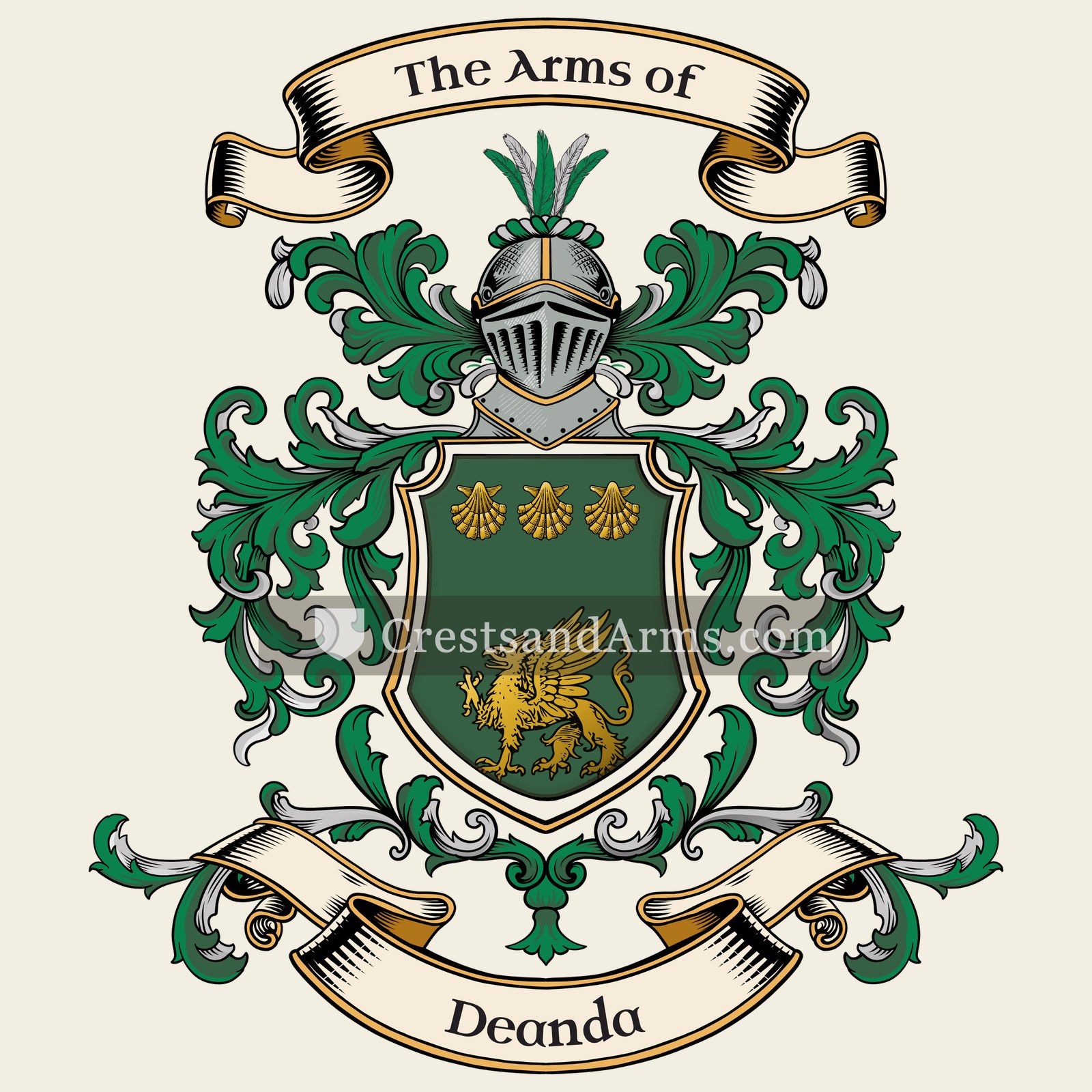
 griffinValour and vigilance, guarding great treasure
 escallopThe pilgrim's shell, and a long journey made
 griffinValour and vigilance, guarding great treasure
 escallopThe pilgrim's shell, and a long journey made