A record of documented arms, meaning and origin, researched for the de Backer family lines. Documented in 3 countries.
Reg. 8882 · Dutch, D–F
Coat of Arms & Family Crest Details
Symbols on this shield
heronPatience and quiet watchfulness
Colours
Blue (Azure)Means: Loyalty and truth
Silver (Argent)Means: Peace and sincerity
Historical info
Source
J. B. Rietstap, Armorial Général, Gouda: G. B. van Goor Zonen, 1884–87
Blazon (the actual original written record)
“D'arg. à trois trèfles de sin. - Ou: D'azur à trois têtes et cols de cuiller (oiseau) d'arg., bq. d'or. En coeur un écusson d'arg. à trois trèfles de sin.”
NetherlandsAmsterdam, c. 1815
Digital archive packCoat of arms PNG, gold border print PDF, vector SVG and the certificate of authenticity. Sent to your email in minutes.
Map of Netherlands showing where the de Backer arms are recorded
The de Backer arms were recorded in Amsterdam, c. 1815.
This is where the arms were entered in the register. Families often moved to other parts of the country, so the same name can turn up in more than one region.
Region
Amsterdam
Town
Amsterdam
First recorded
1815
Granting Authority for the de Backer Arms
Hoge Raad van Adel
Photograph made by me · CC BY-SA 3.0
The body that granted and recorded arms in Netherlands in this period.
William I of the Netherlands
Sovereign of the period
William I of the Netherlands
1815–1840
Reigning in Netherlands when the de Backer arms are first recorded.
How Arms Worked in Netherlands
In the Netherlands, coats of arms were often used by noble families and those who held specific public offices. These arms were passed down through the generations to legitimate descendants. Younger branches of a family usually kept the original design without needing to add special marks. This system ensured that the family identity remained clear and consistent over many years.
Granting authority
The Hoge Raad van Adel is the official body that regulates and manages noble titles and coats of arms in the Netherlands.
How they got arms
Families typically obtained their coats of arms through official royal grants or by proving their long-standing historical use of the symbols.
Where arms were recorded
Coats of arms are officially recorded in the registers held by the Hoge Raad van Adel, which began its work in 1814.
The family's standing
Recorded among the armigerous families of Netherlands.
Origin & History of the de Backer Family in Netherlands
The surname de Backer is a classic occupational name that originated from the Middle Dutch word for a baker. In the Netherlands, such names were often adopted during the Middle Ages as people began using permanent family identifiers to distinguish themselves in growing urban centers. By the early 19th century, the name was well-established among the working and merchant classes of Amsterdam. When the Napoleonic administration introduced formal civil registration in the Netherlands around 1811, many families were required to solidify their surnames for government records. The presence of the de Backer family in Amsterdam by 1815 suggests they were part of the city’s resilient population that navigated the transition from French rule back to the independent Kingdom of the Netherlands. During this era, families with this name were typically involved in the essential trades that kept the bustling port city fed and functioning, reflecting a long history of labor and community integration within the Dutch capital.
Coat of Arms & Family Crest Details
Symbols on this shield
chevronProtection, and faithful service completed
pine coneLife and fertility
Colours
Gold (Or)Means: Generosity
Blue (Azure)Means: Loyalty and truth
Red (Gules)Means: Military strength
Historical info
Source
J. B. Rietstap, Armorial Général, Gouda: G. B. van Goor Zonen, 1884–87
Blazon (the actual original written record)
“D'or au chev. d'azur, acc. de trois pommes de pin de gu., les queues en bas.”
FlandreFlandre, c. 1663
Digital archive packCoat of arms PNG, gold border print PDF, vector SVG and the certificate of authenticity. Sent to your email in minutes.
Map of France showing where the de Backer arms are recorded
The de Backer arms were recorded in Flandre, c. 1663.
Flandre grew rich on cloth, and its towns were among the busiest in Europe. Merchant families bought land with their profits and took arms to go with it, so trade put as many names in the registers here as land did.
This is where the arms were entered in the register. Families often moved to other parts of the country, so the same name can turn up in more than one region.
The body that granted and recorded arms in France in this period.
Louis XIV of France
Sovereign of the period
Louis XIV of France
1643–1715
Reigning in Netherlands when the de Backer arms are first recorded.
How Arms Worked in France
In France, a coat of arms was a mark of honor that passed down through the male line to all legitimate descendants. Families often used the same shield without changes to show their shared heritage. If a branch wanted to stand out, they could add a small mark to their shield to show their specific place in the family tree.
Granting authority
The Juge d'armes de France acted as the official authority that regulated and verified coats of arms across the country.
How they got arms
Families typically inherited their arms from ancestors, though they could also receive them through royal grants or by proving their noble status.
Where arms were recorded
Coats of arms were officially recorded in the Armorial Général de France, which began its main collection in the year 1696.
The family's standing
Recorded among the armigerous families of Flandre.
Origin & History of the de Backer Family in France
The surname de Backer originates from the Middle Dutch word for a baker, serving as an occupational descriptor for those who provided essential bread to their local communities. While the name is deeply rooted in the linguistic traditions of the Low Countries, its presence in France is tied to the shifting borders and cultural exchanges of the seventeenth century. By 1663, records confirm that members of the family were established in the region of Flanders, which was a territory frequently contested between the French Crown and the Spanish Habsburgs. During this era, families often moved across these porous borders for trade or agricultural opportunities, carrying their occupational surnames into new administrative jurisdictions. As these individuals settled into French-controlled areas, the name evolved from a simple job title into a fixed family identity that reflected the vital role of the baker in the social and economic life of the village.
Coat of Arms & Family Crest Details
Symbols on this shield
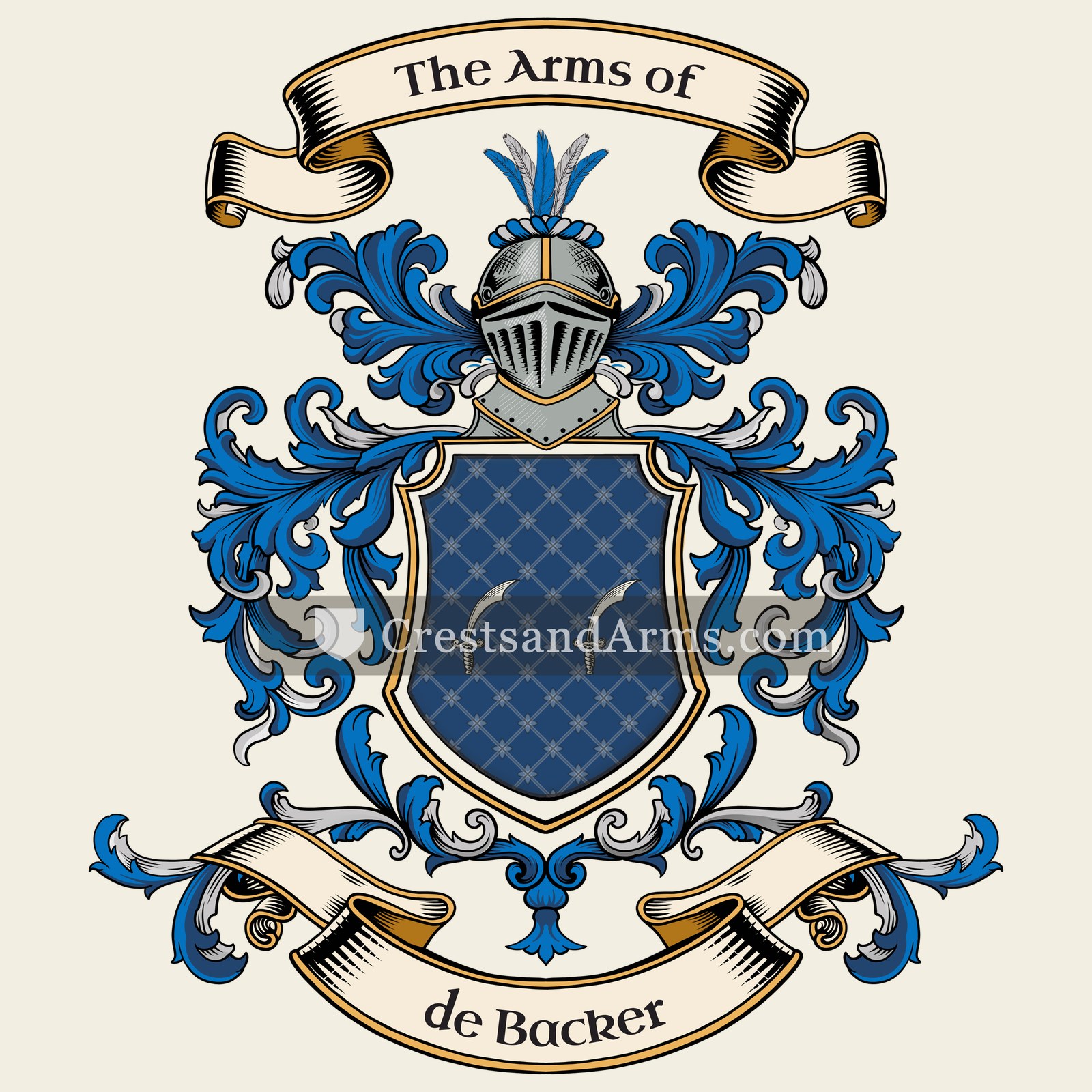
swordJustice, and military honour
Colours
Blue (Azure)Means: Loyalty and truth
Silver (Argent)Means: Peace and sincerity
Historical info
Source
J. B. Rietstap, Armorial Général, Gouda: G. B. van Goor Zonen, 1884–87
Blazon (the actual original written record)
“D'azur à deux épées d'arg., garnies d'or, passées en saut., acc. au point du chef d'une couronne du troisième. Cq. cour. C.: deux lames d'épée d'arg., posées en chev. renv. L. d'arg. et d'azur.”
BelgiumBruxelles, c. 1650
Digital archive packCoat of arms PNG, gold border print PDF, vector SVG and the certificate of authenticity. Sent to your email in minutes.
Map of Belgium showing where the de Backer arms are recorded
The de Backer arms were recorded in Bruxelles, c. 1650.
This is where the arms were entered in the register. Families often moved to other parts of the country, so the same name can turn up in more than one region.
The body that granted and recorded arms in Belgium in this period.
Philip IV of Spain
Sovereign of the period
Philip IV of Spain
1621–1665
Reigning in Netherlands when the de Backer arms are first recorded.
How Arms Worked in Belgium
In Belgium, a coat of arms is considered personal property that is passed down through the male line to legitimate descendants. Families often use the same shield design across generations to show their shared heritage. If a branch of the family wants to change the design, they must apply for an official update to their specific version of the arms.
Granting authority
The Conseil héraldique is the official body that regulates and approves all coats of arms in Belgium.
How they got arms
Families obtain their coats of arms through formal royal grants or by confirming their historical right to use existing designs.
Where arms were recorded
All approved coats of arms are officially recorded in the public registers of the Conseil héraldique since 1844.
The family's standing
Recorded among the armigerous families of Belgium.
Origin & History of the de Backer Family in Belgium
The surname de Backer is a classic occupational name that emerged from the medieval practice of identifying people by their trade. In the Dutch language, which is one of the primary historical languages of Belgium, the word "bakker" translates directly to baker. By the time the family was firmly established in Brussels around 1650, the name served as a clear indicator that their ancestors were likely skilled tradespeople responsible for supplying bread to the growing urban population. During the seventeenth century, Brussels was a bustling center of commerce and craft guilds, and families like the de Backers often held stable positions within these local economic structures. Because bread was a daily necessity, those who mastered the craft of baking held a respected and essential role in the community. Over generations, what began as a simple description of a person’s daily work evolved into a permanent family name that was passed down to descendants long after the original bakers had retired from their ovens.
de Backer Meaning & Related Branches
Root word
bakker
a person who bakes bread
This name
de Backeran occupational surname referring to a professional baker
also spelled
Debakker
de Baker
Backer
Documented Sources
J. B. Rietstap, Armorial Général, Gouda: G. B. van Goor Zonen, 1884–87
P.J. Meertens, De betekenis van de Nederlandse familienamen, 1959
Stadsarchief Amsterdam, Bevolkingsregister 1815
Centraal Bureau voor Genealogie, Nederlandse Familienamenbank, 2010
Digital archive packCoat of arms PNG, gold border print PDF, vector SVG and the certificate of authenticity. Sent to your email in minutes.


 heronPatience and quiet watchfulness
 heronPatience and quiet watchfulness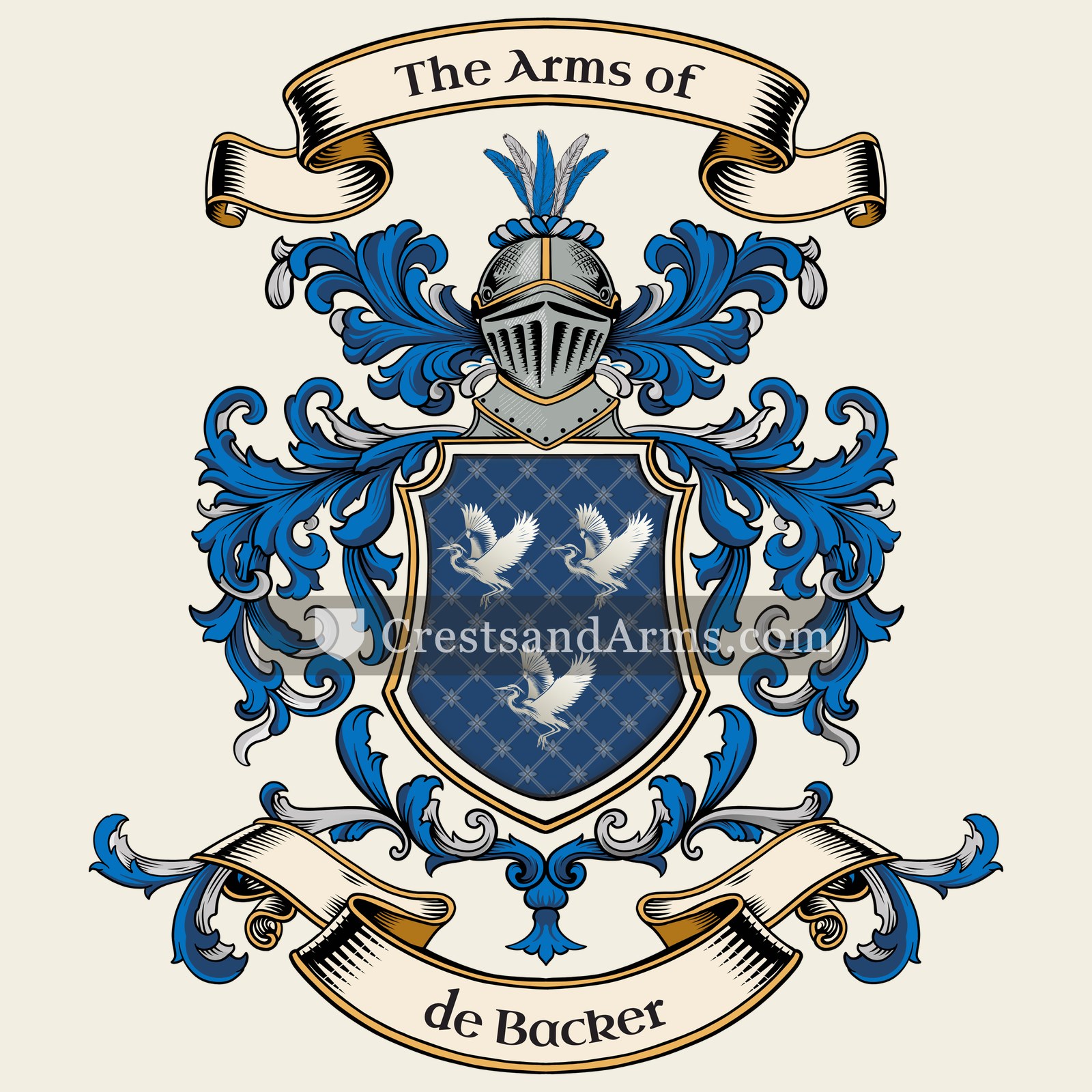


 chevronProtection, and faithful service completed
 pine coneLife and fertility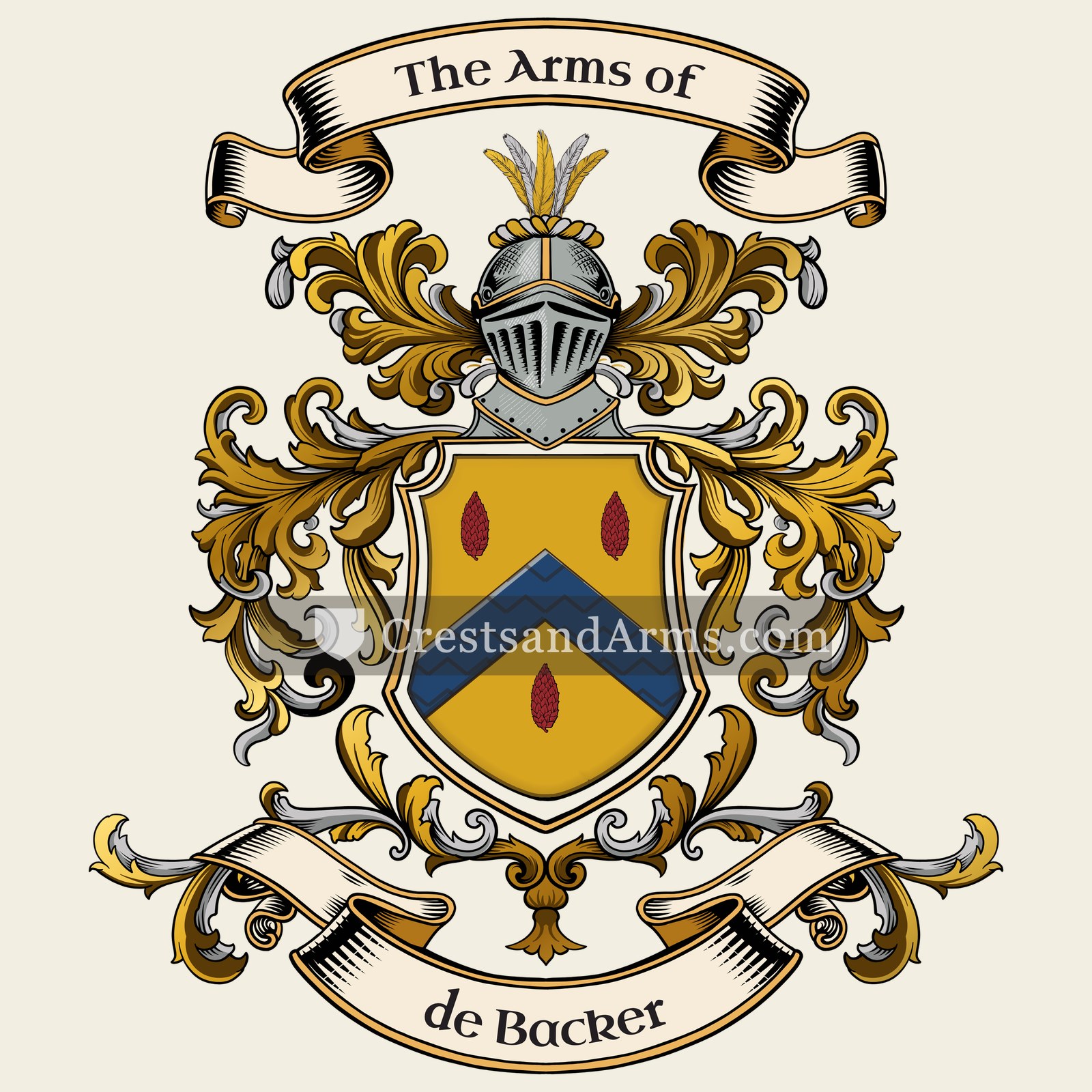


 swordJustice, and military honour