Map of France showing where the Debeaux arms are recorded
The Debeaux arms were recorded in Lorraine, c. 1609.
Lorraine sat on the border between France and the German lands, and border country bred soldiers. Families here held small estates and served in arms, and a fighting man was exactly the sort who carried a shield of his own.
This is where the arms were entered in the register. Families often moved to other parts of the country, so the same name can turn up in more than one region.
The body that granted and recorded arms in France in this period.
Henry IV of France
Sovereign of the period
Henry IV of France
1589–1610
Reigning in France when the Debeaux arms are first recorded.
How Arms Worked in France
In France, a coat of arms was a mark of honor that passed down through the male line to all legitimate descendants. Families often used the same shield without changes to show their shared heritage. If a branch wanted to stand out, they could add a small mark to their shield to show their specific place in the family tree.
Granting authority
The Juge d'armes de France acted as the official authority that regulated and verified coats of arms across the country.
How they got arms
Families typically inherited their arms from ancestors, though they could also receive them through royal grants or by proving their noble status.
Where arms were recorded
Coats of arms were officially recorded in the Armorial Général de France, which began its main collection in the year 1696.
The family's standing
Recorded among the armigerous families of Lorraine.
Origin & History of the Debeaux Family in France
The family name Debeaux finds its roots in the linguistic traditions of northern France, specifically within the historic region of Lorraine. By the early seventeenth century, records confirm the presence of the family in this area, which was then a crossroads of European culture and political tension. The name itself is derived from the French phrase "des beaux," which translates to "of the beautiful" or "of the handsome." It likely began as a descriptive nickname used to identify an individual or a specific branch of a family based on their appearance or perhaps their residence near a pleasant piece of land. As the family established itself in Lorraine by 1609, they lived through a period of significant regional transition, as the duchy navigated the complex power dynamics between the Holy Roman Empire and the French monarchy. This early history reflects the broader movement of families who settled in the fertile valleys of eastern France, where they contributed to the local agricultural and social life for generations.
Meaning of the Debeaux family crest colors & symbols
Symbols on this shield
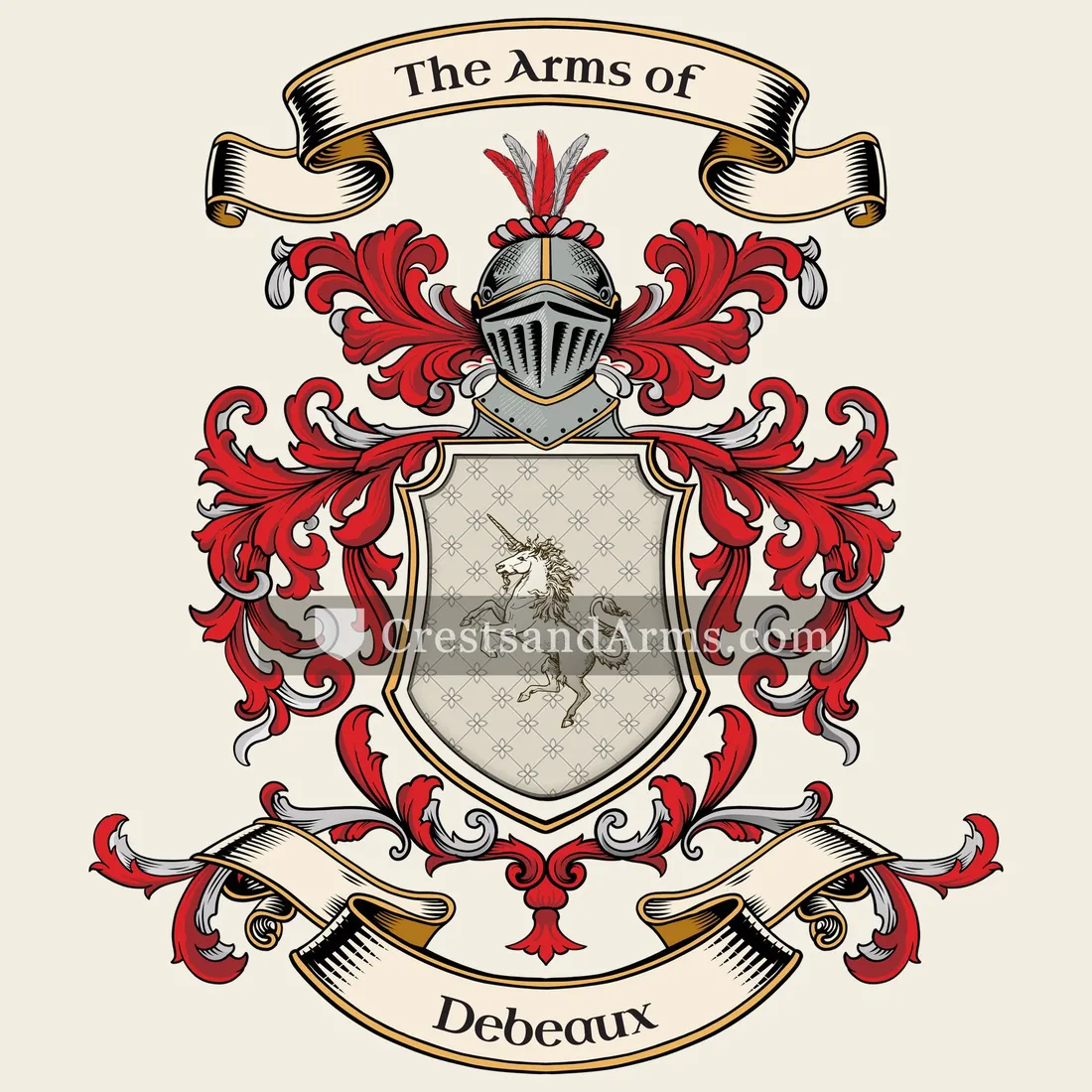
unicornPurity, and extreme courage in defence of honour
Colours
Silver (Argent)Means: Peace and sincerity
Historical info
Source
J. B. Rietstap, Armorial Général, Gouda: G. B. van Goor Zonen, 1884–87
Blazon (the actual original written record)
“D'arg. à cinq fusées de gu., accolées en fasce et touchant les bords de l'écu. Sur le tout un écusson d'azur, ch. d'une tête et col de licorne d'arg.”
LiegeLiege, c. 1737
Digital archive packCoat of arms PNG, gold border print PDF, vector SVG and the certificate of authenticity. Sent to your email in minutes.
Map of Belgium showing where the Debeaux arms are recorded
The Debeaux arms were recorded in Liege, c. 1737.
Liege was a prosperous town and its surrounding country, living on metalworking and trade. Merchant families grew rich, bought land outside the walls, and took arms as landowners rather than tradesmen.
This is where the arms were entered in the register. Families often moved to other parts of the country, so the same name can turn up in more than one region.
The body that granted and recorded arms in Belgium in this period.
Charles VI, Holy Roman Emperor
Sovereign of the period
Charles VI, Holy Roman Emperor
1711–1740
Reigning in France when the Debeaux arms are first recorded.
How Arms Worked in Belgium
In Belgium, a coat of arms is considered personal property that is passed down through the male line to legitimate descendants. Families often use the same shield design across generations to show their shared heritage. If a branch of the family wants to change the design, they must apply for an official update to their specific version of the arms.
Granting authority
The Conseil héraldique is the official body that regulates and approves all coats of arms in Belgium.
How they got arms
Families obtain their coats of arms through formal royal grants or by confirming their historical right to use existing designs.
Where arms were recorded
All approved coats of arms are officially recorded in the public registers of the Conseil héraldique since 1844.
The family's standing
Recorded among the armigerous families of Liege.
Origin & History of the Debeaux Family in Belgium
The family name Debeaux traces its roots to the French-speaking regions of Belgium, with significant historical ties to the city of Liège. By 1737, records confirm that members of the family were already established residents in this bustling industrial and cultural hub. During the eighteenth century, Liège was a powerful prince-bishopric known for its skilled metalworkers and coal mining industry. Families like the Debeaux likely participated in the local economy by working in these trades or serving the administrative needs of the growing urban center. The name itself is derived from the French term for handsome or beautiful, which was often used as a descriptive nickname in medieval times before becoming a permanent family surname. As the family lived in the heart of the Meuse valley, they were part of a region that frequently shifted between different political influences, requiring them to be adaptable and resilient as they built their lives in the city.
Debeaux Meaning & Related Branches
Root word
de beau
Preposition indicating origin from a beautiful place or location.
This name
DebeauxA topographic name denoting someone who lived near a beautiful site or settlement.
also spelled
Devaulx
Devau
de Vo
Documented Sources
J. B. Rietstap, Armorial Général, Gouda: G. B. van Goor Zonen, 1884–87
Albert Dauzat, Dictionnaire étymologique des noms et prénoms de France, 1951
Jean-Marie Pierret, Dictionnaire des noms de famille de Wallonie et de Bruxelles, 1999
Archives départementales de Meurthe-et-Moselle, Registres paroissiaux et d'état civil de Lorraine
Digital archive packCoat of arms PNG, gold border print PDF, vector SVG and the certificate of authenticity. Sent to your email in minutes.


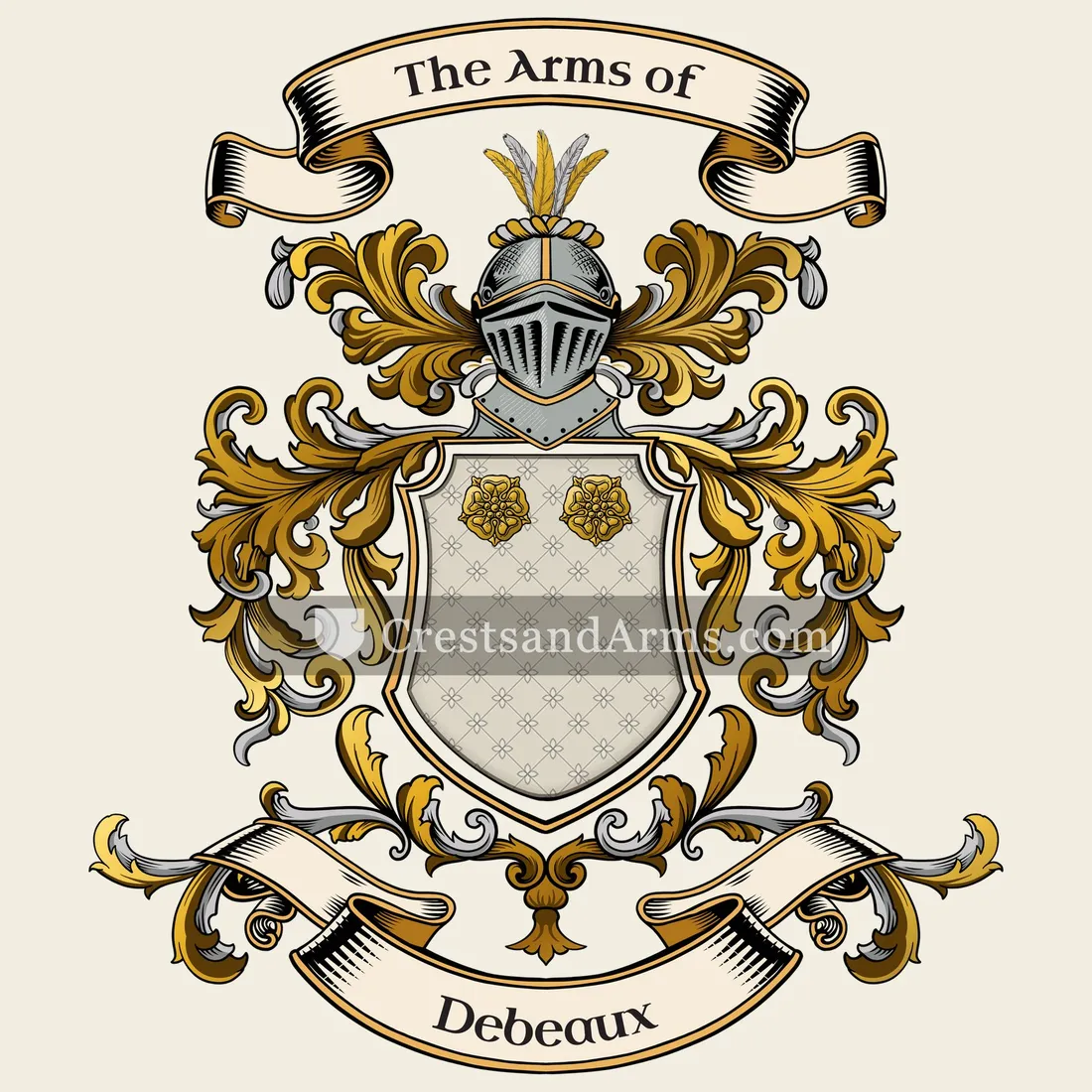
 roseThe seventh son, and beauty with grace
 roseThe seventh son, and beauty with grace


 unicornPurity, and extreme courage in defence of honour