A record of documented arms, meaning and origin, researched for the Debo family lines. Documented in 2 countries.
Reg. 8480 · Belgian, D–F
Meaning of the Debo family crest colors & symbols
Symbols on this shield
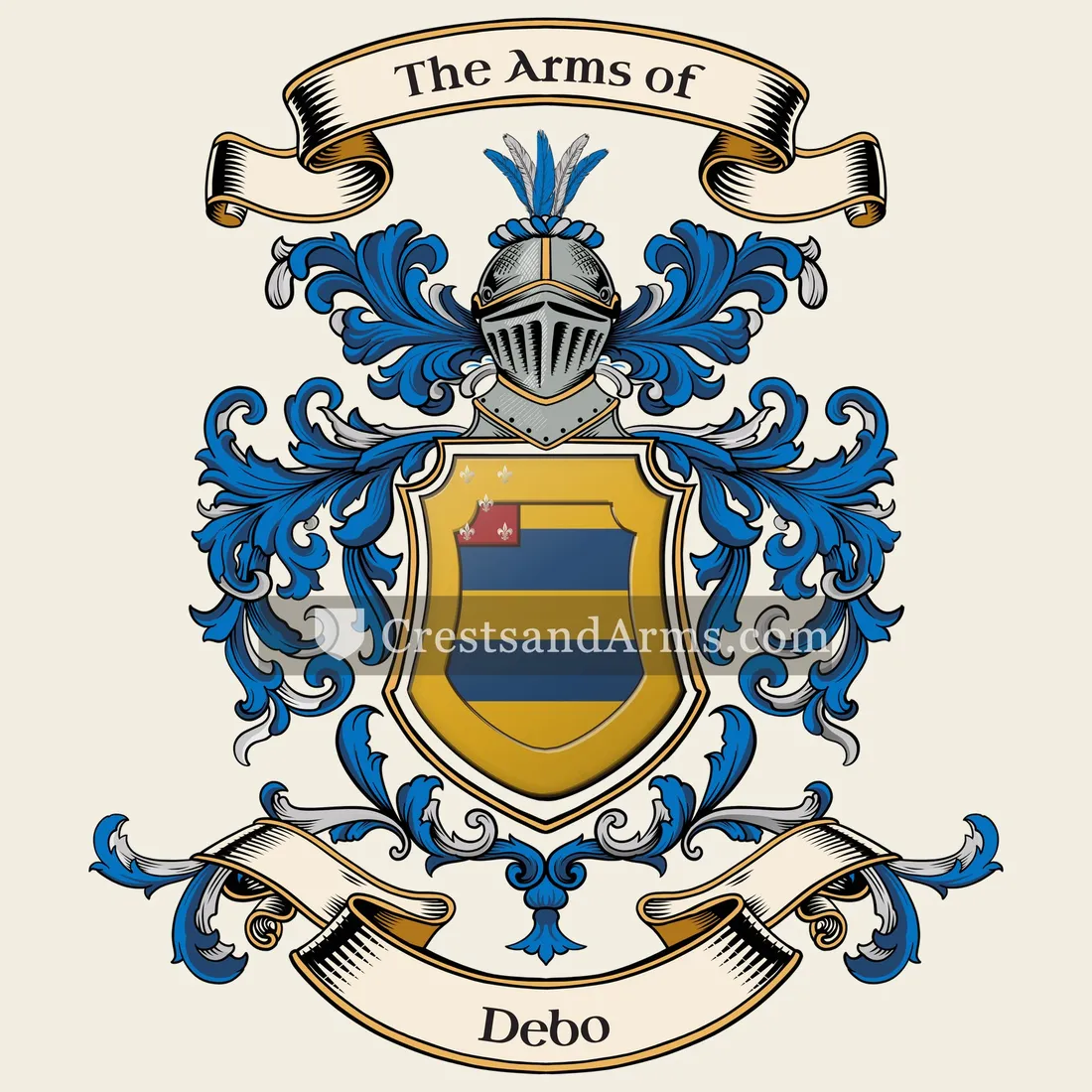
fessThe military belt, and readiness to serve
fleur de lisPurity, light, and the sixth son
Colours
Blue (Azure)Means: Loyalty and truth
Gold (Or)Means: Generosity
Red (Gules)Means: Military strength
Silver (Argent)Means: Peace and sincerity
Historical info
Source
J. B. Rietstap, Armorial Général, Gouda: G. B. van Goor Zonen, 1884–87
Blazon (the actual original written record)
“D'azur à trois fasces d'or; au fr.-q. de gu., ch. de cinq fleurs-de-lis d'arg., 2, 1 et 2; l'écu bordé d'une engrêlure d'or. C.: un cygne d'or, le vol levé. L. d'or et d'azur.”
HainautHainaut, c. 1450
Digital archive packCoat of arms PNG, gold border print PDF, vector SVG and the certificate of authenticity. Sent to your email in minutes.
Map of Belgium showing where the Debo arms are recorded
The Debo arms were recorded in Hainaut, c. 1450.
Hainaut sat on the border between France and the Low Countries and was fought over for centuries. Families there held their land under arms and expected to defend it, so a shield was a working thing.
This is where the arms were entered in the register. Families often moved to other parts of the country, so the same name can turn up in more than one region.
The body that granted and recorded arms in Belgium in this period.
Frederick III, Holy Roman Emperor
Sovereign of the period
Frederick III, Holy Roman Emperor
1440–1493
Reigning in Belgium when the Debo arms are first recorded.
How Arms Worked in Belgium
In Belgium, a coat of arms is considered personal property that is passed down through the male line to legitimate descendants. Families often use the same shield design across generations to show their shared heritage. If a branch of the family wants to change the design, they must apply for an official update to their specific version of the arms.
Granting authority
The Conseil héraldique is the official body that regulates and approves all coats of arms in Belgium.
How they got arms
Families obtain their coats of arms through formal royal grants or by confirming their historical right to use existing designs.
Where arms were recorded
All approved coats of arms are officially recorded in the public registers of the Conseil héraldique since 1844.
The family's standing
Recorded among the armigerous families of Hainaut.
Origin & History of the Debo Family in Belgium
The family name Debo traces its roots back to the historic province of Hainaut in what is now modern-day Belgium. By the year 1450, records indicate that family members were already established in this region, which was then part of the powerful Burgundian Netherlands. During this period, the name likely functioned as a descriptive identifier for individuals living in or near specific local landmarks. Because Hainaut served as a major crossroads for trade and cultural exchange between the French and Flemish-speaking worlds, the family was positioned in a dynamic environment that shaped their early social and economic life. These early ancestors lived through a time of significant political transition as the region moved under the influence of the Dukes of Burgundy, which likely influenced how the family integrated into the local administrative and agricultural systems of the fifteenth century.
Meaning of the Debo family crest colors & symbols
Symbols on this shield
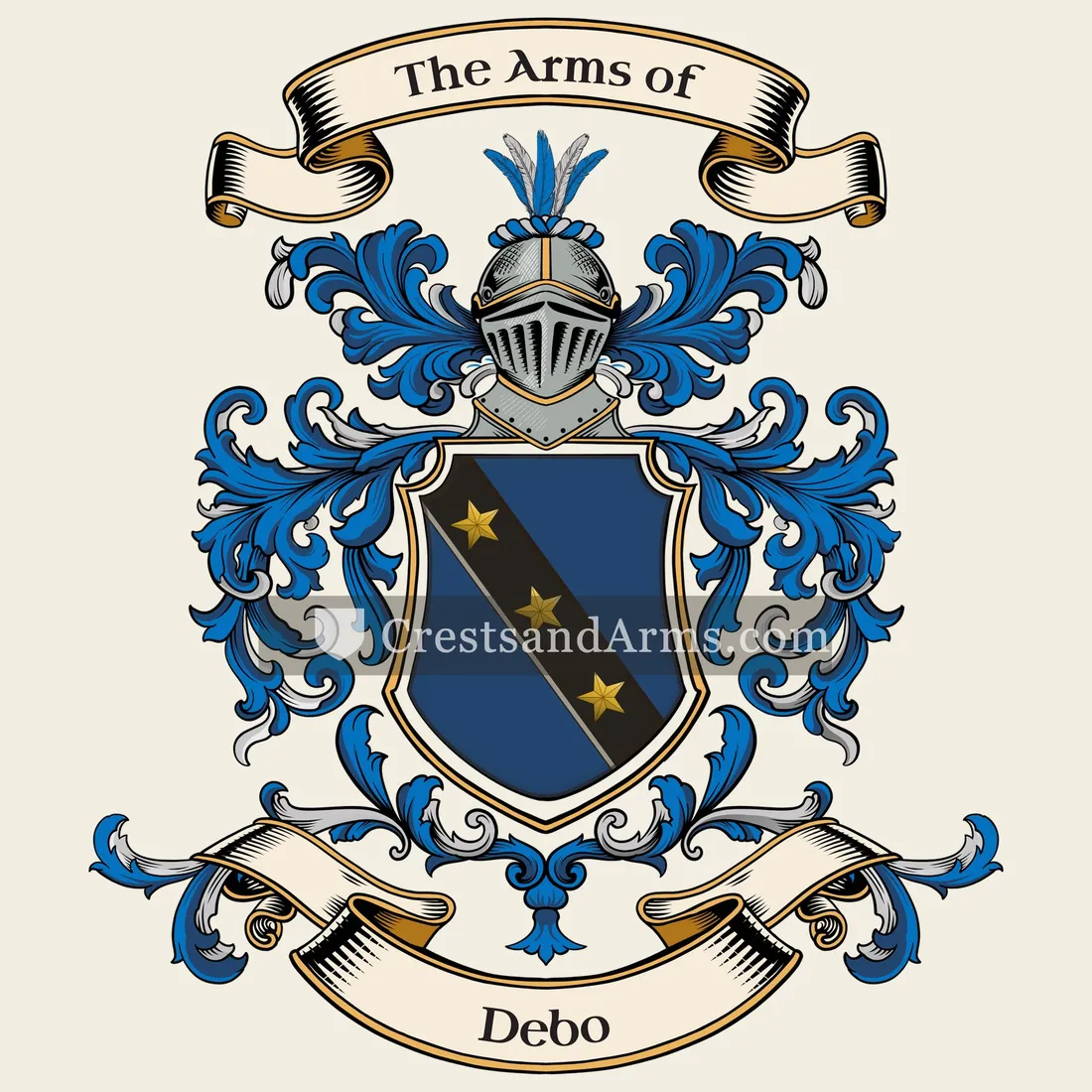
bendDefence, and the scarf of a commander
mulletThe third son, and a divine quality from above
Colours
Blue (Azure)Means: Loyalty and truth
Black (Sable)Means: Constancy
Gold (Or)Means: Generosity
Historical info
Source
J. B. Rietstap, Armorial Général, Gouda: G. B. van Goor Zonen, 1884–87
Blazon (the actual original written record)
“D'azur à la bande de sa., ch. de trois étoiles (6) d'or. C.: une étoile (6) d'or. L. d'or et de sa.”
Netherlandsc. 1580
Digital archive packCoat of arms PNG, gold border print PDF, vector SVG and the certificate of authenticity. Sent to your email in minutes.
Map of Netherlands showing where the Debo arms are recorded
The Debo arms were recorded in Netherlands, c. 1580.
Arms such as these were typically recorded in Friesland.
Friesland was low, wet country on the northern coast of the Netherlands, farmed by families who had held the same land for centuries. Free landholders were unusually common there, and a free landholder could carry arms.
This is where the arms were entered in the register. Families often moved to other parts of the country, so the same name can turn up in more than one region.
Region
Friesland
First recorded
1580
Granting Authority for the Debo Arms
Hoge Raad van Adel
Photograph made by me · CC BY-SA 3.0
The body that granted and recorded arms in Netherlands in this period.
How Arms Worked in Netherlands
In the Netherlands, coats of arms were often used by noble families and those who held specific public offices. These arms were passed down through the generations to legitimate descendants. Younger branches of a family usually kept the original design without needing to add special marks. This system ensured that the family identity remained clear and consistent over many years.
Granting authority
The Hoge Raad van Adel is the official body that regulates and manages noble titles and coats of arms in the Netherlands.
How they got arms
Families typically obtained their coats of arms through official royal grants or by proving their long-standing historical use of the symbols.
Where arms were recorded
Coats of arms are officially recorded in the registers held by the Hoge Raad van Adel, which began its work in 1814.
The family's standing
Recorded among the armigerous families of Netherlands.
Origin & History of the Debo Family in Netherlands
The family name Debo finds its historical roots in the northern province of Friesland, where records confirm members were established by the year 1580. During this period, the Frisian landscape was defined by a unique social structure that allowed families to maintain a strong sense of local identity. The name likely evolved from regional naming customs where individuals were identified by their specific farmsteads or small village communities. As the Netherlands navigated the political and religious shifts of the late sixteenth century, the Debo family lived within a culture that valued independence and maritime trade. These early ancestors were part of a society that relied on strict record-keeping for land ownership and tax purposes, which helped preserve their presence in the region for future generations. By settling in Friesland, the family became part of a long tradition of resilient people who helped shape the rural character of the Dutch northern territories.
Debo Meaning & Related Branches
Root word
Bode
Old Germanic term for a messenger or herald.
This name
DeboA habitational or occupational name referring to a messenger or someone living near a specific dwelling.
also spelled
Debehaut
de Bo
Behault
Documented Sources
J. B. Rietstap, Armorial Général, Gouda: G. B. van Goor Zonen, 1884–87
Duvivier, Charles, Les influences étrangères à Tournai et dans le Hainaut, 1890
Archives de l'État à Mons, Fonds de la Cour féodale du Hainaut, 1400–1500
Pirenne, Henri, Histoire de Belgique, 1900
Digital archive packCoat of arms PNG, gold border print PDF, vector SVG and the certificate of authenticity. Sent to your email in minutes.


 fessThe military belt, and readiness to serve
 fleur de lisPurity, light, and the sixth son
 fessThe military belt, and readiness to serve
 fleur de lisPurity, light, and the sixth son


 bendDefence, and the scarf of a commander
 mulletThe third son, and a divine quality from above