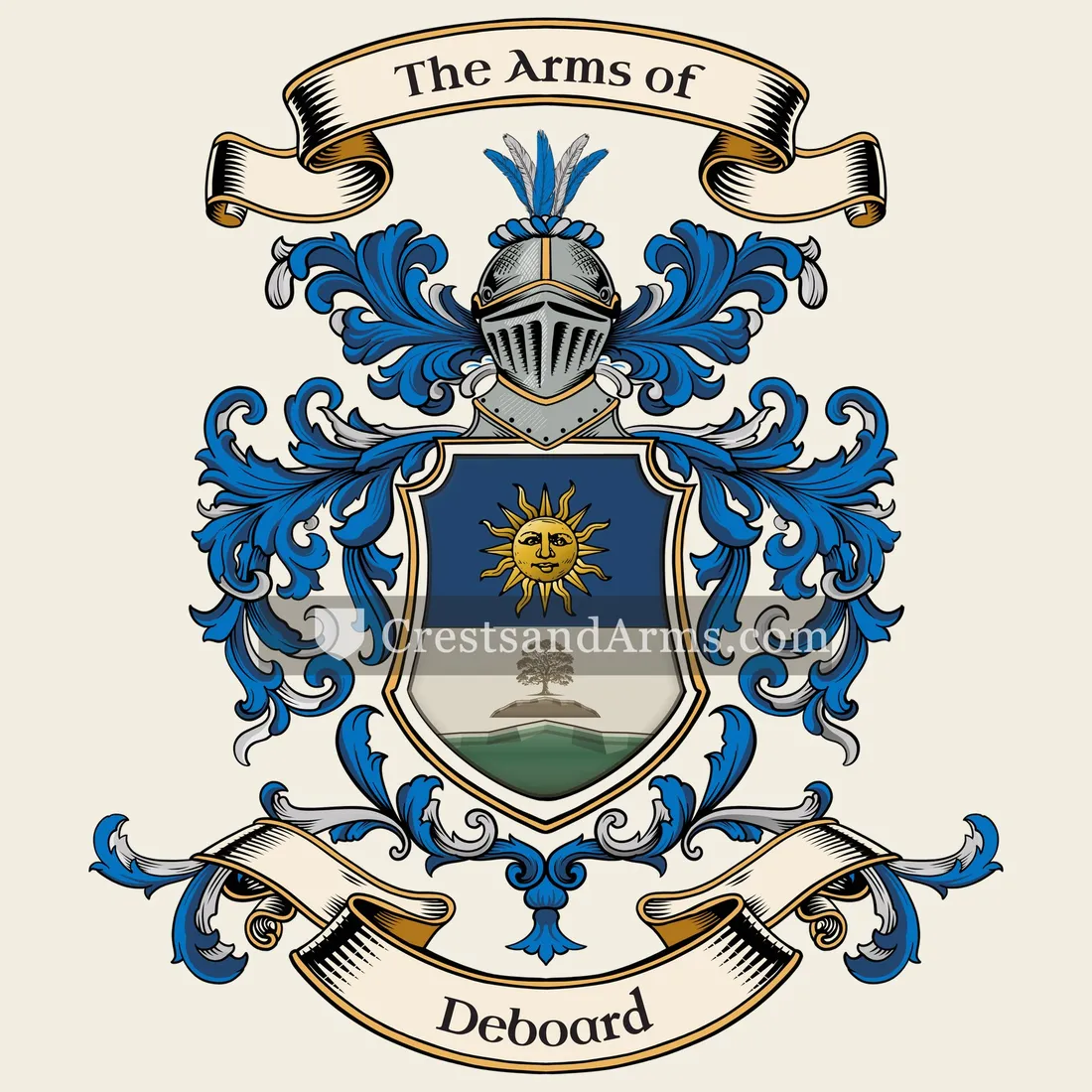
A record of documented arms, meaning and origin, researched for the Deboard family of Netherlands.
Reg. 0374 · Dutch, D–F
Meaning of the Deboard family crest colors & symbols
Symbols on this shield
mountThe ground held, and steadfastness upon it
sunGlory, splendour and the source of life
treeLife, endurance and deep roots
Colours
Blue (Azure)Means: Loyalty and truth
Silver (Argent)Means: Peace and sincerity
Green (Vert)Means: Hope
Gold (Or)Means: Generosity
Historical info
Source
J. B. Rietstap, Armorial Général, Gouda: G. B. van Goor Zonen, 1884–87
Blazon (the actual original written record)
“Coupé: au 1 d'azur au soleil d'or, ch. d'une ancre de sa.; au 2 d'arg. à un tronc d'arbre terrassé au nat., poussant à dextre et à sen. une branche feuillée de sin.”
NetherlandsAmsterdam, c. 1815
Digital archive packCoat of arms PNG, gold border print PDF, vector SVG and the certificate of authenticity. Sent to your email in minutes.
Map of Netherlands showing where the Deboard arms are recorded
The Deboard arms were recorded in Amsterdam, c. 1815.
This is where the arms were entered in the register. Families often moved to other parts of the country, so the same name can turn up in more than one region.
Region
Amsterdam
Town
Amsterdam
First recorded
1815
Granting Authority for the Deboard Arms
Hoge Raad van Adel
Photograph made by me · CC BY-SA 3.0
The body that granted and recorded arms in Netherlands in this period.
William I of the Netherlands
Sovereign of the period
William I of the Netherlands
1815–1840
Reigning in Netherlands when the Deboard arms are first recorded.
How Arms Worked in Netherlands
In the Netherlands, coats of arms were often used by noble families and those who held specific public offices. These arms were passed down through the generations to legitimate descendants. Younger branches of a family usually kept the original design without needing to add special marks. This system ensured that the family identity remained clear and consistent over many years.
Granting authority
The Hoge Raad van Adel is the official body that regulates and manages noble titles and coats of arms in the Netherlands.
How they got arms
Families typically obtained their coats of arms through official royal grants or by proving their long-standing historical use of the symbols.
Where arms were recorded
Coats of arms are officially recorded in the registers held by the Hoge Raad van Adel, which began its work in 1814.
The family's standing
Recorded among the armigerous families of Netherlands.
Origin & History of the Deboard Family in Netherlands
The family name Deboard carries a rich history that likely traces its roots to the movement of people across Western Europe during the early nineteenth century. By 1815, records confirm that members of the family were established in Amsterdam, a bustling hub of trade and culture during the post-Napoleonic era. The name itself suggests a connection to the French language, as it is often interpreted as a locational surname meaning from the board or from the edge of a specific territory. As these individuals lived in the Netherlands, they were part of a diverse urban population that navigated the significant political changes occurring across the continent at that time. Their presence in a major port city indicates that the family may have been involved in the merchant class or the skilled trades that defined the economic life of Amsterdam. Over the following generations, the family likely adapted to the shifting borders and cultural landscapes of Europe, eventually carrying their name to new regions and building a legacy that began in these historic urban centers.
Deboard Meaning & Related Branches
Root word
de boer
Dutch term for a farmer or peasant.
This name
DeboardAn occupational surname identifying someone who worked as a farmer or lived on a farm.
also spelled
Debordez
Bordes
Documented Sources
J. B. Rietstap, Armorial Général, Gouda: G. B. van Goor Zonen, 1884–87


 mountThe ground held, and steadfastness upon it
 sunGlory, splendour and the source of life
 treeLife, endurance and deep roots
 mountThe ground held, and steadfastness upon it
 sunGlory, splendour and the source of life
 treeLife, endurance and deep roots