Map of France showing where the de Boe arms are recorded
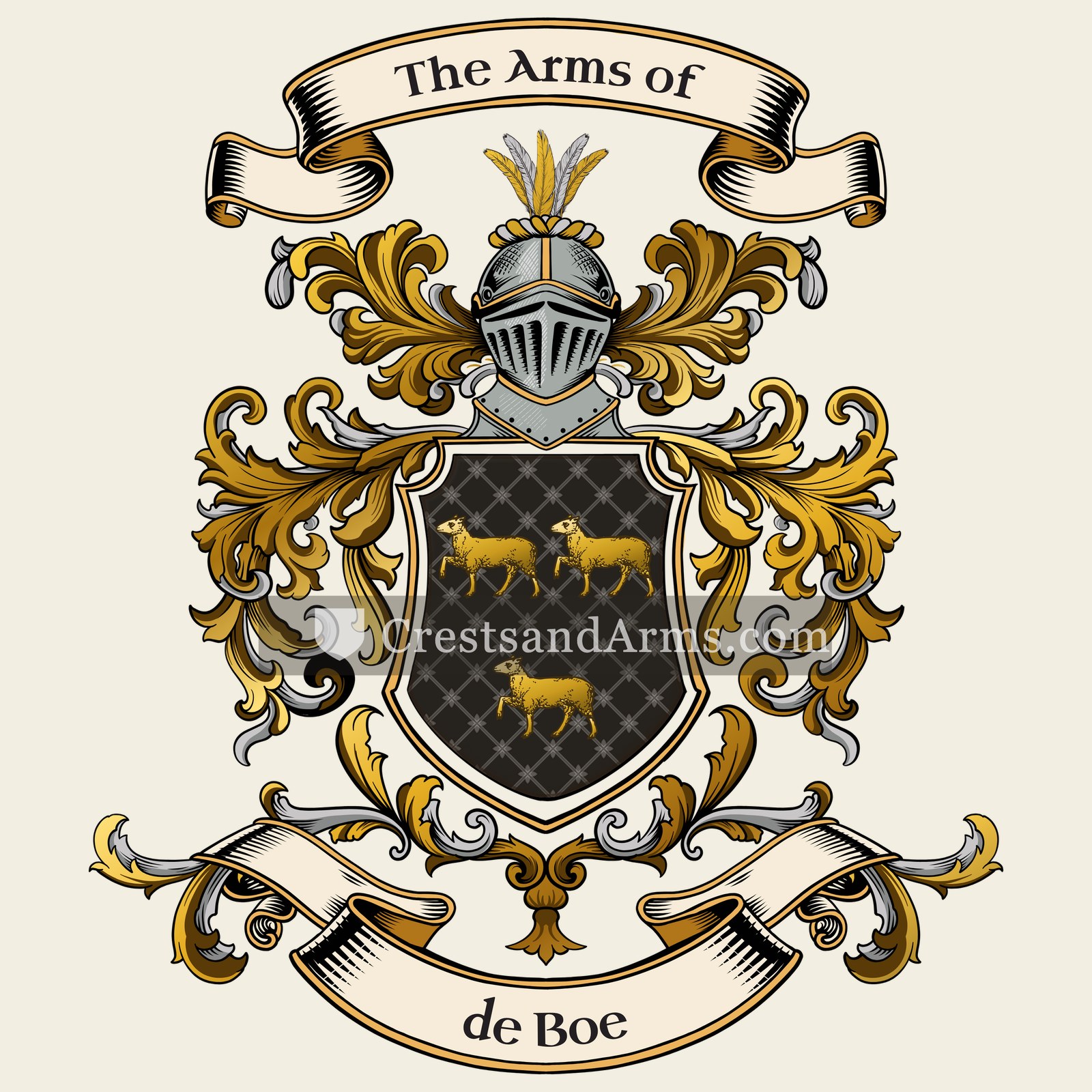
The de Boe arms were recorded in Flandre, c. 1663.
Flandre grew rich on cloth, and its towns were among the busiest in Europe. Merchant families bought land with their profits and took arms to go with it, so trade put as many names in the registers here as land did.
This is where the arms were entered in the register. Families often moved to other parts of the country, so the same name can turn up in more than one region.
The body that granted and recorded arms in France in this period.
Louis XIV of France
Sovereign of the period
Louis XIV of France
1643–1715
Reigning in France when the de Boe arms are first recorded.
How Arms Worked in France
In France, a coat of arms was a mark of honor that passed down through the male line to all legitimate descendants. Families often used the same shield without changes to show their shared heritage. If a branch wanted to stand out, they could add a small mark to their shield to show their specific place in the family tree.
Granting authority
The Juge d'armes de France acted as the official authority that regulated and verified coats of arms across the country.
How they got arms
Families typically inherited their arms from ancestors, though they could also receive them through royal grants or by proving their noble status.
Where arms were recorded
Coats of arms were officially recorded in the Armorial Général de France, which began its main collection in the year 1696.
The family's standing
Recorded among the armigerous families of Flandre.
Origin & History of the de Boe Family in France
The surname de Boe finds its historical roots in the region of Flanders, where records confirm the family was established by at least 1663. The name likely originated as a descriptive term or a topographic reference, as the Dutch word "boe" often related to early agricultural structures or specific livestock enclosures common in the low-lying coastal plains of the area. During the seventeenth century, families in Flanders were deeply connected to the local textile trade and the complex system of polder farming that defined the landscape. As the family grew, members were often recorded in parish registers documenting baptisms and marriages within local Catholic communities. These early ancestors lived through a period of significant political transition in the Southern Netherlands, navigating the shift between regional autonomy and the influence of larger European powers. By maintaining their presence in the Flemish countryside, the de Boe family became part of the enduring social fabric of the region, contributing to the local economy and community life for generations.
de Boe Meaning & Related Branches
Root word
buef
Old French term for an ox or a bull.
This name
de BoeA topographic or occupational name referring to someone who lived near or worked with oxen.
also spelled
de Bo
de Boee
Boe
Documented Sources
J. B. Rietstap, Armorial Général, Gouda: G. B. van Goor Zonen, 1884–87
De Smet, J., De bevolking van de kasselrij Veurne in de 17e eeuw, 1962
Rijksarchief te Brugge, Parochieregisters van de kasselrij Veurne, 1663
Vandenbroeke, C., Sociale geschiedenis van het Vlaamse volk, 1981
Digital archive packCoat of arms PNG, gold border print PDF, vector SVG and the certificate of authenticity. Sent to your email in minutes.


 lambGentleness, patience and faith
 lambGentleness, patience and faith