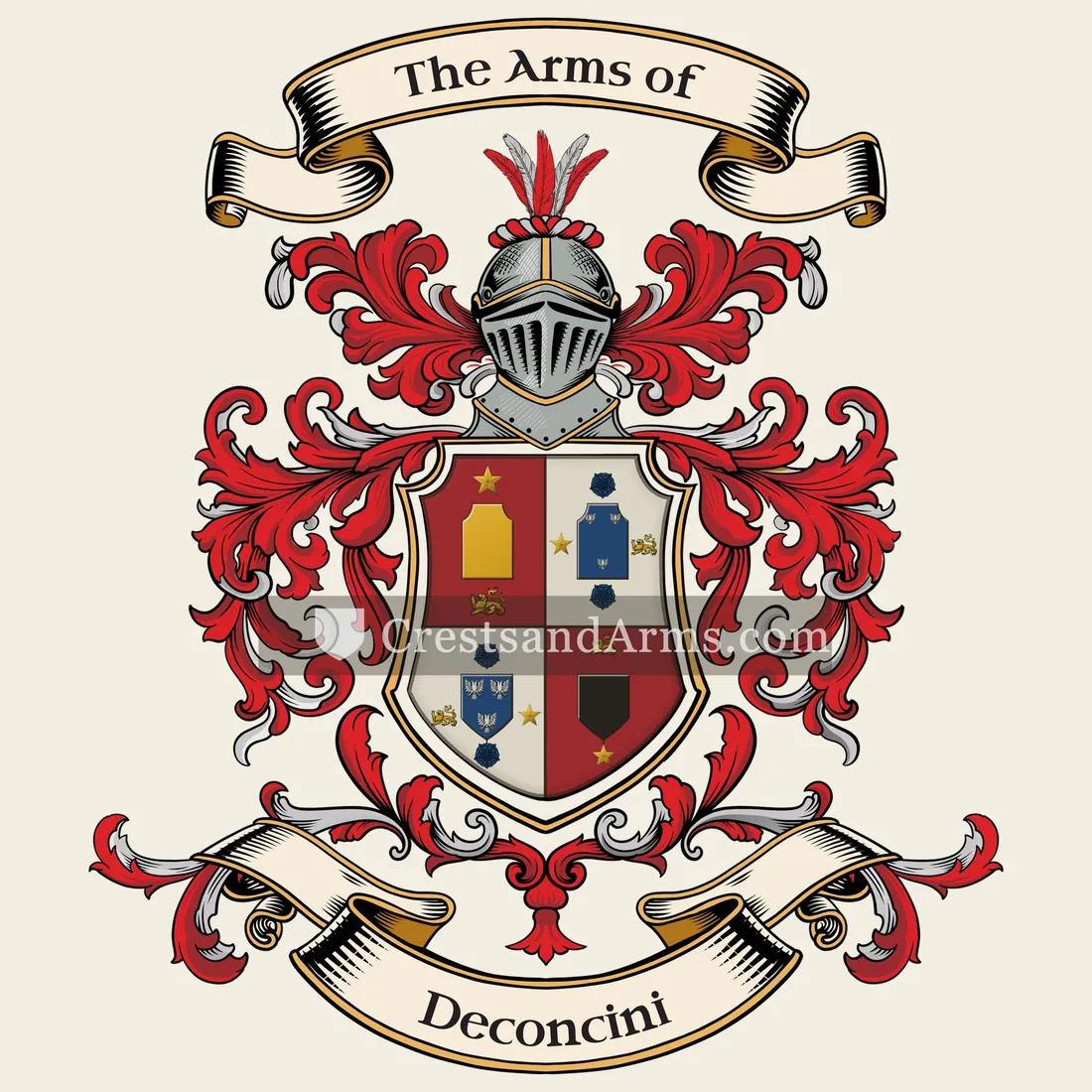
A record of documented arms, meaning and origin, researched for the Deconcini family of Italy.
Reg. 0556 · Italian, D–F
Meaning of the Deconcini family crest colors & symbols
Symbols on this shield
lionCourage, strength and royalty
mulletThe third son, and a divine quality from above
eagleNobility, strength and a keen mind
roseThe seventh son, and beauty with grace
Colours
Red (Gules)Means: Military strength
Silver (Argent)Means: Peace and sincerity
Gold (Or)Means: Generosity
Blue (Azure)Means: Loyalty and truth
Black (Sable)Means: Constancy
Historical info
Source
J. B. Rietstap, Armorial Général, Gouda: G. B. van Goor Zonen, 1884–87
Blazon (the actual original written record)
“Ec.: au 1 parti-enclavé de gu. et d'arg.; aux 2 et 3 d'or à la barre d'azur, ch. de trois aigles d'arg. et acc. de deux roses d'azur; au 4 d'arg. à un V de sa., posé en bande. Sur le tout parti: a. d'azur au lion d'or; b. de gu. à une étoile d'or.”
ItalyFrioul, c. 1780
Digital archive packCoat of arms PNG, gold border print PDF, vector SVG and the certificate of authenticity. Sent to your email in minutes.
Map of Italy showing where the Deconcini arms are recorded
The Deconcini arms were recorded in Frioul, c. 1780.
This is where the arms were entered in the register. Families often moved to other parts of the country, so the same name can turn up in more than one region.
The body that granted and recorded arms in Italy in this period.
Paolo Renier
Sovereign of the period
Paolo Renier
1779–1789
Reigning in Italy when the Deconcini arms are first recorded.
How Arms Worked in Italy
In the Italian states, coats of arms were often used by noble families to show their status and history. These symbols were passed down through the generations to all legitimate male descendants. Younger branches of a family usually kept the original design but sometimes added small changes to distinguish their specific line from the main branch.
Granting authority
Various local rulers and city governments controlled the use of coats of arms across the different Italian states.
How they got arms
Families often assumed their own arms or received them as official grants from local lords, popes, or city councils.
Where arms were recorded
Arms were recorded in local city archives or private family books rather than in one single national register.
The family's standing
Recorded among the armigerous families of Italy.
Origin & History of the Deconcini Family in Italy
The family name Deconcini traces its roots to the northeastern region of Italy known as Friuli. By the late 18th century, records confirm that members of the family were well-established in this area, which served as a vital crossroads between the Italian peninsula and the lands of the Austrian Empire. The name itself follows a common Italian naming pattern where the prefix indicates a connection to a specific place or a founding ancestor. During the 1780s, the region was undergoing significant social and administrative changes under the influence of the Habsburg monarchy. Families like the Deconcini often held roles within local governance or land management, reflecting a stable position in the community. Their presence in Friuli during this era suggests they were part of the local social fabric that navigated the complex cultural shifts between Italian and Central European traditions.
Deconcini Meaning & Related Branches
Root word
Concino
Derived from the Latin name Concinnus meaning harmonious or well-arranged.
This name
DeconciniPatronymic form indicating descent from a person named Concino.
also spelled
Deconcin
Concina
de Konsina
Documented Sources
J. B. Rietstap, Armorial Général, Gouda: G. B. van Goor Zonen, 1884–87
Jože Pirjevec, Storia del Friuli-Venezia Giulia, 2009
Pio Paschini, Storia del Friuli, 1934
Archivio di Stato di Udine, Anagrafe storica del Friuli
Archivio Storico Diocesano di Udine, Registri parrocchiali di stato civile
Digital archive packCoat of arms PNG, gold border print PDF, vector SVG and the certificate of authenticity. Sent to your email in minutes.


 lionCourage, strength and royalty
 mulletThe third son, and a divine quality from above
 eagleNobility, strength and a keen mind
 roseThe seventh son, and beauty with grace
 lionCourage, strength and royalty
 mulletThe third son, and a divine quality from above
 eagleNobility, strength and a keen mind
 roseThe seventh son, and beauty with grace