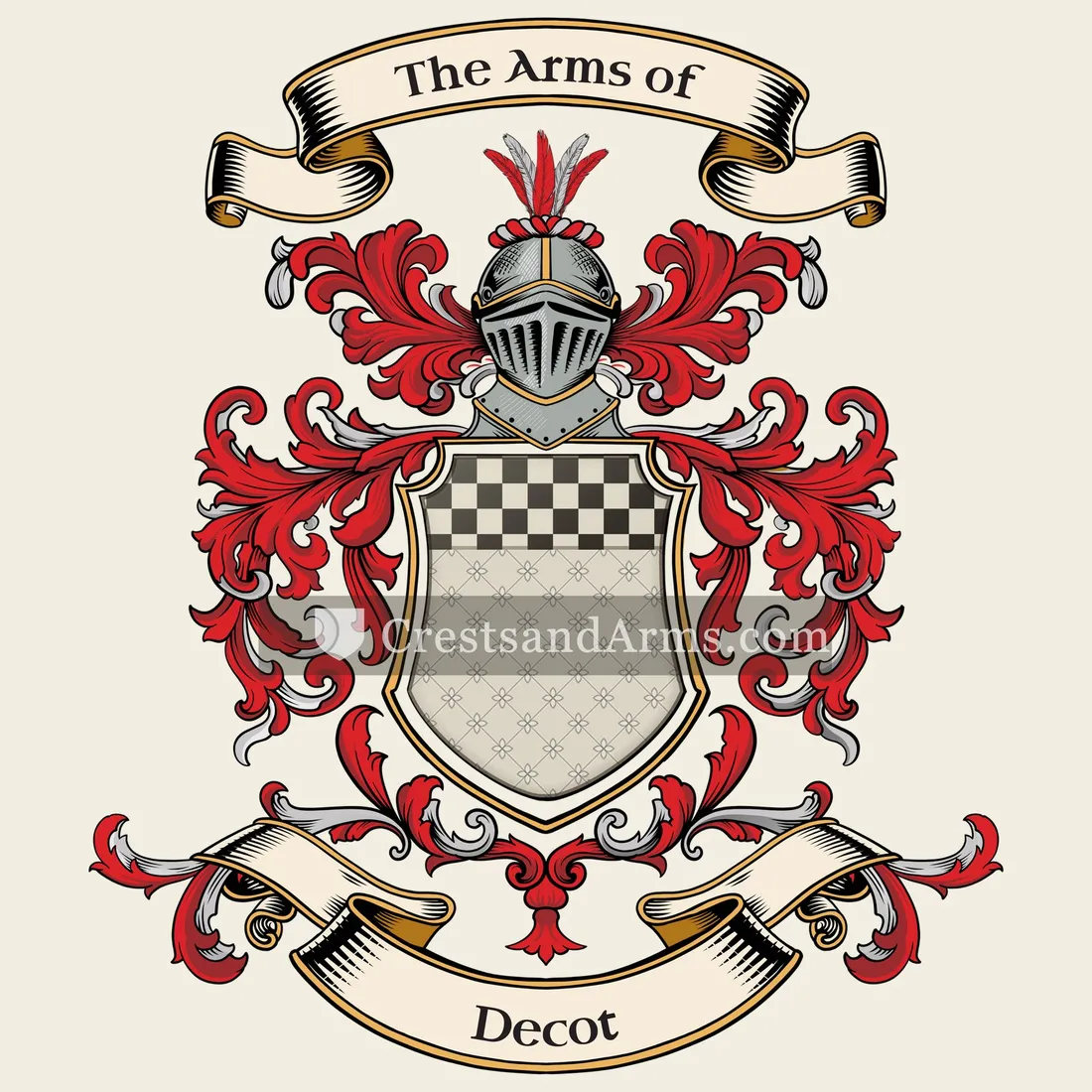
A record of documented arms, meaning and origin, researched for the Decot family of Belgium.
Reg. 1044 · Belgian, D–F
Meaning of the Decot family crest colors & symbols
Symbols on this shield
chiefAuthority, wisdom and dominion
chequyConstancy, and the counting-board
Colours
Silver (Argent)Means: Peace and sincerity
Black (Sable)Means: Constancy
Historical info
Source
J. B. Rietstap, Armorial Général, Gouda: G. B. van Goor Zonen, 1884–87
Blazon (the actual original written record)
“D'arg.; au chef échiq. d'arg. et de sa. de trois tires. Cq. cour. C.: un cygne démembré d'arg., le vol levé, bq. de gu T.: deux sauvages de carn., ceints et cour. de lierre, arm. de massues.”
BelgiumYpres, c. 1737
Digital archive packCoat of arms PNG, gold border print PDF, vector SVG and the certificate of authenticity. Sent to your email in minutes.
Map of Belgium showing where the Decot arms are recorded
The Decot arms were recorded in Ypres, c. 1737.
This is where the arms were entered in the register. Families often moved to other parts of the country, so the same name can turn up in more than one region.
The body that granted and recorded arms in Belgium in this period.
Charles VI, Holy Roman Emperor
Sovereign of the period
Charles VI, Holy Roman Emperor
1711–1740
Reigning in Belgium when the Decot arms are first recorded.
How Arms Worked in Belgium
In Belgium, a coat of arms is considered personal property that is passed down through the male line to legitimate descendants. Families often use the same shield design across generations to show their shared heritage. If a branch of the family wants to change the design, they must apply for an official update to their specific version of the arms.
Granting authority
The Conseil héraldique is the official body that regulates and approves all coats of arms in Belgium.
How they got arms
Families obtain their coats of arms through formal royal grants or by confirming their historical right to use existing designs.
Where arms were recorded
All approved coats of arms are officially recorded in the public registers of the Conseil héraldique since 1844.
The family's standing
Recorded among the armigerous families of Belgium.
Origin & History of the Decot Family in Belgium
The surname Decot traces its roots to the historic city of Ypres in the West Flanders region of Belgium. By the year 1737, records confirm that members of the family were already established residents within this medieval textile hub. The name likely originated as a descriptive term or a local nickname used to identify individuals within the community. During the eighteenth century, Ypres was a center of trade and craftsmanship, and families like the Decots were often deeply connected to the local guilds and the daily commerce of the city. As the family grew, they became part of the social fabric of the region, living through the shifting political landscapes of the Austrian Netherlands. Their presence in Ypres highlights a long-standing history of stability and local integration in one of Europe’s most storied urban centers.
Decot Meaning & Related Branches
Root word
Cote
A slope, hillside, or riverbank derived from the Latin costa.
This name
DecotA topographic name for someone who lived on a hillside or riverbank.
also spelled
Decod
Codt
de Kot
Documented Sources
J. B. Rietstap, Armorial Général, Gouda: G. B. van Goor Zonen, 1884–87
State Archives in Belgium (Rijksarchief te Ieper), Parochieregisters (Dopen, Huwelijken, Begrafenissen)
City Archives of Ypres (Stadsarchief Ieper), Bevolkingsregisters en Poortersboeken
De Flou, Karel, Woordenboek der Toponymie van westelijk Vlaanderen, Vlaamsch Artesië, het Land van den Hoek, de Fransche Westhoek, Staats-Vlaanderen en het Land van Waas, 1914
Despriet, Philippe, Geschiedenis van Ieper: van de middeleeuwen tot heden, 1983
Digital archive packCoat of arms PNG, gold border print PDF, vector SVG and the certificate of authenticity. Sent to your email in minutes.


 chiefAuthority, wisdom and dominion
 chequyConstancy, and the counting-board
 chiefAuthority, wisdom and dominion
 chequyConstancy, and the counting-board