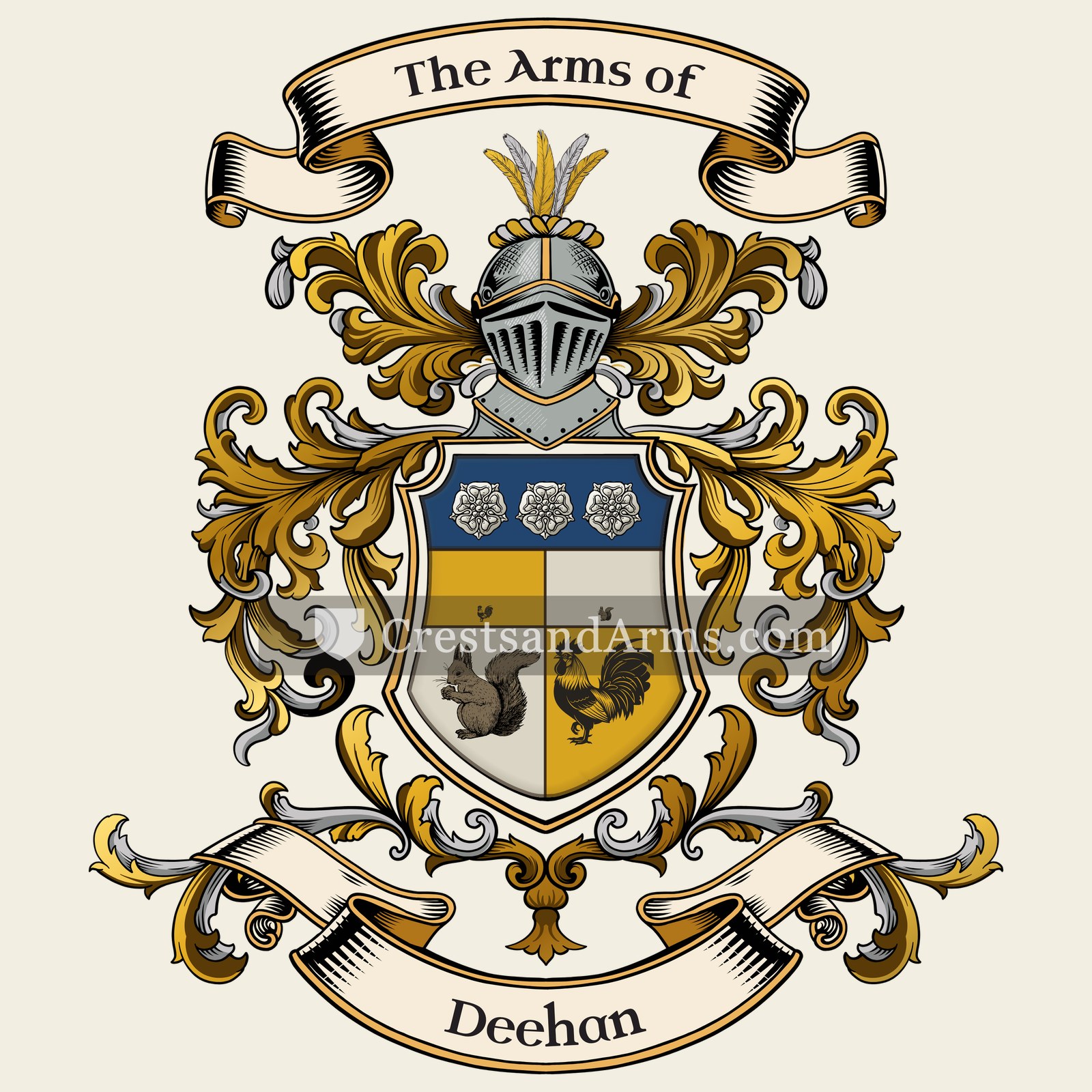
A record of documented arms, meaning and origin, researched for the Deehan family of Belgium.
Reg. 0481 · Belgian, D–F
Coat of Arms & Family Crest Details
Symbols on this shield
chiefAuthority, wisdom and dominion
roseThe seventh son, and beauty with grace
cockCourage, vigilance and readiness for battle
squirrelPatience and foresight in gathering
Colours
Gold (Or)Means: Generosity
Silver (Argent)Means: Peace and sincerity
Blue (Azure)Means: Loyalty and truth
Black (Sable)Means: Constancy
Historical info
Source
J. B. Rietstap, Armorial Général, Gouda: G. B. van Goor Zonen, 1884–87
Blazon (the actual original written record)
“Ec.: aux 1 et 4 d'or à un coq de sa., barbé et crété de gu.; aux 2 et 3 d'arg. à un écureuil au nat.; au chef d'azur, ch. de trois roses d'arg., bout. d'or, barbées de sin. C.: un jeune homme iss. de carn., chevelé d'or, tenant de chaque main une torche allumée au nat.”
BelgiumGand, c. 1737
Digital archive packCoat of arms PNG, gold border print PDF, vector SVG and the certificate of authenticity. Sent to your email in minutes.
Map of Belgium showing where the Deehan arms are recorded
The Deehan arms were recorded in Gand, c. 1737.
This is where the arms were entered in the register. Families often moved to other parts of the country, so the same name can turn up in more than one region.
The body that granted and recorded arms in Belgium in this period.
Charles VI, Holy Roman Emperor
Sovereign of the period
Charles VI, Holy Roman Emperor
1711–1740
Reigning in Belgium when the Deehan arms are first recorded.
How Arms Worked in Belgium
In Belgium, a coat of arms is considered personal property that is passed down through the male line to legitimate descendants. Families often use the same shield design across generations to show their shared heritage. If a branch of the family wants to change the design, they must apply for an official update to their specific version of the arms.
Granting authority
The Conseil héraldique is the official body that regulates and approves all coats of arms in Belgium.
How they got arms
Families obtain their coats of arms through formal royal grants or by confirming their historical right to use existing designs.
Where arms were recorded
All approved coats of arms are officially recorded in the public registers of the Conseil héraldique since 1844.
The family's standing
Recorded among the armigerous families of Belgium.
Origin & History of the Deehan Family in Belgium
The family name Deehan is primarily associated with Irish roots, specifically linked to the Gaelic surname Ó Deocháin. Historical records confirm that members of the family were established in the city of Ghent by 1737, a time when many Irish families moved to mainland Europe due to political and economic instability at home. These early settlers often integrated into the local merchant and military communities of the Low Countries. By maintaining their distinct family identity while adapting to life in a new country, the Deehan family became part of the broader Irish diaspora that shaped urban life in eighteenth-century Europe. Their presence in Ghent suggests a history of migration driven by the search for professional opportunities and stability during a period of significant social change.
Related Branches & Arms
Root word
De Haan
Dutch term referring to a male bird or rooster.
This name
DeehanAn occupational or descriptive surname originally identifying someone who kept roosters or possessed rooster-like traits.
also spelled
Dehanne
de Han
Dehan
Documented Sources
J. B. Rietstap, Armorial Général, Gouda: G. B. van Goor Zonen, 1884–87
State Archives in Belgium (Rijksarchief te Gent), Parochieregisters van Gent (Parish registers of Ghent)
O’Hart, John, Irish Pedigrees; or, The Origin and Stem of the Irish Nation, 1892
Woulfe, Patrick, Sloinnte Gaedheal is Gall: Irish Names and Surnames, 1923
Digital archive packCoat of arms PNG, gold border print PDF, vector SVG and the certificate of authenticity. Sent to your email in minutes.


 chiefAuthority, wisdom and dominion
 roseThe seventh son, and beauty with grace
 cockCourage, vigilance and readiness for battle
 squirrelPatience and foresight in gathering
 chiefAuthority, wisdom and dominion
 roseThe seventh son, and beauty with grace
 cockCourage, vigilance and readiness for battle
 squirrelPatience and foresight in gathering