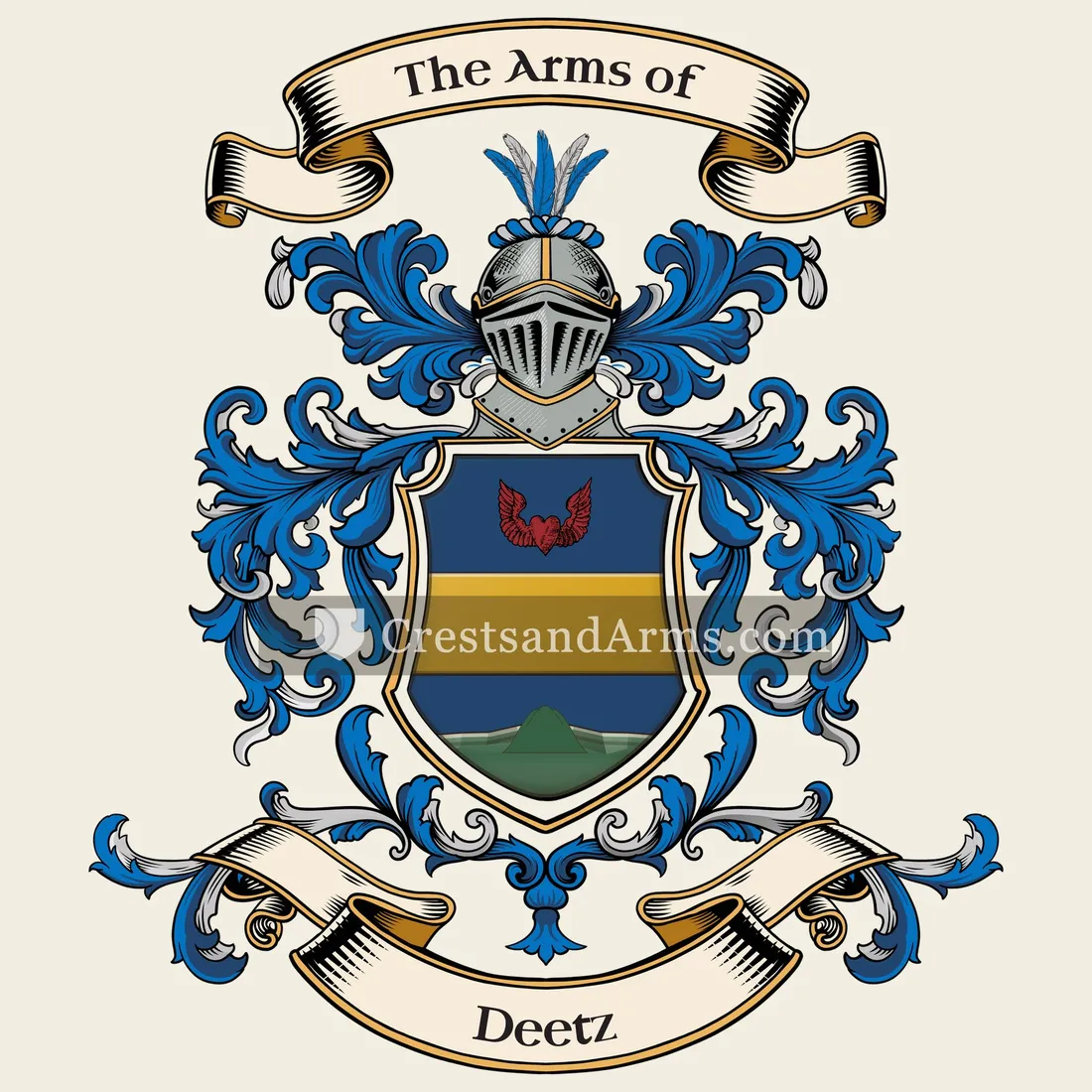
A record of documented arms, meaning and origin, researched for the Deetz family lines. Documented in 3 countries.
Reg. 8759 · German, D–F
Meaning of the Deetz family crest colors & symbols
Symbols on this shield
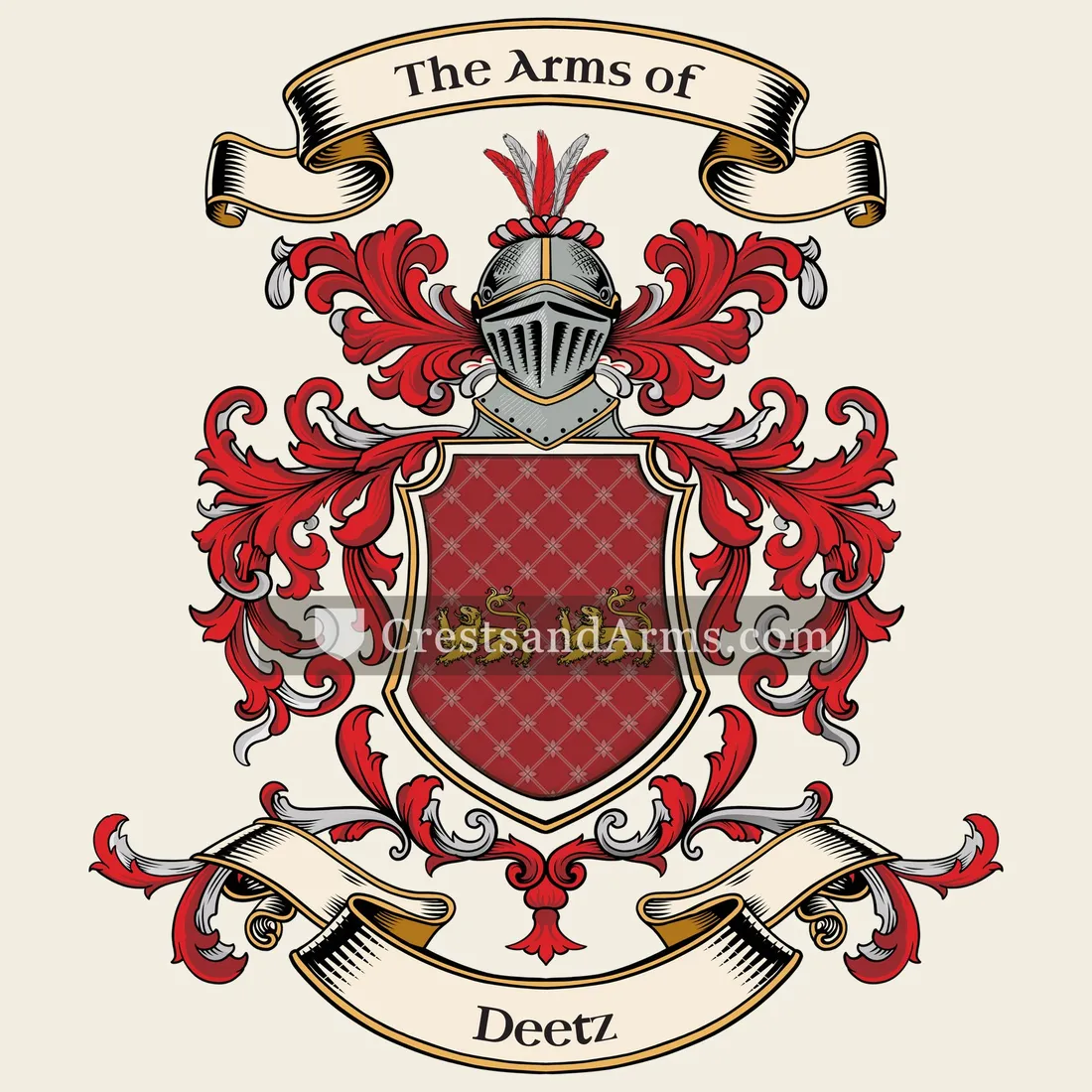
lionCourage, strength and royalty
Colours
Red (Gules)Means: Military strength
Gold (Or)Means: Generosity
Historical info
Source
J. B. Rietstap, Armorial Général, Gouda: G. B. van Goor Zonen, 1884–87
Blazon (the actual original written record)
“De gu. à deux léopards d'or, l'un sur l'autre. C.: un vol à l'antique de sa., ch. d'un tourteau aux armes de l'écu; ou, un chapeau pyramidal palé de gu. et d'or de quatre pièces et sommé de cinq pl. d'aut., alt. de gu. et d'or [Comp. Nassau-Dietz.]”
GermanyNassau, c. 1388
Digital archive packCoat of arms PNG, gold border print PDF, vector SVG and the certificate of authenticity. Sent to your email in minutes.
Map of Germany showing where the Deetz arms are recorded
The Deetz arms were recorded in Nassau, c. 1388.
This is where the arms were entered in the register. Families often moved to other parts of the country, so the same name can turn up in more than one region.
The body that granted and recorded arms in Germany in this period.
How Arms Worked in Germany
In the Holy Roman Empire, coats of arms were often granted to individuals by the Emperor or his representatives. These arms were then passed down through the generations to all legitimate descendants of the original holder. Younger branches of a family usually kept the same shield design without needing to change it, as the arms belonged to the entire lineage.
Granting authority
The Holy Roman Emperor held the sole power to grant new coats of arms throughout his vast imperial territories.
How they got arms
Families typically obtained their coats of arms through a formal imperial grant or by proving their noble status to the authorities.
Where arms were recorded
These grants were officially recorded in the Imperial Chancery registers, which began keeping formal records of such honors during the Middle Ages.
The family's standing
Recorded among the armigerous families of Germany.
Origin & History of the Deetz Family in Germany
The family name Deetz traces its roots back to the medieval period in the region of Nassau, Germany. Historical records confirm that members of the family were established in this area as early as 1388. During this time, the name likely emerged as a descriptive identifier or a toponymic reference linked to the local landscape. In the fourteenth century, families in the Holy Roman Empire often adopted surnames based on their specific village or a prominent geographic feature near their home. The Deetz family lived within the complex social structure of the Nassau lands, which were governed by various counts who managed the local nobility and commoners alike. As the family grew, they became part of the regional fabric, transitioning from simple landholders to participants in the evolving administrative and agricultural life of the German states. Their presence in the historical record of 1388 serves as a testament to their long-standing connection to the cultural and political development of the Nassau region.
Meaning of the Deetz family crest colors & symbols
Symbols on this shield
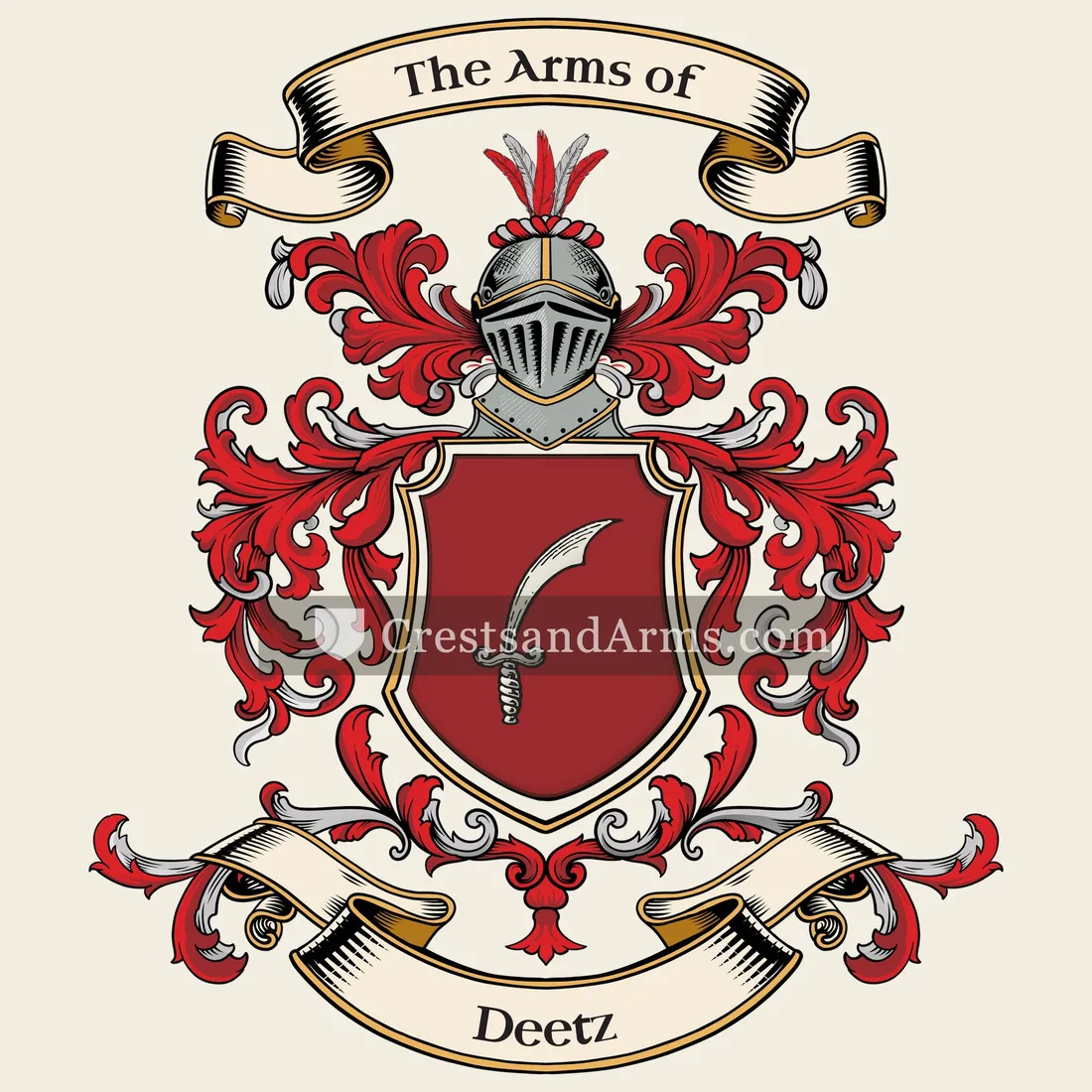
swordJustice, and military honour
Colours
Red (Gules)Means: Military strength
Blue (Azure)Means: Loyalty and truth
Silver (Argent)Means: Peace and sincerity
Historical info
Source
J. B. Rietstap, Armorial Général, Gouda: G. B. van Goor Zonen, 1884–87
Blazon (the actual original written record)
“Coupé de gu. sur azur; à une serpette d'arg., emm. d'or, posée en pal, br. sur le coupé. C.: un demi-vol, aux armes de l'écu.”
PolandThorn Prusse, c. 1772
Digital archive packCoat of arms PNG, gold border print PDF, vector SVG and the certificate of authenticity. Sent to your email in minutes.
Map of Poland showing where the Deetz arms are recorded
The Deetz arms were recorded in Thorn Prusse, c. 1772.
This is where the arms were entered in the register. Families often moved to other parts of the country, so the same name can turn up in more than one region.
Region
Thorn
Town
Thorn Prusse
First recorded
1772
Granting Authority for the Deetz Arms
Ennoblement by the Sejm
Author: Olek Remesz · CC BY-SA 3.0
The body that granted and recorded arms in Poland in this period.
Stanisław August Poniatowski
Sovereign of the period
Stanisław August Poniatowski
1764–1795
Reigning in Germany when the Deetz arms are first recorded.
How Arms Worked in Poland
Polish noble families shared a single coat of arms across many different surnames, creating large clans rather than individual designs. These symbols were held collectively by all members of the clan regardless of their specific family name. When a new family joined the nobility, they were adopted into an existing clan and began using that group's established shield.
Granting authority
The Sejm, which was the Polish parliament, held the power to grant noble status and the right to bear arms.
How they got arms
Families typically received their coat of arms through a formal act of ennoblement granted by the Sejm for distinguished service.
Where arms were recorded
These grants were officially recorded in the Crown Metrica, which served as the central archive for state documents starting in the sixteenth century.
The family's standing
Recorded among the armigerous families of Poland.
Origin & History of the Deetz Family in Poland
The family name Deetz has deep roots in the city of Thorn, which is known today as Toruń, Poland. By the year 1772, members of the Deetz family were already established residents in this historic town. During this period, Thorn served as a vital crossroads for trade and culture between German and Polish territories. Families like the Deetz often worked as skilled craftsmen or merchants, helping to build the local economy during a time of significant political change. As the region transitioned through different national administrations, the Deetz family remained part of the urban fabric of the city. Their presence in the local records suggests they were integrated into the social and professional life of the community. By studying the history of Thorn, we can better understand the environment that shaped the early generations of the Deetz family.
Meaning of the Deetz family crest colors & symbols
Symbols on this shield
fessThe military belt, and readiness to serve
mountThe ground held, and steadfastness upon it
heartSincerity, charity and true affection
Colours
Blue (Azure)Means: Loyalty and truth
Gold (Or)Means: Generosity
Green (Vert)Means: Hope
Red (Gules)Means: Military strength
Historical info
Source
J. B. Rietstap, Armorial Général, Gouda: G. B. van Goor Zonen, 1884–87
Blazon (the actual original written record)
“D'azur à la fasce d'or, acc. en p. d'un coeur de gu., soutenu d'un tertre de trois coupeaux de sin. et sommé de trois roses d'azur, bout. d'or, tigées et feuillées de sin., les roses et les tiges br. sur la fasce. C.: une balance d'or, posée en bande, br. sur un livre ouv. au nat.; le tout br. sur une épée en barre, la pointe en bas, et surm. d'un oeil humain au nat. L. d'or et d'azur.”
SwitzerlandBâle, c. 1745
Digital archive packCoat of arms PNG, gold border print PDF, vector SVG and the certificate of authenticity. Sent to your email in minutes.
Map of Switzerland showing where the Deetz arms are recorded
The Deetz arms were recorded in Bâle, c. 1745.
This is where the arms were entered in the register. Families often moved to other parts of the country, so the same name can turn up in more than one region.
The body that granted and recorded arms in Switzerland in this period.
How Arms Worked in Switzerland
In Switzerland, coats of arms were not restricted to the nobility and were often adopted by common citizens and families. These symbols were passed down through generations to show family identity. When branches of a family grew, they often changed small details of the design to distinguish their own line from the original group.
Granting authority
Cantonal and civic authorities managed the use of coats of arms within their specific regions and local jurisdictions.
How they got arms
Families typically assumed their own coats of arms based on local custom rather than receiving them from a central monarch.
Where arms were recorded
Arms were recorded in various cantonal and civic registers starting from the fourteenth century throughout the Swiss region.
The family's standing
Recorded among the armigerous families of Switzerland.
Origin & History of the Deetz Family in Switzerland
The family name Deetz has deep roots in the Swiss city of Basel, where records confirm members of the family were established by the year 1745. During this period, Basel was a thriving center for trade and craftsmanship, and families like the Deetz were often integrated into the local guild systems that governed urban life. The name likely evolved from regional Germanic dialects, reflecting the linguistic shifts common in the border regions between Switzerland and Germany. As the family grew, they became part of the social fabric of the city, participating in the civic duties and professional activities that defined life in an eighteenth-century Swiss canton. By maintaining a presence in such a significant cultural hub, the Deetz family helped shape the local history of the region through their labor, trade, and community involvement.
Deetz Meaning & Related Branches
Root word
Dietrich
Derived from the Germanic elements for people and ruler.
This name
DeetzA patronymic form indicating a descendant of someone named Dietrich, meaning ruler of the people.
also spelled
Dietze
Ditz
Dietzs
Deets
Documented Sources
J. B. Rietstap, Armorial Général, Gouda: G. B. van Goor Zonen, 1884–87
Hessisches Hauptstaatsarchiv, Bestand 170 I (Urkunden der Grafschaft Nassau-Dillenburg)
Knetsch, Carl, Die von Nassau: Geschichte einer deutschen Fürstenfamilie, 1931
Müller, Josef, Rheinisches Wörterbuch, 1928
Digital archive packCoat of arms PNG, gold border print PDF, vector SVG and the certificate of authenticity. Sent to your email in minutes.


 lionCourage, strength and royalty
 lionCourage, strength and royalty

 swordJustice, and military honour


 fessThe military belt, and readiness to serve
 mountThe ground held, and steadfastness upon it
 heartSincerity, charity and true affection