Map of England showing where the Defeo arms are recorded
The Defeo arms were recorded in Gloucester, c. 1620.
Gloucestershire had good farmland, a cloth trade in its valleys and a river carrying goods to Bristol. All three made money, and money bought the estates that brought arms with them.
This is where the arms were entered in the register. Families often moved to other parts of the country, so the same name can turn up in more than one region.
The body that granted and recorded arms in England in this period.
James VI and I
Sovereign of the period
James VI and I
1603–1625
Reigning in England when the Defeo arms are first recorded.
How Arms Worked in England
English heraldry allowed arms to be shared by all legitimate descendants of the original owner. These symbols were treated as personal property that moved through the generations to all children. While the eldest son kept the original design, other family members could use the same shield without needing to change it or register their own unique versions.
Granting authority
The College of Arms in London has regulated the use of coats of arms throughout England and Wales since 1484.
How they got arms
Families typically obtained their coats of arms through a formal grant from the Crown or by proving their ancient right to them.
Where arms were recorded
All official coats of arms are recorded in the registers kept at the College of Arms, which date back to the fifteenth century.
The family's standing
Recorded among the armigerous families of Gloucester.
Origin & History of the Defeo Family in England
The surname Defeo originates from the Italian language, where it is often categorized as a topographic or descriptive name. It is derived from the phrase "de Feo," which translates to "of Feo," with Feo being a shortened form of the name Bonifacio. This name was historically common in southern Italy, particularly in the regions of Campania and Puglia. By the time members of the family arrived in Gloucester in 1620, they were part of a wave of early settlers seeking new opportunities in the American colonies. These early ancestors were likely drawn to the coastal landscape of Massachusetts, which offered reliable maritime work and fishing prospects similar to the trades practiced by many families in the Mediterranean. Over the centuries, the name evolved from its Italian roots to become a distinct part of the cultural tapestry of New England, representing a lineage that transitioned from European origins to the developing frontier of the seventeenth century.
Related Branches & Arms
Root word
De Fede
Derived from the Italian word for faith or belief.
This name
DefeoAn occupational or locative surname indicating a person of faith or from a specific place associated with religious devotion.
also spelled
Deife
Deif
Documented Sources
Sir Bernard Burke, The General Armory of England, Scotland, Ireland and Wales, London: Harrison & Sons, 1884
De Felice, Emidio. Dizionario dei cognomi italiani. 1978
Fucilla, Joseph G. Our Italian Surnames. 1949
Massachusetts State Archives. Colonial Records of the Massachusetts Bay Colony. 1620–1686
Digital archive packCoat of arms PNG, gold border print PDF, vector SVG and the certificate of authenticity. Sent to your email in minutes.


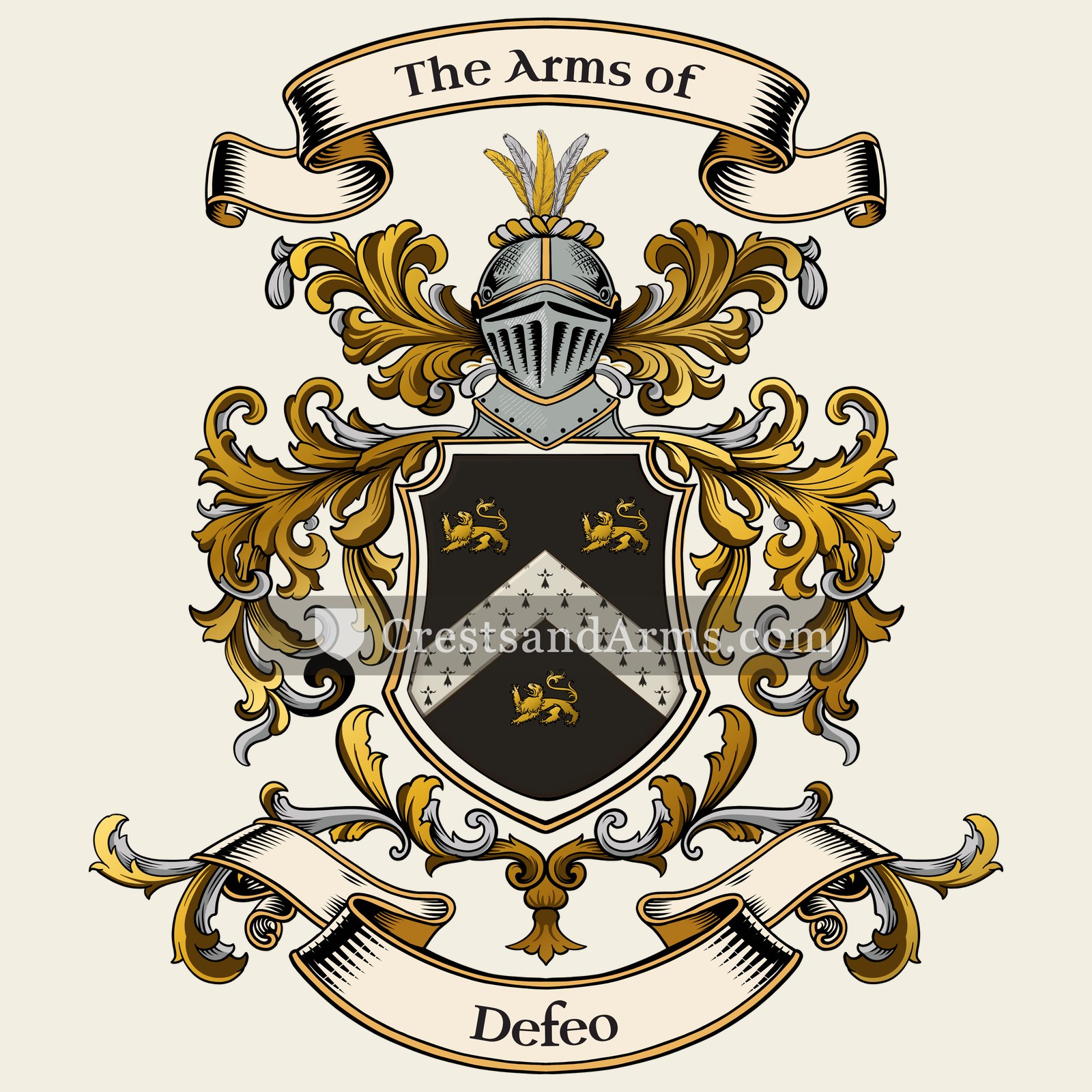
 chevronProtection, and faithful service completed
 lionCourage, strength and royalty
 chevronProtection, and faithful service completed
 lionCourage, strength and royalty