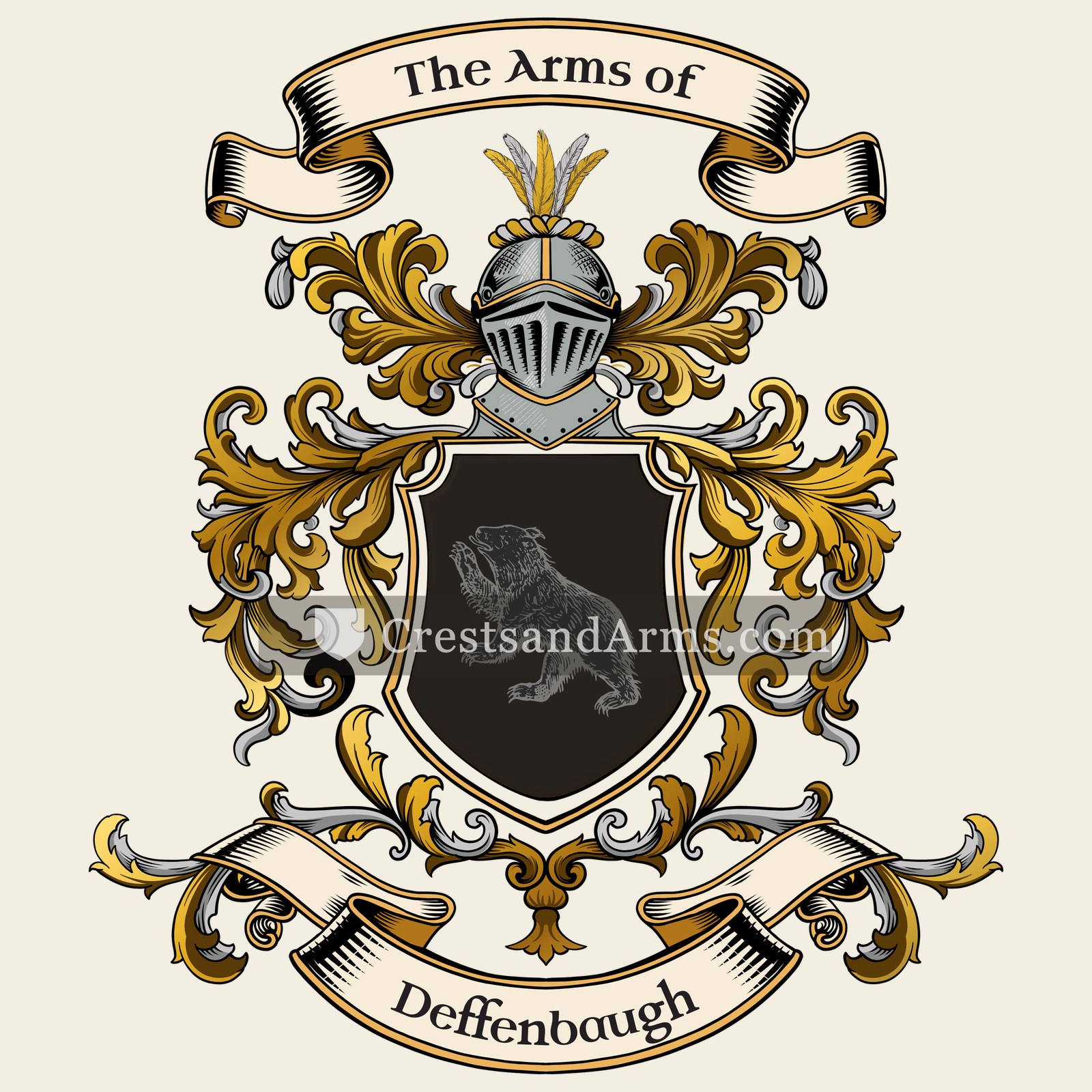
A record of documented arms, meaning and origin, researched for the Deffenbaugh family of Austria.
Reg. 0267 · Austrian, D–F
Coat of Arms & Family Crest Details
Symbols on this shield
bearStrength, cunning and protection of kin
Colours
Black (Sable)Means: Constancy
Gold (Or)Means: Generosity
Historical info
Source
J. B. Rietstap, Armorial Général, Gouda: G. B. van Goor Zonen, 1884–87
Blazon (the actual original written record)
“Coupé de sa. sur or; à un ours au nat., arm. et langué de gu., tenant entre ses pattes une tête humaine d'or, tort. de gu. C.: un vol d'or, ch. d'une patte d'aigle de sa. L.: d'or et de sa.”
AustriaGratz Styrie, c. 1577
Digital archive packCoat of arms PNG, gold border print PDF, vector SVG and the certificate of authenticity. Sent to your email in minutes.
Map of Austria showing where the Deffenbaugh arms are recorded
The Deffenbaugh arms were recorded in Gratz Styrie, c. 1577.
This is where the arms were entered in the register. Families often moved to other parts of the country, so the same name can turn up in more than one region.
Region
Gratz
Town
Gratz Styrie
First recorded
1577
Granting Authority for the Deffenbaugh Arms
Imperial and Royal chancery
Sodacan · CC BY-SA 3.0
The body that granted and recorded arms in Austria in this period.
Emperor Rudolf II
Sovereign of the period
Emperor Rudolf II
1576–1612
Reigning in Austria when the Deffenbaugh arms are first recorded.
How Arms Worked in Austria
Austrian coats of arms were often linked directly to noble titles granted by the Emperor. These symbols belonged to the entire family line rather than just one individual. When a family grew, new branches kept the original design without needing to change it. This system allowed all members of a noble house to share the same identity across many generations.
Granting authority
The Imperial and Royal chancery managed all heraldic matters and controlled the official granting of arms throughout the Austrian lands.
How they got arms
Families typically received their arms through a formal imperial decree that often accompanied the elevation of a person to noble status.
Where arms were recorded
Official records of these grants were kept in the Imperial Register of Nobility which began its formal documentation process in 1453.
The family's standing
Recorded among the armigerous families of Austria.
Origin & History of the Deffenbaugh Family in Austria
The family name Deffenbaugh is an anglicized version of the German surname Diefenbach. Historical records confirm that members of this family were living in the town of Gratz, located in the modern-day Austrian state of Styria, as early as 1577. The name itself is topographical, meaning it was originally used to describe where a person lived. In German, the word "tief" means deep and "Bach" means brook or stream. Therefore, the name likely identified ancestors who resided near a deep valley or a stream located in a hollow. As these families moved across Europe and eventually to North America, the spelling shifted to match the way the name sounded to English speakers. This evolution reflects the common pattern of immigrant families adapting their traditional names to fit into new linguistic environments while keeping a connection to their geographic roots.
Related Branches & Arms
Root word
Tiefenbach
A compound of deep and brook or stream.
This name
DeffenbaughRefers to someone who lived near a deep stream or a valley with a creek.
also spelled
Deefenbak
Documented Sources
J. B. Rietstap, Armorial Général, Gouda: G. B. van Goor Zonen, 1884–87
Brechenmacher, Josef Karlmann. Etymologisches Wörterbuch der deutschen Familiennamen. 1957


 bearStrength, cunning and protection of kin
 bearStrength, cunning and protection of kin