Map of Netherlands showing where the Deglopper arms are recorded
The Deglopper arms were recorded in Amsterdam, c. 1815.
This is where the arms were entered in the register. Families often moved to other parts of the country, so the same name can turn up in more than one region.
Region
Amsterdam
Town
Amsterdam
First recorded
1815
Granting Authority for the Deglopper Arms
Hoge Raad van Adel
Photograph made by me · CC BY-SA 3.0
The body that granted and recorded arms in Netherlands in this period.
William I of the Netherlands
Sovereign of the period
William I of the Netherlands
1815–1840
Reigning in Netherlands when the Deglopper arms are first recorded.
How Arms Worked in Netherlands
In the Netherlands, coats of arms were often used by noble families and those who held specific public offices. These arms were passed down through the generations to legitimate descendants. Younger branches of a family usually kept the original design without needing to add special marks. This system ensured that the family identity remained clear and consistent over many years.
Granting authority
The Hoge Raad van Adel is the official body that regulates and manages noble titles and coats of arms in the Netherlands.
How they got arms
Families typically obtained their coats of arms through official royal grants or by proving their long-standing historical use of the symbols.
Where arms were recorded
Coats of arms are officially recorded in the registers held by the Hoge Raad van Adel, which began its work in 1814.
The family's standing
Recorded among the armigerous families of Netherlands.
Origin & History of the Deglopper Family in Netherlands
The family name Deglopper originates from the Dutch tradition of descriptive surnames, which often identified a person by their occupation or a specific physical trait. In the early 19th century, the family was well-established in Amsterdam, a city defined by its bustling trade and maritime culture. By 1815, the Netherlands was undergoing significant social changes following the end of the Napoleonic era, and the formal registration of family names became a standard requirement for citizens. The name likely evolved from a local dialect term, perhaps referencing a specific type of worker or a person with a distinct way of walking. As residents of Amsterdam, the early Degloppers were part of a vibrant urban community that relied on the city's extensive canal network and international commerce to thrive. This historical context suggests that the family was deeply integrated into the civic life of the Dutch capital during a time of national rebuilding.
Deglopper Meaning & Related Branches
Root word
klopper
A person who beats or strikes something.
This name
DeglopperLikely refers to an occupational surname for someone who beat flax or worked as a knocker.
also spelled
de Kloppere
de Clopper
de Cloppere
Klopper
Documented Sources
J. B. Rietstap, Armorial Général, Gouda: G. B. van Goor Zonen, 1884–87


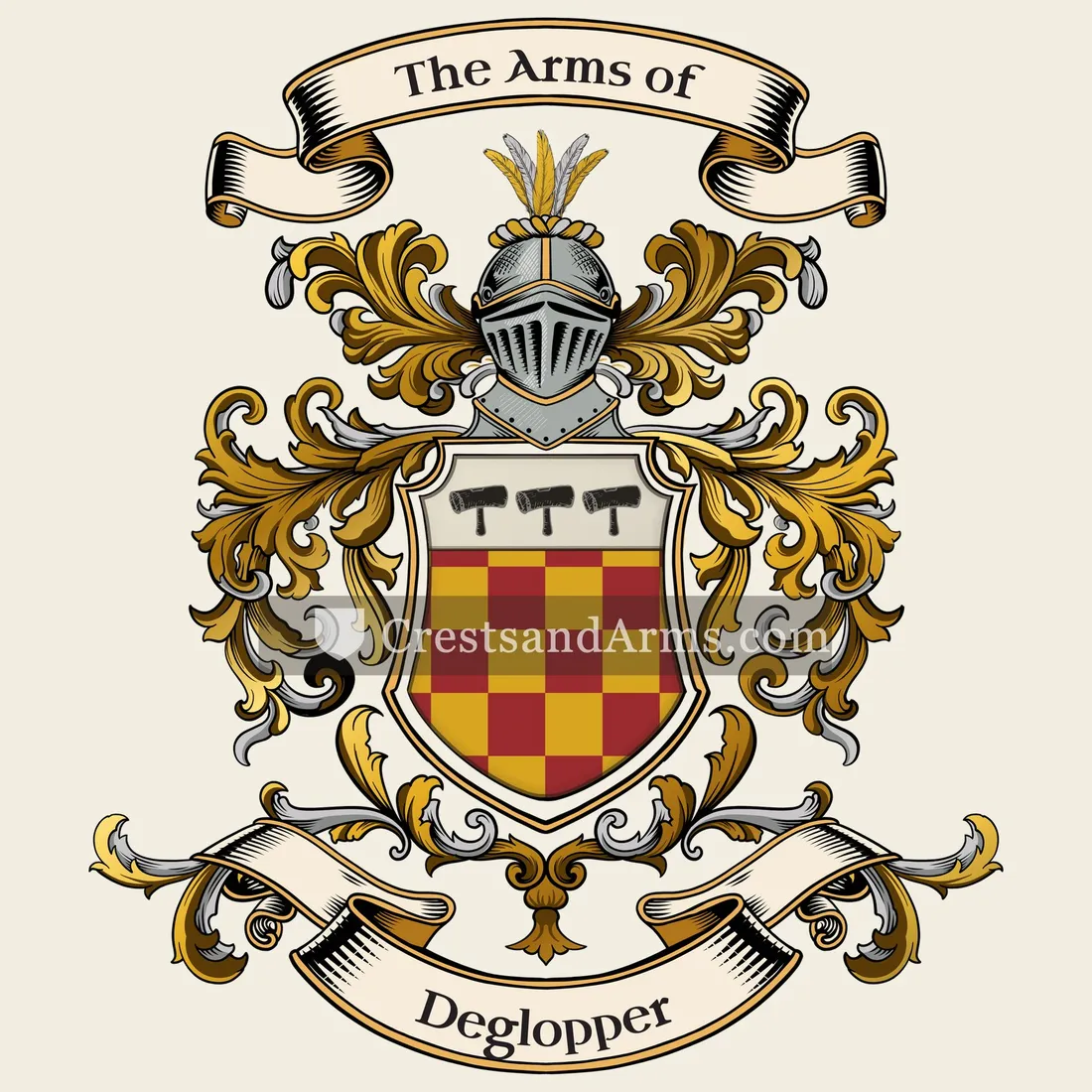
 chequyConstancy, and the counting-board
 chiefAuthority, wisdom and dominion
 hammerHonest labour, and the smith's craft
 chequyConstancy, and the counting-board
 chiefAuthority, wisdom and dominion
 hammerHonest labour, and the smith's craft