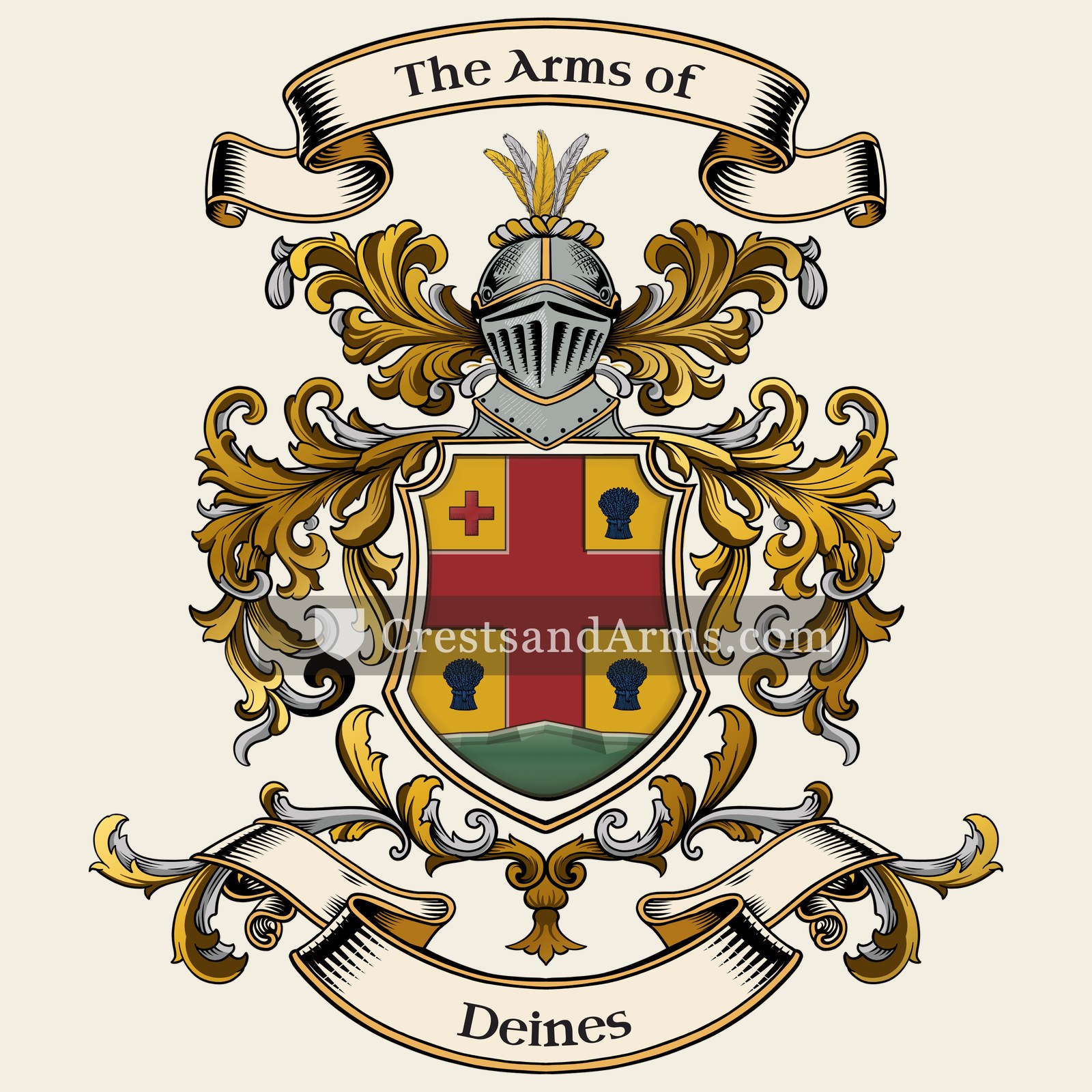
A record of documented arms, meaning and origin, researched for the Deines family of Germany.
Reg. 9978 · German, D–F
Coat of Arms & Family Crest Details
Symbols on this shield
cross symbolChristian faith and service
mountThe ground held, and steadfastness upon it
wheatsheafPlenty, and the harvest of one's own labour
Colours
Gold (Or)Means: Generosity
Blue (Azure)Means: Loyalty and truth
Red (Gules)Means: Military strength
Green (Vert)Means: Hope
Historical info
Source
J. B. Rietstap, Armorial Général, Gouda: G. B. van Goor Zonen, 1884–87
Blazon (the actual original written record)
“Coupé: au 1 d'or à une croix de chevalier de gu.; au 2 d'azur à trois épis d'or, posés sur un tertre du même. Deux cq. cour. C.: 1° un vol de gu., chaque aile ch. d'une étoile d'or; 1. d'or et de gu.; 2° trois pl. d'aut., une d'or entre deux d'azur; 1. d'or et d'azur.”
HesseHesse, c. 1846
Digital archive packCoat of arms PNG, gold border print PDF, vector SVG and the certificate of authenticity. Sent to your email in minutes.
Map of Germany showing where the Deines arms are recorded
The Deines arms were recorded in Hesse, c. 1846.
Hesse was central German country, divided among a large number of small landowners and prosperous towns. So many separate households held ground there that the region produced an unusual number of coats of arms.
This is where the arms were entered in the register. Families often moved to other parts of the country, so the same name can turn up in more than one region.
The body that granted and recorded arms in Germany in this period.
Frederick William IV of Prussia
Sovereign of the period
Frederick William IV of Prussia
1840–1861
Reigning in Germany when the Deines arms are first recorded.
How Arms Worked in Germany
Prussian heraldry was strictly tied to social rank and noble status rather than being a free choice for every citizen. These symbols were treated as permanent family property that moved through the generations to all legitimate heirs. If a family branch wanted to change their design to stand out, they had to apply for official permission to alter their specific version of the shield.
Granting authority
The Prussian Heroldsamt acted as the central state office that managed and strictly controlled all noble titles and coats of arms.
How they got arms
Families usually obtained their arms through formal royal grants or by proving their long-standing noble status to the state authorities.
Where arms were recorded
All official coats of arms were kept in the rolls of the Prussian Heroldsamt, which functioned from 1706 until 1918.
The family's standing
Recorded among the armigerous families of Hesse.
Origin & History of the Deines Family in Germany
The family name Deines originated in the German-speaking regions of Europe, specifically within the historic territory of Hesse. During the mid-19th century, the name was firmly established in this area, as evidenced by records confirming the presence of family members there in 1846. The name itself is likely a patronymic or a locational surname, which was a common way for families to identify themselves during that era. Many people in Hesse at this time lived in small agricultural communities where family identity was closely tied to land ownership and local village life. As the 19th century progressed, the social and economic conditions in the region encouraged some members of the family to maintain their traditional roots while others eventually sought new opportunities abroad. This history reflects the broader movement of families across the German states during a period of significant social change.
Deines Meaning & Related Branches
Root word
Degen
An Old High German term referring to a sword or warrior.
This name
DeinesA patronymic or occupational name denoting a descendant of a warrior or swordsman.
also spelled
Deine
Dines
Documented Sources
J. B. Rietstap, Armorial Général, Gouda: G. B. van Goor Zonen, 1884–87


 cross symbolChristian faith and service
 mountThe ground held, and steadfastness upon it
 wheatsheafPlenty, and the harvest of one's own labour
 cross symbolChristian faith and service
 mountThe ground held, and steadfastness upon it
 wheatsheafPlenty, and the harvest of one's own labour