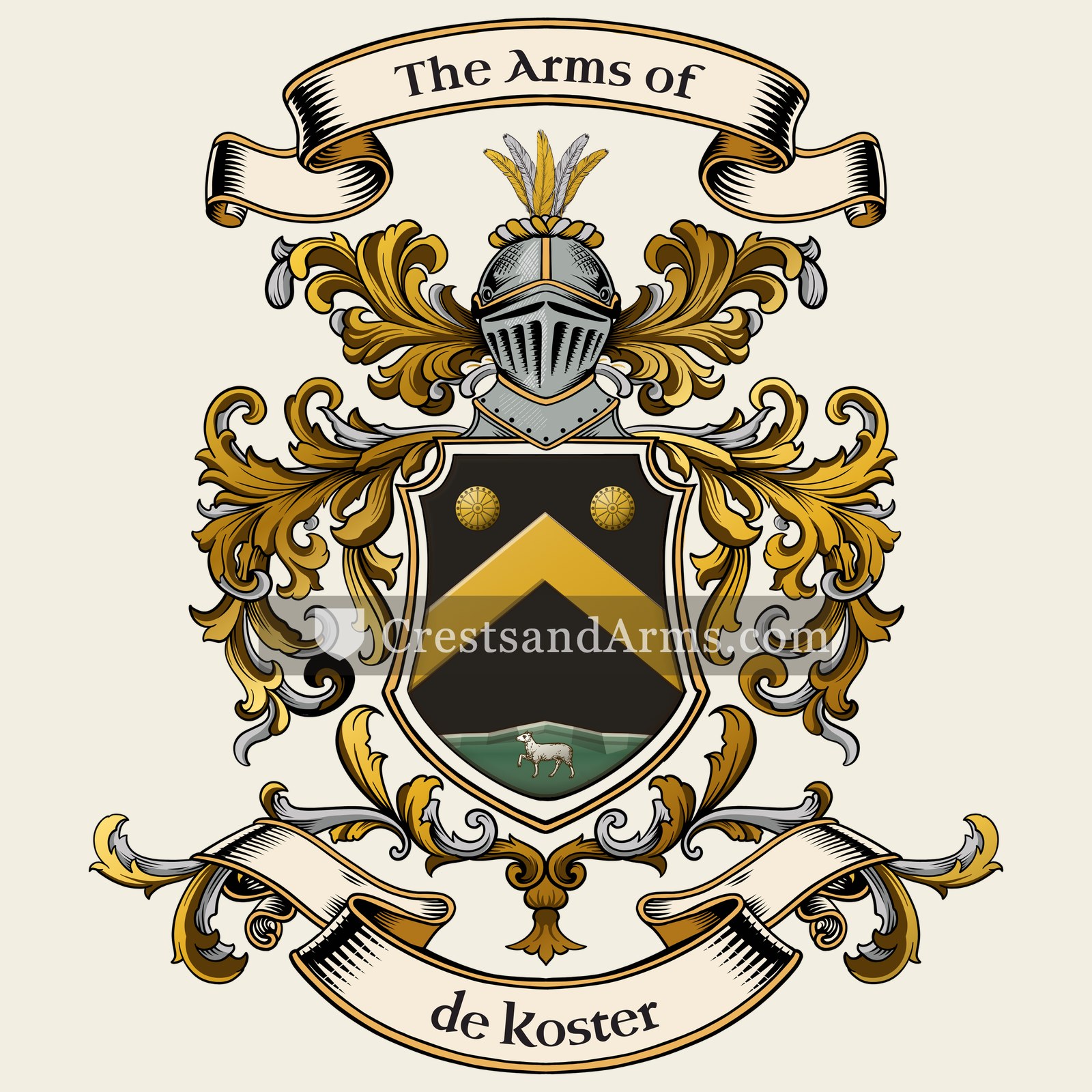
A record of documented arms, meaning and origin, researched for the de Koster family of Netherlands.
Reg. 2151 · Dutch, D–F
Coat of Arms & Family Crest Details
Symbols on this shield
chevronProtection, and faithful service completed
mountThe ground held, and steadfastness upon it
roundelA coin, and one who has been to the crusades
lambGentleness, patience and faith
Colours
Black (Sable)Means: Constancy
Gold (Or)Means: Generosity
Green (Vert)Means: Hope
Silver (Argent)Means: Peace and sincerity
Historical info
Source
J. B. Rietstap, Armorial Général, Gouda: G. B. van Goor Zonen, 1884–87
Blazon (the actual original written record)
“De sa. au chev. d'or, acc. en chef de deux boules du même et en p. d'un agneau d'arg., pass. sur une terrasse au nat. C.: l'agneau, iss. L. d'or et de sa. - Ou: De sin. au chev., acc. en chef de deux bes. et en p. d'un agneau, le tout d'arg. C.: l'agneau, iss.”
NetherlandsMiddelbourg, c. 1815
Digital archive packCoat of arms PNG, gold border print PDF, vector SVG and the certificate of authenticity. Sent to your email in minutes.
Map of Netherlands showing where the de Koster arms are recorded
The de Koster arms were recorded in Middelbourg, c. 1815.
This is where the arms were entered in the register. Families often moved to other parts of the country, so the same name can turn up in more than one region.
Region
Middelbourg
Town
Middelbourg
First recorded
1815
Granting Authority for the de Koster Arms
Hoge Raad van Adel
Photograph made by me · CC BY-SA 3.0
The body that granted and recorded arms in Netherlands in this period.
William I of the Netherlands
Sovereign of the period
William I of the Netherlands
1815–1840
Reigning in Netherlands when the de Koster arms are first recorded.
How Arms Worked in Netherlands
In the Netherlands, coats of arms were often used by noble families and those who held specific public offices. These arms were passed down through the generations to legitimate descendants. Younger branches of a family usually kept the original design without needing to add special marks. This system ensured that the family identity remained clear and consistent over many years.
Granting authority
The Hoge Raad van Adel is the official body that regulates and manages noble titles and coats of arms in the Netherlands.
How they got arms
Families typically obtained their coats of arms through official royal grants or by proving their long-standing historical use of the symbols.
Where arms were recorded
Coats of arms are officially recorded in the registers held by the Hoge Raad van Adel, which began its work in 1814.
The family's standing
Recorded among the armigerous families of Netherlands.
Origin & History of the de Koster Family in Netherlands
The surname de Koster is a classic occupational name that originated in the Low Countries, derived from the Dutch word *koster*, which refers to a sexton or a church warden. In the medieval period, individuals who held this role were responsible for maintaining the church building, ringing the bells, and assisting the clergy during services. Because these duties were vital to the daily life of a parish, the title became a common way to identify families within their local communities. By the time records confirm the family’s presence in Middelburg in 1815, the name had long been established as a hereditary surname. During the early 19th century, Middelburg was a significant trading hub in the province of Zeeland, and families like the de Kosters were often integrated into the urban workforce that kept the city’s religious and civic institutions running smoothly.
de Koster Meaning & Related Branches
Root word
Custos
A Latin term meaning a guard, watchman, or keeper.
This name
de KosterAn occupational surname for a sexton, sacristan, or someone who maintained a church.
also spelled
Dekoste
Koster
Documented Sources
J. B. Rietstap, Armorial Général, Gouda: G. B. van Goor Zonen, 1884–87
Debrabandere, Frans, Woordenboek van de familienamen in België en Noord-Frankrijk, 2003


 chevronProtection, and faithful service completed
 mountThe ground held, and steadfastness upon it
 roundelA coin, and one who has been to the crusades
 lambGentleness, patience and faith
 chevronProtection, and faithful service completed
 mountThe ground held, and steadfastness upon it
 roundelA coin, and one who has been to the crusades
 lambGentleness, patience and faith