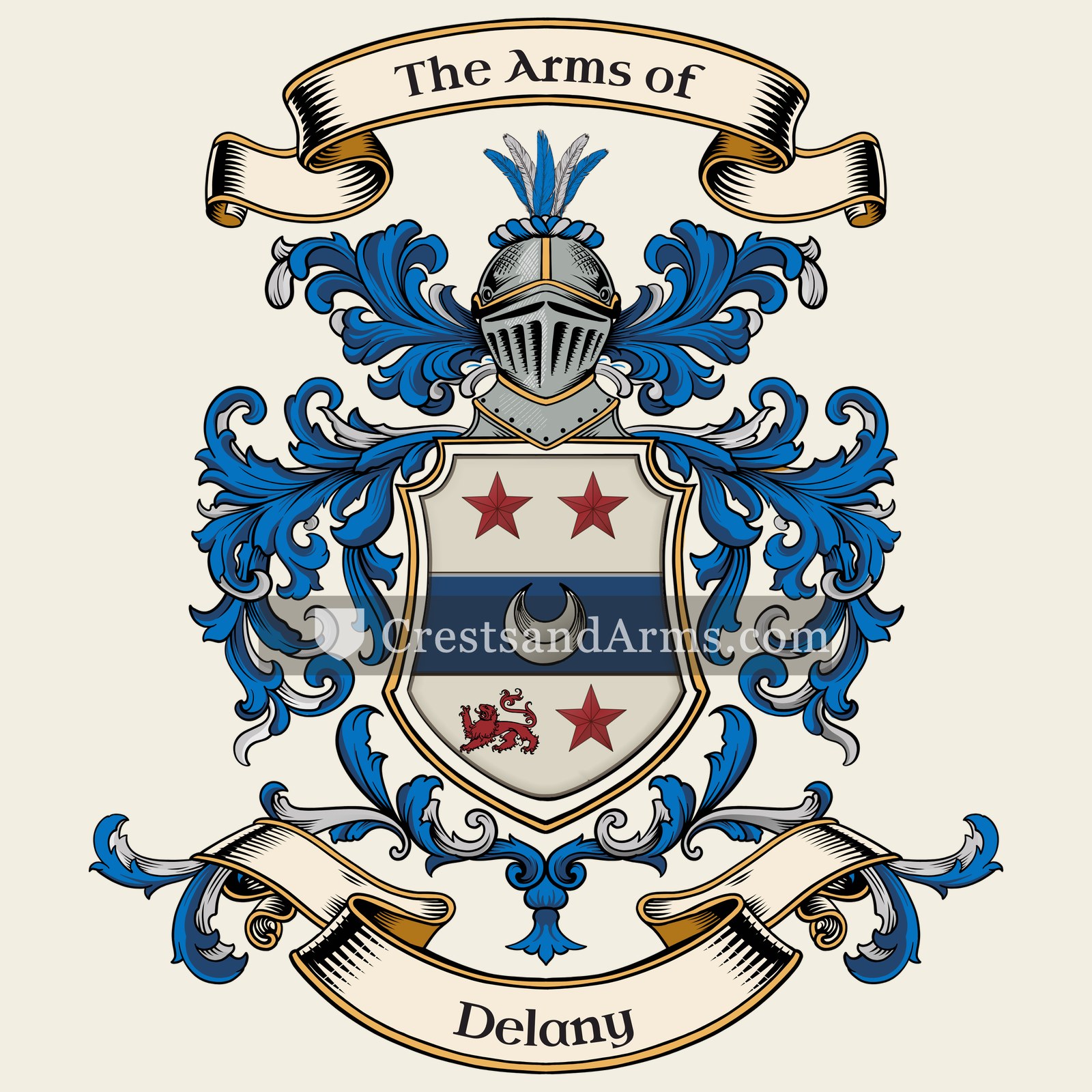
A record of documented arms, meaning and origin, researched for the Delany family of Ireland.
Reg. 3530 · Irish, D–F
Coat of Arms & Family Crest Details
Symbols on this shield
fessThe military belt, and readiness to serve
lionCourage, strength and royalty
mulletThe third son, and a divine quality from above
crescentHonour by the sovereign, and the second son
Colours
Silver (Argent)Means: Peace and sincerity
Blue (Azure)Means: Loyalty and truth
Red (Gules)Means: Military strength
Historical info
Source
Sir Bernard Burke, The General Armory of England, Scotland, Ireland and Wales, London: Harrison & Sons, 1884
Blazon (the actual original written record)
“Ar. a lion ramp. betw. three mullets of eight points gu. over all a fesse az. charged with a crescent of the first”
Irelandc. 1645
Where the Delany Arms Were Recorded
Dublin
Map of Ireland showing where the Delany arms are recorded
The Delany arms were recorded in Ireland, c. 1645.
Arms such as these were typically recorded in Dublin.
Dublin was the seat of government in Ireland and the place where grants were sought and recorded. Families with business at the castle or the courts settled nearby, and settling there put their arms on record.
This is where the arms were entered in the register. Families often moved to other parts of the country, so the same name can turn up in more than one region.
The body that granted and recorded arms in Ireland in this period.
Charles I of England
Sovereign of the period
Charles I of England
1625–1649
Reigning in Ireland when the Delany arms are first recorded.
How Arms Worked in Ireland
The Ulster King of Arms granted coats of arms to individuals who proved their social standing and good character. These symbols were typically inherited by all legitimate descendants of the original holder. If a family branch wanted a unique look, they could apply for a specific change to their design through the office to ensure their identity remained distinct.
Granting authority
The Ulster King of Arms acted as the official body that regulated and issued all coats of arms throughout Ireland.
How they got arms
Families obtained their arms through formal grants issued by the office after proving their eligibility and paying the required fees.
Where arms were recorded
All official grants were recorded in the registers held by the Ulster King of Arms starting from the year 1552.
The family's standing
Recorded among the armigerous families of Ireland.
Origin & History of the Delany Family in Ireland
The surname Delany originates from the Irish Gaelic name Ó Dubhshláine, which translates to descendant of the dark man of the River Slaney. The family was historically associated with the region of County Laois, where they served as prominent chiefs of the territory known as Tuath na bhFiodh. By the mid-seventeenth century, members of the family had established a notable presence in Dublin, as evidenced by records from 1645. During this period, the family began to transition from their traditional rural roots into the urban life of the capital city. This shift reflected the broader social changes occurring in Ireland as families moved toward centers of commerce and administration. Over time, the name evolved from its original Gaelic form into the anglicized version commonly used today.
Related Branches & Arms
Root word
Dubhshláine
Derived from the Gaelic words for black and defiance or challenge.
This name
DelanyRefers to a descendant of the dark challenger or one who is dark-complexioned.
also spelled
Delaney
Related arms
Delaney, or Delanyvariant spelling
Documented Sources
Sir Bernard Burke, The General Armory of England, Scotland, Ireland and Wales, London: Harrison & Sons, 1884
Woulfe, Patrick, Sloinnte Gaedheal is Gall: Irish Names and Surnames, 1923
MacLysaght, Edward, The Surnames of Ireland, 1985
National Archives of Ireland, Civil Survey of the County of Leix, 1654
Digital archive packCoat of arms PNG, gold border print PDF, vector SVG and the certificate of authenticity. Sent to your email in minutes.


 fessThe military belt, and readiness to serve
 lionCourage, strength and royalty
 mulletThe third son, and a divine quality from above
 crescentHonour by the sovereign, and the second son
 fessThe military belt, and readiness to serve
 lionCourage, strength and royalty
 mulletThe third son, and a divine quality from above
 crescentHonour by the sovereign, and the second son